

Count how many of the three things Thought Industries is built around your academy actually runs. They are co-branded portals for separate audiences, a storefront that sells training in 150 currencies, and a BI connector into your own warehouse. Two or more, and the Thought Industries alternatives worth a demo are the like-for-like platforms: Skilljar, Intellum, Docebo and Absorb. None, and the shortlist is the platforms that print a price: Trainn, TalentLMS, AcademyOcean and Mini Course Generator, with LearnUpon and Eurekos in between.
The count matters because Thought Industries names three tiers and publishes no figure, no seat floor, no term length and no exit process. The contract in front of you is the only document that says what your academy costs, and a renewal you didn’t read is the surprise this page exists to prevent. This guide reads what Thought Industries commits to on its own site, puts ten alternatives through the same six checks, and ends with the steps for getting your content out.
Before the next sales call, put one help-center article through customer training software that turns it into a tracked course the same afternoon. That’s the job every platform below is being quoted for, and it’s the quickest way to learn how much of a Thought Industries contract your academy needs.
What Thought Industries Does Well, and Where It Stops
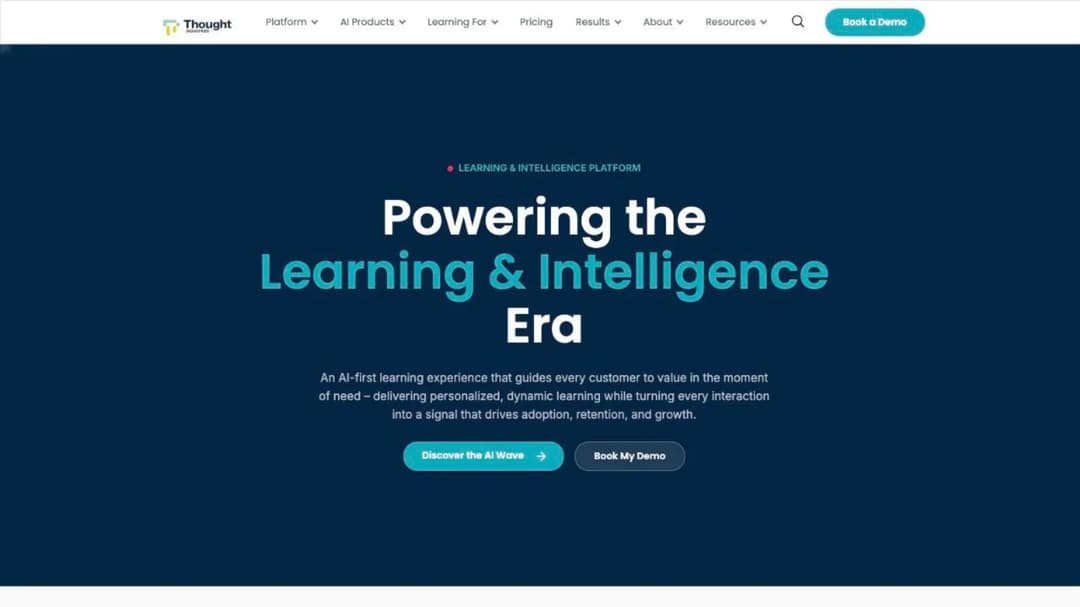
Thought Industries is built for teams that train people outside their own company first. Its audience pages are Customer Training under the line “Trained Customers Don’t Churn”, Partner Enablement, Member Education and Professional Learning, with employee learning behind them.
Three capabilities do the work that a smaller platform can’t. Panorama runs co-branded, multi-tenant portals, so a partner tier, a paying customer segment and a member association each get their own site from one content library. The Monetize module sells subscriptions, bundles, a la carte courses and training credits in 150 currencies through four payment gateways and five tax providers. The BI Connector pushes “90 tables” of platform data into Power BI, Tableau, Looker or Domo on a five-to-ten-minute refresh.
The AI layer is shipped, and it’s more specific than most. Conversational AI Learning answers questions over your videos, PDFs and SCORM files with cited answers, and an “Enroll Me Agent” enrolls a learner from inside the chat, including in Slack. A first-party plugin, “Thought Industries for Claude”, lets an admin author and update the catalog from inside Claude “with every change staged as a draft”.
AI content creation drafts text, images and quiz questions, AI video runs through Synthesia and AI coaching through Bongo. Thought Industries reports The Linux Foundation at “50% revenue growth” and “200k+ certification exams administered”.
Import is broad: SCORM, xAPI, LTI or HTML embed, alongside in-platform authoring. Integrations named on its own pages include Salesforce, Zendesk, Zoom, Teams, Credly, Zapier, Segment, Localize, OpenSesame and Avalara for tax. If your customer education program sells across borders, serves three audiences that must never see each other’s catalog, and feeds a warehouse your CFO reads, Thought Industries does a job the smaller platforms below don’t.
Where it stops is the pricing page, not the feature list
The pricing page names three tiers and prints nothing you can budget on. Starter (“Launch & scale”) includes the assessment engine, certification pathways, custom portals and site designs, audience segmentation, learner analytics, the Salesforce integration, SSO and unlimited administrator licenses. Professional (“Expand reach”) adds multi-language support and eCommerce. Enterprise (“Lead the market”) adds advanced analytics, data integration, gamification and API workflows.
Every tier carries the same “Let’s talk” button to the same demo form, so the tier gates are the first thing to check on your quote. Selling training and running the academy in a second language both start at Professional, and the BI Connector, the data integration and the API workflows sit on Enterprise. If your quote is for Starter and your plan includes a storefront, the number will move.
There is no per-seat, per-active-user or per-learner mechanic on the page, no seat floor, no minimum spend, no trial and no free plan. The only contract-duration clue on the whole site sits on the services page: “Onboarding services are a one-time cost for the first year of your contract”, which implies an annual term without stating one. The leaving process is not published at all, and the evaluation path is a demo: “Fill out one form to unlock access to our on-demand demo library”, then “Book My Personalized Demo”.
Compliance lives on a separate Trust Center. It lists SOC 2 Type 2, ISO/IEC 27001 with its Statement of Applicability, GDPR, HIPAA, CCPA, the EU-US Data Privacy Framework, PCI DSS and TX-RAMP as available documentation. Hosting is AWS, with a recovery time and recovery point objective of two hours. Ask for the SOC 2 report and the HIPAA documentation before procurement signs, not after.
Two of Thought Industries’s own figures are worth a question in the demo. The homepage states a “74% reduction in customer onboarding time”, while the customer-training page attributes the same 74% to ArrowStream “cutting training staff time by 74%”, a different metric with the same number. The Partners page calls the product “Thought Industries Customer Learning Cloud” and the homepage calls it a “Learning & Intelligence Platform”.
Neither is disqualifying. Each is a question that tells you how carefully the quote in front of you was assembled.
What to Check Before You Switch
Six checks decide the cost of a customer education platform more than any feature does, and Thought Industries publishes an answer to none of them. Each one below gives the range across the ten alternatives and the question to put in writing.
What do you pay per learner, and who counts as one?
The unit decides the bill, and three mechanics are in play. An active-user meter counts a learner only in a month they touch the academy, a registered count bills everyone you load, and a yearly learner allowance sits between the two.
The definitions differ enough to move the invoice. Skilljar’s active user is “someone who consumes or interacts with a lesson in your Academy”, counted once per calendar month against a yearly allocation that rolls forward. Trainn’s is a learner who logs in and watches at least five seconds of a course. Eurekos counts active users per month and “each month it resets”.
If a fifth of your customers touch the academy in a given month, an active-user meter costs less than a registered count. If a certification program makes everyone log in every quarter, a registered count or a yearly allowance is cheaper and a monthly meter is a true-up waiting to happen. Docebo lets you choose the counting method, and that choice moves the price more than the tier does. The LMS pricing guide works the arithmetic, and whatever you shortlist, ask for the definition of an active learner in the order form rather than the FAQ.
What is the seat floor, and can it go down?
Thought Industries publishes no floor. Two of the ten print one: LearnUpon’s Customer Education product starts “From 300 Users”, and Trainn’s floors run the other way, as caps of 100 or 250 monthly active users by tier. Skilljar, Eurekos and Mini Course Generator state no minimum, and AcademyOcean publishes no contract minimum, though its calculator starts at fifty learners, so ask whether fifty is a floor or just the first band.
Docebo’s public agreement is the clause that bites. It turns whatever count you sign into a floor, because “no ‘downgrading’ of the User thresholds will be permitted during the Term”, with a notice at roughly 90% of the limit and overage billed monthly.
If your academy has fewer than 300 named customers, LearnUpon’s customer education product is priced above you. If you forecast learners for a launch that may not land, avoid a contract that won’t let the count fall. Ask two things in writing before you sign: whether the contracted count can go down at renewal, and what happens the month you exceed it.
When does it renew, how much notice, and what happens to the price?
The renewal clauses live in the terms pages rather than the product pages, and that is where the money is. Six of the ten publish one, and the shape is the same everywhere: a twelve-month term that renews itself unless you give notice. What differs is the notice window and what the price may then do, and the table below carries both.
Three clauses are worth reading in full before you sign anything. Docebo’s Master Services Agreement carries the only published price cap here: the renewal fee moves to “Docebo’s then-current fees, or a ten percent (10.0%) increase over the highest level of annual fees charged during the previous Term or Renewal Term, whichever is lower”. Skilljar’s Subscription Services Agreement makes leaving early expensive, because you pay “all fees owed for the remainder of the Initial Term” and the Initial Term itself is “Specified in each Service Order”. Eurekos’s initial twelve months cannot be terminated at all, and its ninety days’ notice applies only after that.
Intellum’s Platform Terms defer term, renewal and pricing to a private Service Order, and LearnUpon’s fees “may change over time” with thirty days’ notice, applied at the next renewal, with no cap published.
If you’re leaving Thought Industries because the renewal arrived without warning, shortlist the platforms whose notice windows you can read. LearnUpon and Skilljar both publish thirty days, against Docebo’s sixty and Trainn’s and Eurekos’s ninety. If you’re staying, the same clauses are your negotiating floor: ask Thought Industries for its renewal term, notice period and price cap in the order form, because its site names none of them.
What leaves with you if you go?
Thought Industries’s SCORM Connect “Export[s] content authored or managed in the TI learning platform to a third-party domain or LMS without losing valuable data”. No page states a SCORM version, and no data-return window is published anywhere.
Three alternatives publish an export path: Absorb Create writes SCORM, xAPI and HTML5, Intellum’s Evolve exports SCORM 1.2 and 2004, and Mini Course Generator exports as PDF or SCORM at any time. Skilljar, Docebo, LearnUpon and Eurekos deliver SCORM and say nothing about getting it back out, TalentLMS is import only, and Trainn’s site does not mention SCORM at all.
The data-return windows disagree even inside one vendor. Skilljar’s agreement promises your content “within thirty (30) days” of a request, while its data processing agreement says 60. Intellum’s terms give a 30-day export window after termination against a 90-day purge in its security summary. Ask which document governs your data return, and get the answer into the order form.
Which compliance claims does the vendor publish, and which does it not?
Thought Industries lists nine frameworks on its Trust Center as available documentation. The alternatives are more uneven than a feature table suggests, and the gaps matter more than the badges.
Three publish an ISO certificate in their own name: Docebo (27001, 27017, 27018, 27701 and 9001 with certificate numbers, plus PCI DSS Level 2), LearnUpon (27001:2022 and 27701:2019) and Eurekos (27001:2022, 27701:2019 and 27017:2021). Skilljar’s ISO 27001 is attributed to AWS rather than to Skilljar, and Trainn’s certifications are Chargebee’s. Skilljar and Intellum complete SOC 2 Type II audits, LearnUpon says “SOC 2 compliant” without the type, and Eurekos and Mini Course Generator publish none.
Accessibility and health data are where the real gaps sit. Skilljar publishes a VPAT dated August 2024 that rates the learner experience “Partially Supports” for WCAG 2.2 A and AA. LearnUpon claims WCAG 2.2 AA for the learner experience since June 2026, and the rest publish no level. Intellum states it “has also completed a third-party HIPAA attestation examination” without offering a business associate agreement, and no other platform here publishes one.
If your customers include healthcare accounts that will ask for a business associate agreement, the question goes to the vendor in writing before the demo. If procurement needs an ISO certificate in the vendor’s own name, three platforms print one. Whichever you pick, ask for the audit report with its date, because a label on a trust page is a promise and a report is evidence.
What does it connect to, and what does the AI actually do?
Every platform here names Salesforce. Beyond that the lists diverge in ways that matter to a CS team.
Skilljar names Gainsight, Intercom, Zendesk, Pendo, Okta and Stripe, with SSO for learners on its entry tier. LearnUpon names HubSpot, Planhat, Intercom, Zendesk, Slack and Shopify, and Intellum names Marketo, Credly, Honorlock, BigQuery, Workday and Okta. Absorb reaches HubSpot, Zendesk Sell, Intercom, NetSuite and Credly, and Trainn adds three BI tools to the same shape. The LMS integration guide covers what to wire first.
Delivery inside your own product separates the group again. Thought Industries markets a “headless framework, webhooks, and APIs”, the model a headless LMS describes. LearnUpon Anywhere embeds learning in your product, Skilljar embeds through unified login, and Mini Course Generator delivers inside Intercom Messenger and through a headless API on its top plan. If your activation metric lives in the product, weigh the embed path above the portal, because a course nobody leaves the app to take is the one that gets finished.
The BI question is simpler. Thought Industries’s BI Connector, Skilljar’s Data Connector and Intellum’s BigQuery connector each feed your own warehouse, and everyone else reports inside the platform. If proving the retention link is what you’re measured on, and measuring customer education comes down to joining completion data with account data, a warehouse connector is the difference between an answer and an estimate.
On AI, compare what has shipped, not what’s announced. Skilljar’s MCP Server is in beta, LearnUpon and Docebo each ship one, and LearnUpon’s scenario role-plays are marked “COMING SOON”. Intellum’s agents run on OpenAI and IBM Watson as sub-processors, with Conversational Queries in “Early Access Via Labs”. Mini Course Generator’s MCP Server builds a course from Confluence, Notion, Slack or Google Drive material and acts on quiz data after publish.
How to evaluate an LMS MCP server gives the test to run in a trial. The rule is the same for every vendor: ask for the release date of each AI feature in the order form, and treat a roadmap item as absent.
Thought Industries Competitors Compared
The customer education platforms compared guide covers the category; this table covers the Thought Industries competitors specifically, on the six checks above. The order runs from the platforms that replace Thought Industries like for like, enterprise contract and all, to the ones that change the shape of the purchase, because whether you want the same shape again is the first decision. Every price, plan limit and contract term below comes from the vendor’s own pages and published agreements, quoted as printed; where a vendor publishes nothing, the entry says so.
| Platform | Built for | Price published | Seat floor or meter | Term and notice (public) | SCORM out | Compliance published |
|---|---|---|---|---|---|---|
| Thought Industries | Customer, partner and member academies with commerce and BI at enterprise scale | No (three named tiers, no figure) | Not published | Not published (onboarding fee tied to “the first year of your contract”) | SCORM Connect, no version stated | SOC 2 Type 2, ISO 27001, HIPAA, PCI DSS and others listed as available documentation |
| Skilljar | Customer and partner academies with certification | Core no; add-ons yes ($10k content syndication, from $25k data connector, from $10k language packs) | Active user counted once a month, yearly allocation rolls forward; no floor | 12-month auto-renewal, 30 days’ notice, pay out the Initial Term | Delivers SCORM, no version; export not stated | SOC 2 Type II; ISO 27001 via AWS; VPAT; no HIPAA |
| Intellum | Enterprise customer, partner and employee programs | Core no; Evolve authoring $49 and $65 per user per month | Not published | Deferred to the Service Order; Net 30; 99.9% SLA, credits only | Evolve exports SCORM 1.2 and 2004 | SOC 2 Type II; HIPAA attestation examination; WCAG 2.1 evaluated; no ISO 27001 |
| Docebo | Multi-audience enterprise suite with a content marketplace | No | Per active user (monthly, yearly or registered); 250 learners recommended; no downgrade mid-term | 12-month auto-renewal, 60 days’ notice, up to 10% uplift | Not stated (imports SCORM 1.2 and 2004, xAPI, AICC) | SOC 2 Type II; ISO 27001, 27017, 27018, 27701, 9001; PCI DSS; no HIPAA |
| LearnUpon | Customer education from 300 users, with in-product embed | No | 300 users for Customer Education | 12-month auto-renewal, 30 days’ notice, fees changeable on 30 days’ notice | Not stated (SCORM and xAPI import) | ISO 27001:2022, ISO 27701; “SOC 2 compliant”; WCAG 2.2 AA learner side; no HIPAA |
| Absorb LMS (now Absorb AI) | Multi-tenant learner portals at scale | No (form by learner band) | Not published | Not published | Yes (Absorb Create publishes SCORM, xAPI, HTML5) | Ask the vendor |
| Eurekos | Extended-enterprise customer and partner training, cloud or on-premise | No | Active users per month, resets monthly; no floor | 12 months non-terminable, then 90 days’ notice; 99.9% SLA with credits | Not stated (imports SCORM, all versions, and xAPI) | ISO 27001:2022, 27701, 27017; GDPR; no SOC 2, no HIPAA |
| Trainn | SaaS academies built from product video | Yes ($2,400 to $39,900 a year) | Academy capped at 100 or 250 monthly active users by tier | 12-month term, 90 days’ notice, non-refundable | No SCORM | Chargebee’s SOC 2 Type II and ISO 27001:2022; no HIPAA |
| TalentLMS | Small academies on a published ladder | Yes ($119 to $449 a month by user band) | Bands of 1-40, 1-70 and 1-100 users; free plan to 5 users | Monthly or annual plans | No (SCORM 1.2 import only) | Ask the vendor |
| AcademyOcean | Small teams that want a number before a call | Yes ($4.00 per learner per month at 50 learners, billed annually) | Per learner per month, bands from 50 to 300-plus | Monthly or annual billing, annual saves 20% | SCORM on the entry tier; export not stated | Ask the vendor |
| Mini Course Generator | Academies built from the help docs you already have, delivered by link, embed or Intercom | Yes (pricing page) | Yearly learner allowance, no floor | No minimum annual commitment; zero implementation fees | PDF or SCORM, any time | None published |
Read the table before the demos, and mark the rows that answer all six checks in writing. That’s the shortlist a procurement team can defend, whatever the feature demo shows.
The 10 Best Thought Industries Alternatives
1. Skilljar (by Gainsight)
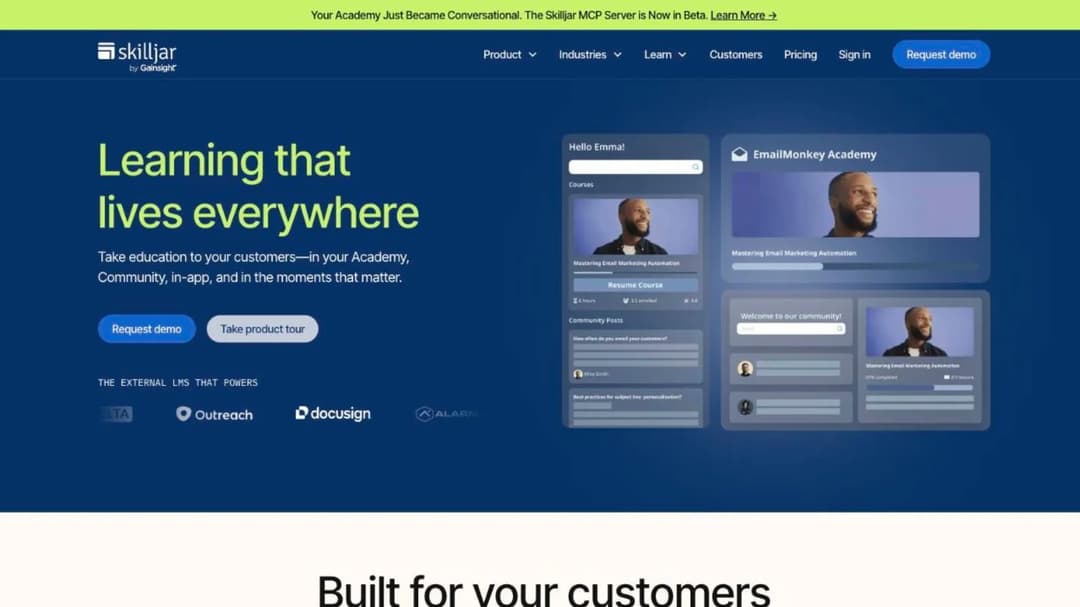
Best for: customer education teams that want the same external-audience shape as Thought Industries with a public contract they can read.
Top Features
- Academy sites by tier (1, 2 or 3), with custom themes, unlimited seats and a low-code page builder
- Certifications with proctored exams and re-certification flows, plus instructor-led training with attendance tracking
- Premium integrations by tier (3, 5 or 7) across Salesforce, Gainsight, Zendesk, Intercom, Pendo and Zoom
- Content Syndication and External Management for partner and reseller training licenses, from Professional
- Skilljar MCP Server, in beta, for managing the program from Claude, ChatGPT or Copilot
Skilljar is the closest peer to Thought Industries: an external LMS explicitly not built for compliance training, sold as Essentials, Professional or Enterprise plus an active-user fee tiered on volume. The core subscription is quote-only, but three add-ons are priced on the page: Content Syndication at “$10k”, the Data Connector “starting at $25k”, and Language Packs “starting at $10k for 5 languages”. Multiple currencies start at Professional, so selling in more than one currency is a tier decision here as it is at Thought Industries. No trial and no minimum are published.
Skilljar reports Automox at a “75% Reduction in customer onboarding time”, the result an education-first onboarding process is built to produce. Its “+19pt” Asana figure is a gap between trained and untrained customers, not a measured lift. Skilljar now trades as Skilljar by Gainsight, and Northpass’s entire site leads to the Skilljar page, so a Northpass quote and a Skilljar quote are the same conversation. The Skilljar alternatives page holds the wider comparison.
Pros
- The public agreement names the renewal term, the notice window and the exit clause, which Thought Industries does not
- Active users are counted once a month with a yearly allocation that rolls forward, so a launch spike doesn’t become a monthly true-up
- SOC 2 Type II audited annually, with a published VPAT
Cons
- Early termination pays out the remainder of the Initial Term, and the term length itself is set in a private Service Order
- Multi-language support is a paid add-on from $10k, and the data connector for your warehouse starts at $25k
- SCORM delivery is confirmed with no version and no export stated, and the two data-return windows disagree
2. Intellum
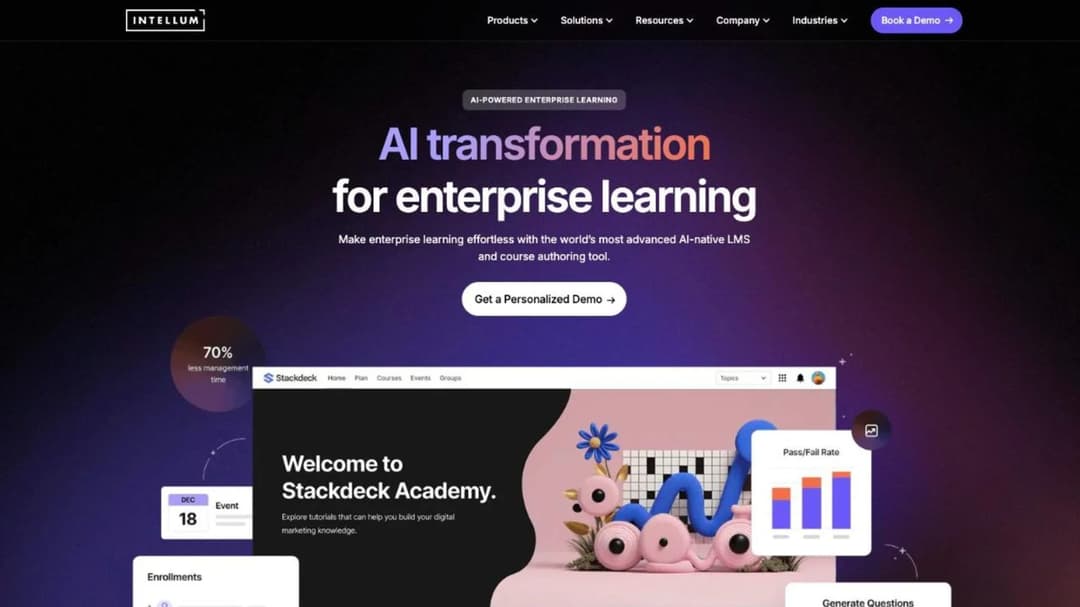
Best for: enterprise programs measured in millions of external learners that need US or EU hosting and native mobile apps.
Top Features
- Creator, Manager and Learner agents for drafting from release notes, assigning in natural language, and tutoring learners
- Evolve authoring with 50-plus interaction types, exporting SCORM 1.2 and 2004, priced separately from the LMS
- Assessment and credentialing with proctoring through Honorlock and badges through Credly
- Native iOS and Android apps, with hosting in the US or in AWS’s Ireland region
- BigQuery connector for streaming platform events into your own warehouse
Intellum is the enterprise-scale peer, and its case studies say so: Meta at “2M+ Global users”, Pinterest at “170% growth in user base YoY”, and Gusto at “$200K ARR” from a certification program for accountants. The core platform publishes no price, no term and no minimum, because the Platform Terms of Service defer all three to a private Service Order. Evolve, the authoring tool acquired with Appitierre in 2019, is priced on its own page at $49 per user per month (Personal) and $65 (Team, with a 21-day trial), billed annually.
Two facts sit behind the “AI-native” line. Intellum’s sub-processor list names OpenAI and IBM Watson, and its Conversational Queries analytics feature is labeled “Early Access Via Labs”. Intellum took a $25 million minority investment from Guidepost Growth Equity in August 2023 and states no parent company. Where Intellum itself is the incumbent, Intellum alternatives works through the same questions from that side.
Pros
- Choice of US or EU hosting, native mobile apps, and a warehouse connector
- Authoring with SCORM 1.2 and 2004 export, priced in the open
- SOC 2 Type II and a completed HIPAA attestation examination
Cons
- The core platform publishes no price, no term, no notice window and no seat floor, so the contract you get is the contract you negotiate
- The uptime remedy is a 10% credit and nothing else, and the two exit windows are not reconciled on its site
- No ISO 27001 and no VPAT published
3. Docebo
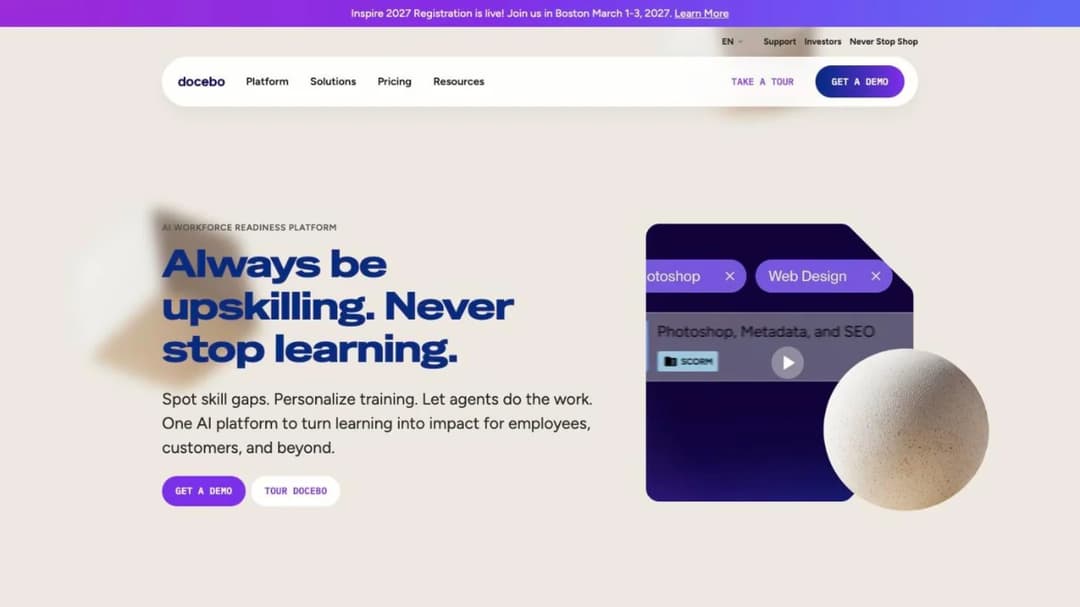
Best for: companies that need one platform for customers, partners and staff, with extended enterprise across up to ten domains and a course marketplace.
Top Features
- Extended enterprise on the Enterprise tier, up to 10 domains, with a branded mobile app and two sandboxes
- Content Marketplace of 30,000-plus courses through OpenSesame and Go1, in 50-plus languages
- SCORM 1.2 and 2004, xAPI and AICC import for moving an existing library
- Creator (AI authoring), AI Roleplay, AgentHub agents and an MCP connection, all listed as live
- Shopify, Stripe and PayPal for selling training, plus Salesforce, HubSpot and BambooHR
Docebo is the most-named Thought Industries alternative and the one whose contract you can read most completely. Elevate and Enterprise are both quote-only, priced per active user with the counting method chosen by you. Elevate includes 4 integrations and Enterprise 6, with API access capped at 100 calls a minute. Docebo reports Cloudbeds at “+15%” upsell rates for trained customers.
The Master Services Agreement is where the Thought Industries comparison gets decided. Section 12.2 renews for twelve months unless you give sixty days’ written notice, and section 5.2(d) states that “no ‘downgrading’ of the User thresholds will be permitted during the Term”. There’s no self-serve trial: evaluation runs under a Trial Environment Agreement with no fixed length. Docebo is a public company (NASDAQ: DCBO), and the Docebo alternatives page covers the employee-training side of the decision.
Pros
- Published renewal term, notice window and price cap
- Broadest published compliance list here: SOC 2 Type II, five ISO certificates with numbers, PCI DSS
- Extended enterprise, marketplace content and a branded mobile app on one tier
- AI features listed as shipped rather than announced
Cons
- The user count can’t go down during the term, so an over-forecast is paid for until renewal
- No published price, no self-serve trial, and skills intelligence quoted as a separate product
- No HIPAA statement and no WCAG level published
4. LearnUpon
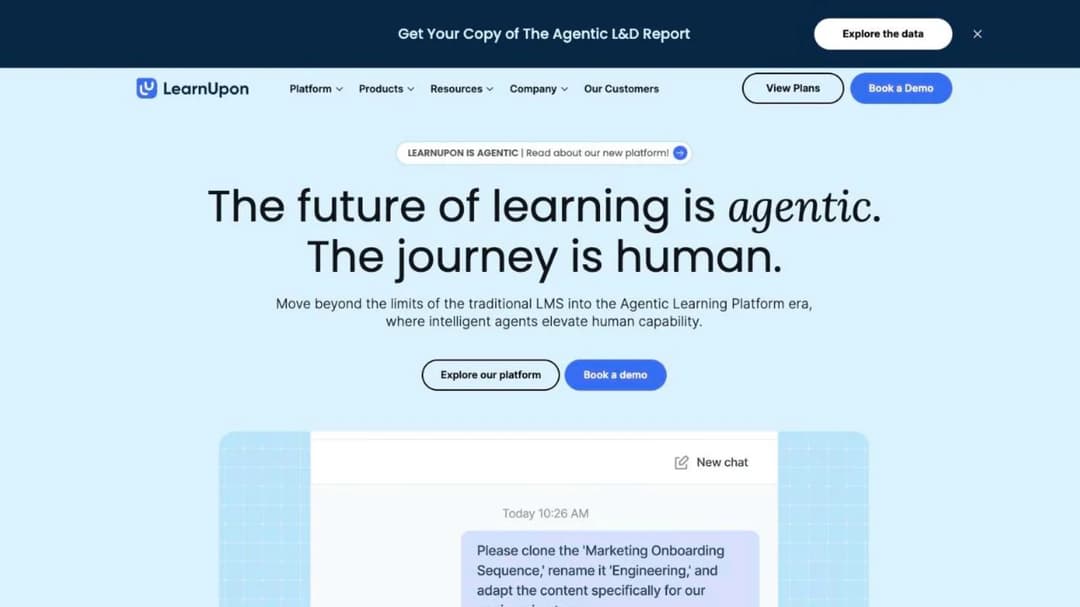
Best for: customer education teams above 300 users that want separate learner portals, an in-product embed and a thirty-day notice window they can read before signing.
Top Features
- Learning Portals for separate customer, partner and staff audiences from one account
- LearnUpon Anywhere, which puts courses inside your own product experience
- Create+ authoring from video, PDF, PowerPoint or a web link, with AI narration and translation into 120-plus languages
- LearnUpon IQ, Ask Lia for learner questions, and a LearnUpon MCP Server for ChatGPT, Claude and Gemini
- Salesforce, HubSpot, Planhat, Intercom, Zendesk, Okta, Stripe and Shopify
LearnUpon publishes the floor and the terms, not the price. Its Customer Education product starts “From 300 Users”, and an unpriced Enterprise plan unlocks white labeling, eCommerce and group branding. The Terms of Service auto-renew for twelve months on thirty days’ notice (section 9.1) and let you cancel on thirty days’ notice with the current period non-refundable (section 10.1). LearnUpon reports gWorks “reduced support tickets by 18%”, the kind of figure a ticket deflection program is judged on.
The embed is the reason to look at it against Thought Industries. LearnUpon Anywhere delivers education inside the product rather than in a portal, which is the pattern an embedded LMS describes, and it pairs with Learning Portals for the audiences that need their own front door. The LearnUpon alternatives page compares it on its own terms.
Pros
- Thirty days’ notice to leave, published, against sixty at Docebo and ninety at Trainn and Eurekos
- Separate portals plus an in-product embed on one platform
- ISO 27001:2022 and WCAG 2.2 AA published in the vendor’s own name
- Authoring that translates into 120-plus languages without an add-on
Cons
- A 300-user floor for the customer education product, and no published price above it
- Fees can change on thirty days’ notice with no published cap
- No mobile app mentioned anywhere on its site, no SCORM version stated, and scenario role-plays marked “COMING SOON”
5. Absorb LMS (now Absorb AI)
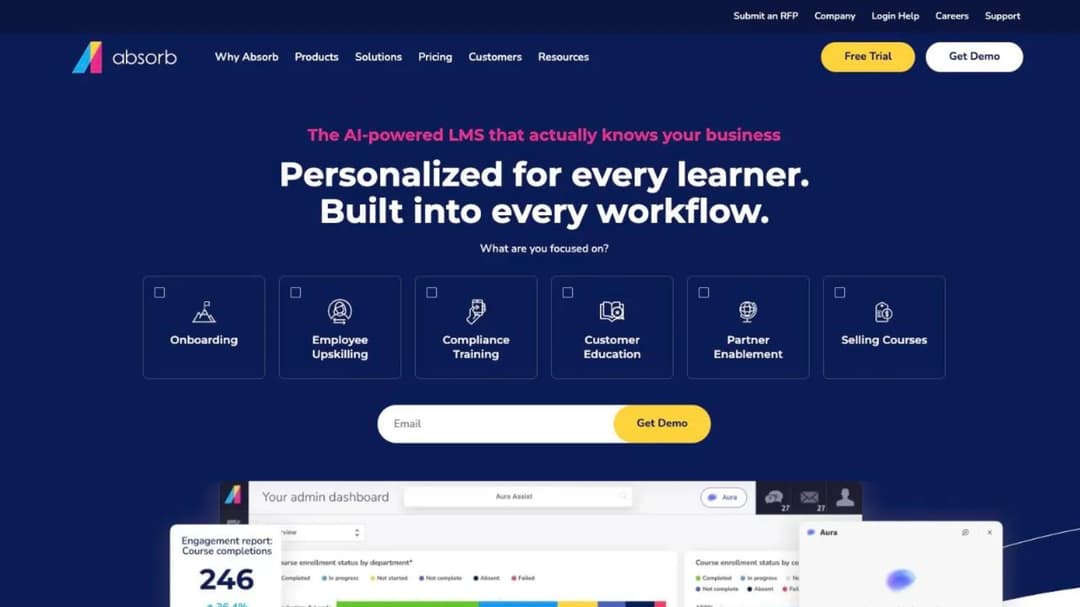
Best for: programs that need a separate branded portal per customer segment, partner tier or region, and SCORM that goes out as well as in.
Top Features
- Multi-tenant learner portals: “unique learner portals based on any number of criteria, including roles, locations, languages and more”
- Absorb Create publishes to SCORM, xAPI and HTML5, and the platform imports SCORM 1.2 and 2004
- Native iOS and Android apps with offline access
- Salesforce, HubSpot, Zendesk Sell, Intercom, NetSuite, Credly and Workday, plus Go1 and Skillsoft content
- Interface available in 25 languages
Absorb now trades as Absorb AI, so a quote or an older guide that says Absorb LMS means the same company. Its multi-tenant architecture is the closest structural match to Panorama in this group: one content library, separate portals with their own branding and rules. Absorb reports standardizing training for A&W Canada across 900 locations and 45,000 employees, an employer deployment rather than a customer academy.
Absorb gates the quote more tightly than anyone here. Both pricing pages are lead-capture forms that ask for your learner band and your email before any number appears, and no tiers, trial length or contract term are published. What is published is the export path: Absorb Create’s SCORM, xAPI and HTML5 output means a course built here leaves as a package, which is more than Thought Industries states about its own.
Pros
- Portals per audience from one library, the structural match for Panorama
- SCORM 1.2 and 2004 in, and SCORM, xAPI and HTML5 out
- Native mobile apps with offline access
- Intercom, Zendesk Sell and HubSpot named, which a CS team can use on day one
Cons
- No price without handing over your contact details, and no published term or notice window
- Twenty-five interface languages, fewer than Eurekos’s 130-plus or LearnUpon’s 120-plus translation
- The scale proof is an employer case, not a customer education one
6. Eurekos
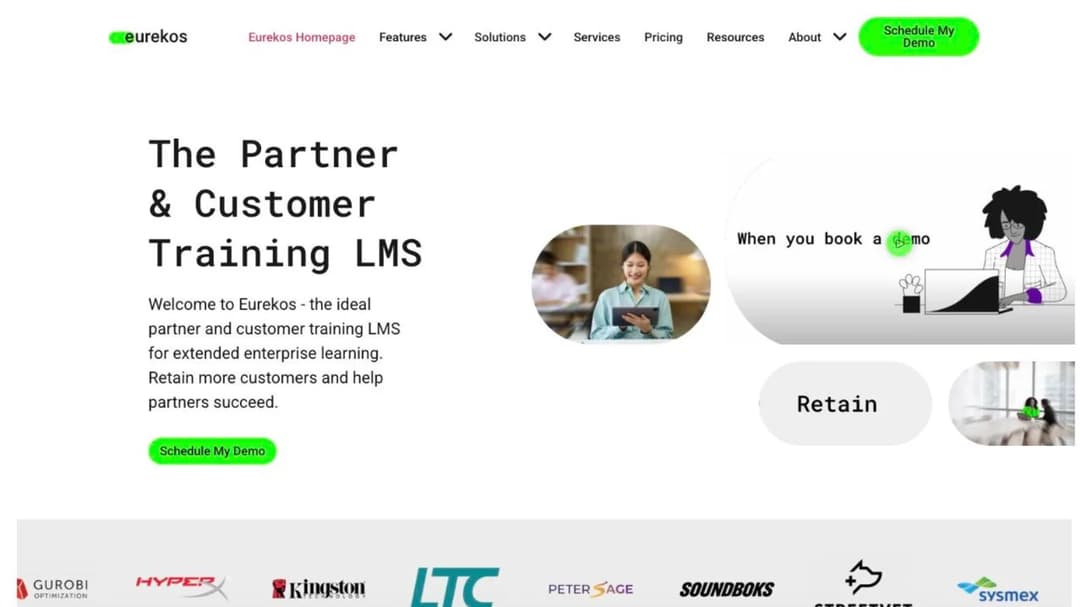
Best for: customer and partner programs that want unlimited branded portals, a storefront and 130-plus languages included, on a consumption meter that resets monthly.
Top Features
- Unlimited branded portals, each with its own SSO, included in the price
- Built-in e-commerce with storefronts, coupons, bundles, multiple currencies, virtual credits and country-level VAT configuration
- 130-plus languages across interfaces, emails and notifications, with a built-in translation interface
- Certification management with real-time compliance monitoring and on-demand audit exports
- Cloud or on-premise deployment, with native iOS and Android apps at no extra cost
Eurekos is the platform in this group whose included list reads most like Thought Industries’s paid tiers. Its pricing page publishes no figure but does publish the mechanic: “You pay for your number of active users per month and each month it resets”, with fixed pricing available “for up to one full year” on request. Portals, video streaming and premium support are described as all-inclusive, and no trial is published.
The public Terms are the most complete here. A twelve-month initial term that can’t be terminated is followed by ninety days’ written notice, with monthly billing in arrears and a liability cap of the greater of twelve months’ fees or $200,000, and the SLA is 99.9% monthly with credits from 10% to 100%. The legal entity is Eurekos Systems ApS in Hillerød, Denmark, and Eurekos reports Sysmex reaching “100k+ Customers Worldwide”.
Pros
- Portals, storefront, languages and mobile apps included rather than tiered
- An active-user meter that resets monthly, so a quiet month costs less
- Published term, notice, SLA credits and liability cap
- ISO 27001:2022, 27701:2019 and 27017:2021 in its own name, plus an on-premise option
Cons
- The first twelve months can’t be terminated, and ninety days’ notice applies after that
- Imports SCORM and xAPI but states no export, and no SOC 2 or HIPAA statement is published
- Its features page names no AI capability, and its AI blog post describes most of its AI in the future tense
7. Trainn
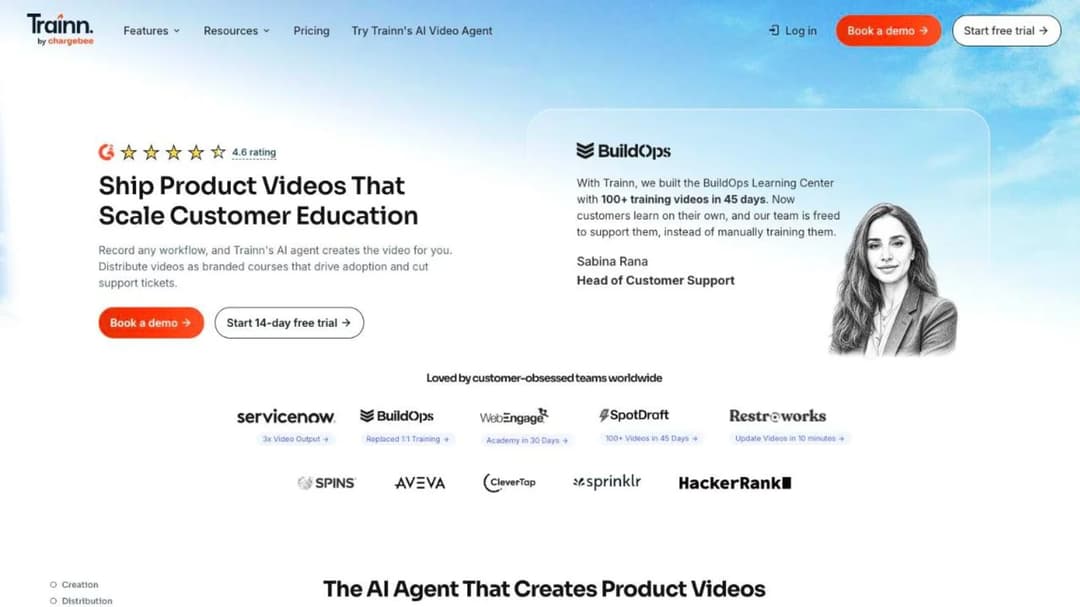
Best for: SaaS teams whose academy is product video first, who want every price on the page and a trial before any commitment.
Top Features
- An AI agent that turns a screen recording or webinar into a finished product video, with narration in 100-plus voices
- Step-by-step and interactive guides, a branded Knowledge Hub and in-app tutorials without code
- A no-code Academy with courses, quizzes and certifications, capped by monthly active users
- One-click translation into 30 languages on Scale, and SAML SSO on Enterprise
- Okta, Azure AD, Workday, Salesforce, HubSpot, Stripe, Shopify, Tableau, Power BI and Looker
Trainn prints its whole ladder, which is why it belongs on a Thought Industries shortlist even though it’s a different shape. Creator is $19 a month for one user and 15 videos with no academy, and Launch is $2,400 a year for 3 users and 120 videos, still without an academy. Scale is $10,000 a year for 5 users and the Academy with 100 monthly active users. Enterprise is $39,900 a year for 25 users, 250 monthly active users, SAML SSO and a master service agreement.
The page shows higher list prices struck through above those figures, and extra learner bundles come through sales. Trainn has contracted through Chargebee Inc. since its acquisition in March 2025. Two of its own comparison pages claim “plans starting from $499” and “a free account”, and the pricing page says neither, so budget from the pricing page. Budgeting from the pricing page rather than the comparison pages is the habit to carry into Trainn alternatives, which reads the video tools the same way.
Pros
- Every tier priced on the page, with a fourteen-day trial on the academy plans and no card required
- The video agent removes the production bottleneck that stalls most SaaS academies
- SSO, a master service agreement and three named BI tools on the top tier
Cons
- No SCORM, so a course built in the Academy is not confirmed portable to another LMS, and content built during the trial is lost at expiry
- Ninety days’ notice, non-refundable fees, and an academy capped at 100 or 250 monthly active users
- Trainn’s own FAQ rules it out for teams whose primary format is live instructor-led training
8. TalentLMS
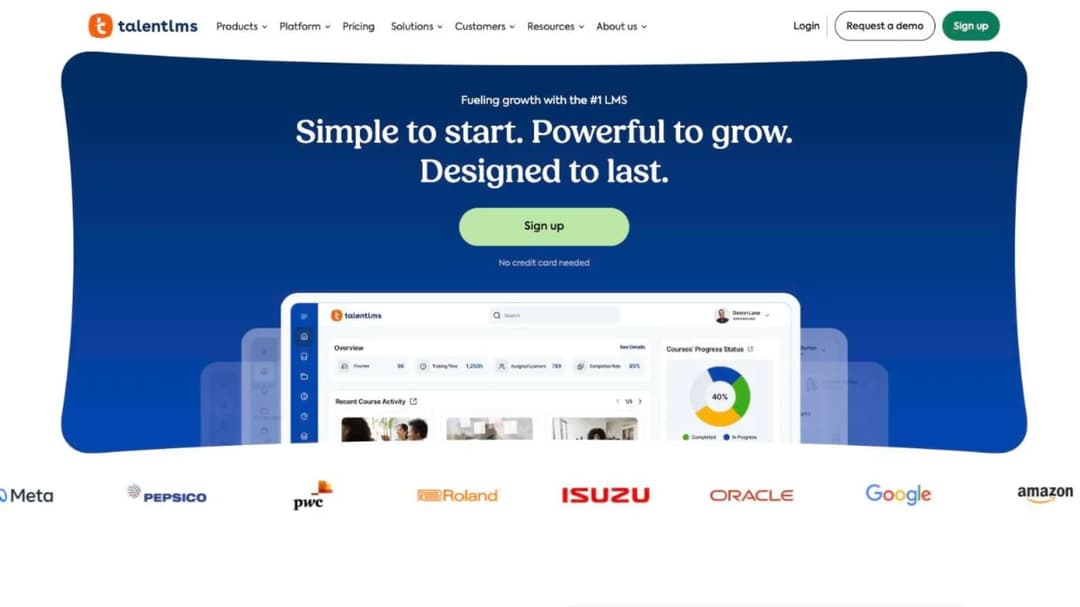
Best for: academies under 100 customers that want the full price ladder on screen and separate branches for separate audiences.
Top Features
- Branches, which give each customer audience its own portal, at 1, 3 or 15 by plan
- Certificate expiry with automatic re-assignment when a certification lapses
- Salesforce, Intercom, Zendesk, HubSpot, Zoom, Okta, OneLogin and SAML, plus Stripe, Shopify and WooCommerce for selling
- Native iOS and Android apps, with offline completion for compatible content
- xAPI, cmi5, LTI 1.3 and a Zapier connection to “1000+ other tools”
TalentLMS isn’t a customer education product and doesn’t claim to be. What it offers this reader is the most complete published ladder in the group. Core is $119 a month for 1 to 40 users, rising to $219 at 71 to 100; Grow is $229 for 1 to 70 users; Pro is $449 for 1 to 100, then $6 per additional user. Enterprise is custom, and the page prints its floor two ways, “starts at 1000 users” and “flexible starts at 500 users”, so ask which applies.
Two limits matter against Thought Industries. SCORM is version 1.2 and import only, and TalentLMS’s own documentation states it isn’t possible to create SCORM files inside the platform, so a course built here doesn’t leave as a package. There’s no multi-currency storefront and no BI connector, so if either was the reason you bought Thought Industries, this isn’t the replacement.
Pros
- The clearest tier-by-tier pricing here, with a free plan for 5 users and a fourteen-day premium trial
- Branches give small partner or customer audiences their own portal without an enterprise contract
- Intercom, Zendesk and HubSpot connectors on a platform a CS team can run without an admin
Cons
- SCORM 1.2 import only, no export
- The Enterprise floor is printed as both 500 and 1,000 users
- Renewal notice and price-change terms aren’t on the pricing page
9. AcademyOcean
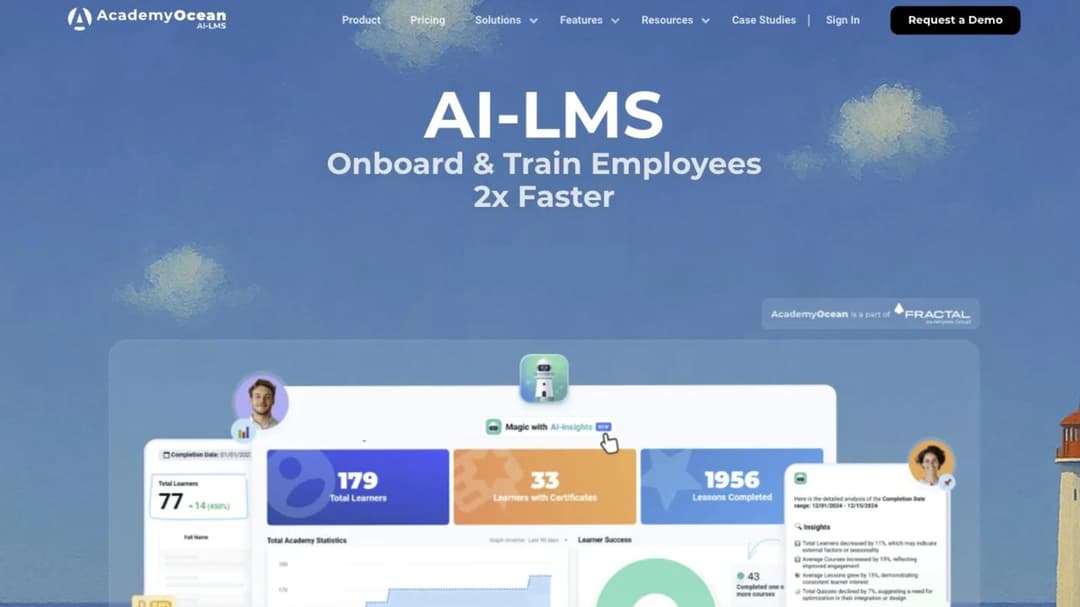
Best for: small teams that want to see a per-learner number before speaking to anyone.
Top Features
- A live price calculator on the page: pick a learner count and a billing period and the figure appears
- Essential tier with the editor, quizzes and certification, AI tools, SCORM, learner groups and reporting
- Professional tier adding assessments, multiple training portals, workflow automations, API, webhooks and SAML
- Learning portals per location or audience with assigned managers
- Zapier, API and webhooks for connecting the rest of the stack
AcademyOcean is the only platform in this group with a calculator on the page. Fifty learners cost $200 a month billed annually, which is $4.00 per learner per month, with bands running 50, 100, 150, 200 and 300 or more, and annual billing saving 20%. Three tiers sit behind that: Essential, Professional and Enterprise, with SCORM on the entry tier rather than gated upward.
The calculator makes the arithmetic honest in a way no quote-only platform can. At 300 learners, set its annual figure against Trainn’s Enterprise tier and LearnUpon’s 300-user floor. Then ask AcademyOcean how a learner is counted, because per-learner and per-active-user are not the same bill.
Pros
- A per-learner price you can compute before a call
- SCORM and certification on the entry tier
- Separate portals with assigned managers on Professional
Cons
- Integrations are Zapier, API and webhooks, so Salesforce or Intercom runs through Zapier rather than a native connector
- The calculator prices by learner count, so confirm whether a dormant customer counts before you set the band
10. Mini Course Generator
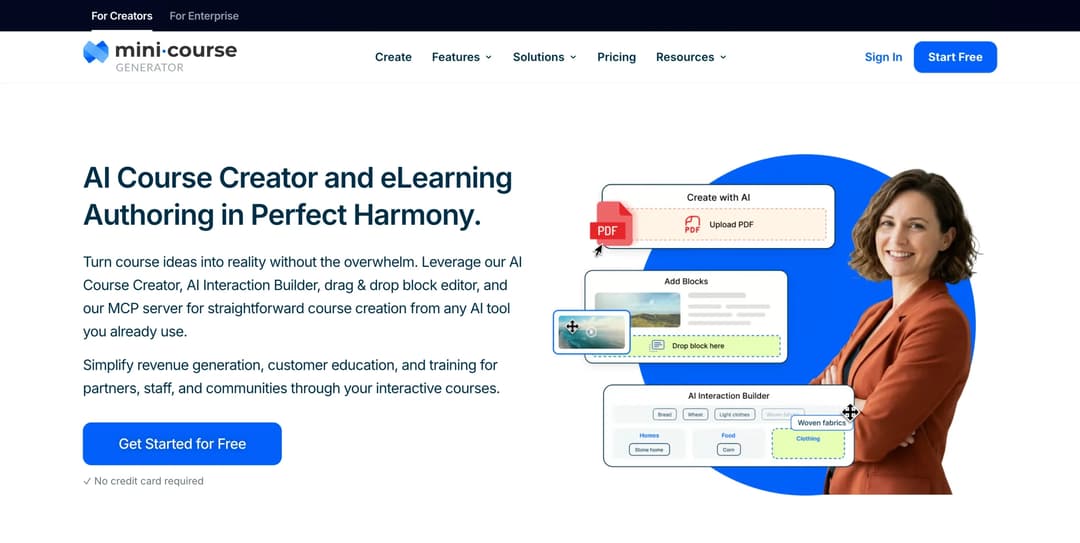
Mini Course Generator is our product.
Best for: customer education leads whose next course already exists as a help-center article, a release note or a Confluence page, and who want a contract they can read before a sales call.
Top Features
- AI Course Creator and PDF to Course Creator draft a course from your own documents, with Hallucination-Proof generation that MCG reports as 95% hallucination-free from your own resources
- The Mini Course Generator MCP Server lets Claude, ChatGPT, Manus or Cursor create, edit, publish and update courses from Confluence, Slack, Notion or Google Drive material, live since June 2026
- Six learner access Gateways (everyone, double opt-in, pay-wall, specific learners, in-app authentication, Password Wall) and magic links, so a customer opens a course without another account
- The MCG App for Intercom delivers courses inside Intercom Messenger, and embed widgets (Sidebar, Modal, Embed link, Direct link) put them in your product or help center
- Learning analytics and learner tracking, Certificates & Badges, Micro-credentialing, and account-based reporting for your customers’ admins on the Scale plan
The comparison against Thought Industries is the commercial terms, stated flat. Every plan opens with 14 days of full access and no credit card, and the pricing FAQ states “zero implementation or onboarding fees” and no minimum annual commitment. A learner is “anyone who takes your courses”, plans include a yearly learner allowance, and there are no transaction fees on training you sell through the pay-wall Gateway. Content is always yours: export as SCORM or PDF at any time, “whatever your subscription status”, and the plan details are on the pricing page.
The work itself runs on a rapid loop: help doc in, course live the same day, and a re-issued course when the release ships rather than a rebuild. The AI Interaction Builder adds Branching Scenarios, Dialogue Simulations and Interactive Quizzes to a drafted course. The AI Role-play skill gives customers a graded practice conversation that exports as SCORM 1.2 to any LMS.
After publish, the MCP Server can act on results, hardening a quiz question everyone aces or emailing customers who stopped halfway, which is what running a course with AI agents looks like in practice. Connections run through Zapier, Make and webhooks, a WordPress plugin and the Intercom app, and the weekend academy build shows the sequence from help article to live academy.
Pros
- Price, trial and commitment terms published, with no implementation fee and no minimum annual term
- Courses drafted from the help docs you already have, and an MCP Server that builds them from where those docs live
- Delivery inside Intercom Messenger, by embed, or by link with no account required
- Export as SCORM or PDF at any time, whatever the subscription status
Cons
- Publishes no SOC 2 report, no ISO 27001 certificate, no HIPAA statement and no security page, so if procurement needs one on paper, it doesn’t publish one
- One academy rather than co-branded multi-tenant portals: no sub-accounts and no per-client instances
- A pay-wall Gateway rather than a storefront: no multi-currency tax engine, no choice of payment gateway, no training credits or bundles
- No BI connector into Power BI, Tableau, Looker or Domo; analytics live in the platform, with webhooks, Zapier and Make for the rest and a REST API only on the Custom plan
- No native Salesforce or Zendesk integration named, no proctored exams, no content library and no instructor-led session management
- SSO for learners and the Headless LMS API are Custom-plan features, and the largest multi-portal programs need that plan
See what the plans include on the pricing page, then put one help-center article through the trial and time how long the course takes to go live.
Which Alternative for Which Situation
Six rules cover the situations that bring a customer education lead here, starting with the count of the three: co-branded portals, a multi-currency storefront and a warehouse connector. Each is a condition you can check against your own academy before a demo.
If your academy runs two or more of the three, shortlist Skilljar, Intellum, Docebo and Absorb, and spend the negotiation on term, notice and overage. You want the same shape again, so the difference between these four is the contract. Skilljar and Docebo publish theirs, so use their clauses as the floor: thirty days’ notice, a renewal cap, a count that can fall at renewal. Intellum and Absorb publish nothing, so those three items are the first three lines of your order form.
If you run one of the three, usually the portals, shortlist LearnUpon and Eurekos. LearnUpon gives you separate Learning Portals, an in-product embed and thirty days’ notice, above a 300-user floor. Eurekos gives you unlimited portals with their own SSO and a storefront included, behind a twelve-month term you can’t break. Pick LearnUpon if the notice window matters more than the meter, and Eurekos if the meter matters more.
If you run none of the three and your content is product video, shortlist Trainn. Its ladder is printed and its academy caps at 100 or 250 monthly active users, a fit for a SaaS company under 500 people and a mismatch above it. Skip it if you need SCORM or if live sessions are your primary format.
If you run none of the three and want a price on screen for an academy under 100 customers, shortlist TalentLMS and AcademyOcean. TalentLMS prints every band and gives each audience a branch; AcademyOcean prints a per-learner figure and gives each audience a portal on Professional. The small-business LMS comparison goes further down that range.
If your content already exists as help docs and release notes, and what you want is a contract you can read, shortlist Mini Course Generator. No implementation fee, no minimum annual commitment, and delivery inside Intercom or your product. Skip it if procurement needs a certification on paper or if your program needs a storefront in several currencies.
If partners are the audience, the portal count per tier is the line to read. Skilljar sells 1, 2 or 3 academy sites by tier, Docebo caps extended enterprise at 10 domains, and Eurekos includes unlimited portals. The partner training software comparison sorts platforms by what each one meters, the partner enablement guide draws the line between training a channel and running one, and the partner training LMS page covers the delivery side.
Two forks for readers who aren’t quite this article’s reader. If you’re on the product team and the academy has to live inside the app, weigh a headless LMS platform over any portal-first vendor. If you sell courses as a business rather than run an academy for customers, Thought Industries was never your shelf, and the Thinkific alternatives and LearnWorlds alternatives pages are the right comparison. For the program these platforms are bought to run, customer training in B2B SaaS sets out the wider playbook.
What Happens to Your Content When You Leave
Thought Industries publishes no leaving process, no data-return window and no SCORM version, so the exit is a set of questions to its account team before it’s a migration. Work through four steps in order.
- Find the end date of your current term and the notice window in your order form. The site publishes neither; the only clue is that onboarding services are priced for “the first year of your contract”. Put the end date and the notice deadline in your calendar today, with a reminder thirty days before. Done looks like a date, a named person who will send the notice, and the address it goes to.
- Export before you notify. Run SCORM Connect on every course you own, and download the certificate records and the completion reports your customers’ admins will ask for. Ask Thought Industries in writing what format the export takes, how long it stays available after the term ends, and who performs the work, because none of that is published. Put the same question to whichever vendor you move to, even one that publishes a window.
- Check what the new platform accepts before you buy it. Absorb and Docebo import SCORM 1.2 and 2004, LearnUpon and Eurekos import SCORM and xAPI without stating a version, and TalentLMS takes SCORM 1.2 only. Mini Course Generator doesn’t import packages at all: a course is re-drafted from the source document, which is fast for a help-doc academy and wrong for a library of authored SCORM modules. SCORM, xAPI and cmi5 compared explains which standard your certificates and completions need to survive the move.
- Run the replacement inside a trial with a clock on it, before the notice date. Trainn, TalentLMS and Mini Course Generator give you fourteen days; Skilljar, LearnUpon, Absorb and Eurekos publish no trial at all. Import one SCORM package or one help article, connect Salesforce or Intercom, and run one cohort of real customers through it. Then sign with six answers in the order form: the learner definition, the floor and whether it can fall, the term and notice, the price at renewal, the export path and its window, and the compliance documents with their dates.
Count the three capabilities first, today, before any of the four steps. Two or more, and the decision is a negotiation with Thought Industries or a like-for-like peer, with the clauses above as your leverage. None, and the decision is a published-price platform whose terms you’ve read. Either way, take one help-center article your customers keep asking about and put it through customer training software this week, because the cost of leaving is measured in the courses you’d have to rebuild.
Frequently Asked Questions
What are Thought Industries?
Thought Industries is a learning platform for training people outside your own company: customers, partners, association members and professional learners, with employee learning behind them. Founded in 2013 and headquartered in Boston, it sells co-branded multi-tenant portals, a training storefront in 150 currencies, a warehouse connector and an AI layer, on three quote-only tiers named Starter, Professional and Enterprise.
How does Skilljar by Gainsight compare with Thought Industries for certification programs, analytics and partner training portals?
Skilljar publishes its contract and Thought Industries doesn’t, and that’s the difference that decides the bill. Both run certification programs with proctored exams, and both offer a warehouse connector. Skilljar prints a price for one: the Data Connector starts at $25k, while Thought Industries’s BI Connector sits on the Enterprise tier with no figure. On partner portals, Skilljar sells 1, 2 or 3 academy sites by tier with partner syndication from Professional, and Thought Industries’s Panorama portals are included from Starter with no count published. Skilljar’s agreement renews for twelve months on thirty days’ notice with an early-exit payout of the Initial Term, and it publishes no HIPAA statement anywhere, while Thought Industries lists HIPAA on its Trust Center as available documentation.
How much does Thought Industries cost?
Thought Industries publishes no price for any tier. Starter, Professional and Enterprise each route to the same “Let’s talk” demo form, with no per-seat or per-learner mechanic, no seat floor and no minimum spend on the page. The figures in circulation come from procurement-data services and from vendors selling against it, not from Thought Industries, and they describe typical contracts running to tens of thousands of dollars a year. Treat any number you’ve seen as a benchmark, and get the real one in writing with its term, notice window and overage rate beside it.
Does Thought Industries have a free trial?
No. The published evaluation path is “Fill out one form to unlock access to our on-demand demo library”, followed by “Book My Personalized Demo”, and no free plan exists. Among the alternatives, Trainn, TalentLMS and Mini Course Generator each offer a fourteen-day trial, and Intellum’s Evolve authoring tool offers twenty-one days. Skilljar, LearnUpon, Absorb and Eurekos publish no trial.
Which Thought Industries alternatives publish a price?
Four of the ten print a figure for the platform itself. Trainn runs from $2,400 to $39,900 a year, TalentLMS from $119 to $449 a month by user band, and AcademyOcean from $4.00 per learner per month at 50 learners. Mini Course Generator publishes its plans in full on its pricing page. Intellum prices only its Evolve authoring tool in the open, Skilljar prints three add-on prices with the core subscription on quote, and Docebo, LearnUpon, Absorb and Eurekos publish no figure at all.
Can I export my courses if I leave Thought Industries?
Thought Industries’s SCORM Connect exports content “to a third-party domain or LMS without losing valuable data”, but no page states the SCORM version, the data-return window after your term ends, or who performs the export. Ask for all three in writing before you give notice, and check the receiving platform: Absorb and Docebo import SCORM 1.2 and 2004, TalentLMS imports 1.2 only, and Trainn doesn’t mention SCORM.
Is Thought Industries SOC 2 or HIPAA compliant?
Thought Industries’s Trust Center lists SOC 2 Type 2, ISO/IEC 27001, HIPAA, GDPR, CCPA, PCI DSS, the EU-US Data Privacy Framework and TX-RAMP as available documentation, with AWS hosting and a two-hour recovery objective. Ask for the SOC 2 report with its period and for the HIPAA documentation, and if your customers’ data includes health information, ask whether a business associate agreement is on offer, because the site doesn’t say.
Sources
- Thought Industries pricing page, services page, demo center, and the create, deliver, monetize, measure and integrate platform pages
- Thought Industries Trust Center, privacy policy, about page, customer training, member education and partner pages
- Skilljar pricing page, Subscription Services Agreement, Data Processing Agreement, security page and VPAT
- Intellum Platform Terms of Service (sections 1.2, 2.2, 2.5, 4.2 and 8.2), Service Level Agreement, Security, Privacy and Architecture Summary (sections 17 and 22), Sub-Processors page and Evolve pricing page
- Docebo Master Services Agreement (sections 5.2, 10.2 and 12.2), Trial Environment Agreement, pricing page, Learn LMS page and compliance and security page
- LearnUpon pricing page, Terms of Service (sections 8.2, 9.1 and 10.1), security page, accessibility page and customer education product page
- Absorb LMS pricing pages, platform page, Absorb Create page and integrations page
- Eurekos pricing page, Terms, security page, course authoring page and multilingual LMS page
- Trainn pricing page and FAQ, Terms of Service (sections 6.1, 6.2, 7.1 and 7.2), LMS integrations page and Chargebee acquisition announcement
- TalentLMS pricing page and SCORM support documentation
- AcademyOcean pricing calculator and plan pages
- Mini Course Generator pricing page