
Customer education is the practice of teaching customers how to succeed with your product through structured learning: onboarding courses, feature training, certifications, and academies. It differs from support (which reacts to problems) and from marketing (which persuades); its job is competence. Done well, it is one of the few programs that touches revenue, retention, and support costs at the same time.
The numbers behind that claim are unusually strong. A 2024 Forrester Consulting study commissioned by Intellum found that formalized programs improve top-line revenue by an average of 7.6%. The same study measured 38.3% higher adoption of trained-on products and positive ROI for 96% of organizations. Few internal programs of any kind survive that kind of measurement.
Yet most content in this niche skips the uncomfortable parts. Programs launch to silence. Academies sit unvisited. Certifications expire into meaninglessness. This guide covers the whole picture. What customer education is, the sourced case for it, a step-by-step build blueprint, the failure patterns, how to measure honestly, and how to choose the stack.
Key Takeaways
- Customer education is structured teaching that makes customers competent with your product; it complements support and self-service rather than replacing them.
- The business case is measured: 7.6% average revenue lift, 38.3% adoption increase on trained products, 15.5% lower support costs, 96% positive ROI (Forrester Consulting study commissioned by Intellum, 2024).
- The binding constraint is reach: on average only 29% of a customer base engages with training annually (Skilljar 2022 benchmarks). Delivery beats content polish.
- The most common failure is building an academy portal before proving one course; start with your top three repeat questions instead.
- Measure verified understanding and business outcomes, not course pageviews.
What Is Customer Education?
Customer education is any structured effort to teach customers the knowledge and skills they need to get value from your product or service. The word “structured” carries the definition. A help article answers one question; a course builds competence in a sequence, tracks who completed it, and verifies who understood.
The umbrella covers several distinct types:
- Onboarding education teaches new customers the path to first value: setup, core workflow, the first win.
- Feature and use-case training deepens adoption after onboarding, usually around the features tied to renewal.
- Certification programs verify competence formally, with credentials customers can show. Common in partner ecosystems and technical products.
- Academies collect all of it under one branded roof, from a simple course library to a full learning destination.
- Just-in-time education delivers a short lesson at the moment of need, inside the product or the support conversation, instead of waiting for the customer to visit a portal.
Related terms overlap and get confused. Customer training usually means the same thing (this guide uses both). Customer enablement is broader: education plus the resources and processes that help customers succeed. User education and product education are near-synonyms used by product-led teams. What matters is the boundary with support: support resolves an incident; education prevents the class of incident from recurring.
Why Customer Education Matters Now
Three shifts pushed customer education from nice-to-have to revenue infrastructure.
Self-service hit its ceiling. Gartner found that 73% of customers use self-service at some point in their journey, but only 14% of service issues are fully resolved there. Customers are willing to help themselves; documentation alone does not make them capable. That gap between willingness and capability is what structured education fills. It is why education has become the second layer of the support stack; our ticket deflection playbook covers the mechanism in detail.
Retention became the growth engine. In subscription businesses, most of a customer’s value arrives after the sale, and untrained customers churn quietly: they never adopt the sticky features, never build habits, and leave without complaining first. The Forrester/Intellum study measured a 35% increase in average lifetime value per trainee. Education is retention work that scales without adding headcount.
AI collapsed the production cost. The historical blocker for customer education was content production: courses took instructional designers weeks. AI course creation changed the equation; a team can now turn existing documentation into a structured, interactive course in minutes and update it the same day the product changes. The programs that used to need a department now need an owner and an afternoon a week.
The Benefits, With Sources
Each benefit below carries its number and its source. The full dataset lives in our customer education statistics guide.
Faster adoption of the product you actually sell
The largest measured effect: a 38.3% average increase in adoption of products targeted by training (Forrester Consulting study commissioned by Intellum, 2024; n=300 US decision-makers). The finding has a practical edge. Adoption gains concentrate on what you teach, so train the features tied to retention first, not the ones easiest to document.
Lower support costs
The same study measured a 15.5% average decrease in customer support costs. The mechanism is upstream: a trained customer stops filing the repeat how-do-I tickets that make up the biggest pile in most support queues. Education does not replace the help center; it shrinks the class of questions the help center keeps failing to retire.
Revenue you can point to
Formalized programs correlate with a 7.6% average top-line revenue improvement, a 28.9% increase in win rates for new customers, and a 26.2% improvement in customer satisfaction (same study). The win-rate figure surprises people. Education helps close deals because a public academy signals that customers succeed with you, and trials convert better when trialists know what they are doing.
Customers who defend the renewal
Trained customers are power users, and power users renew and expand. The 35% lifetime-value-per-trainee figure captures it quantitatively. Qualitatively, every CS leader knows the pattern: the champion who took your certification defends the renewal from inside the account better than any QBR deck.
A support team that scales sublinearly
When education absorbs the repetitive teaching, support specialists handle what genuinely needs them: real bugs, complex configurations, unhappy moments. Teams that pair a customer self-service portal with structured education get both layers: lookups resolve themselves, and repeat questions stop being asked.
Knowledge that survives churn on their side
Your champion leaves; their replacement inherits a product they never learned. Without education, that transition is a silent churn risk. With an on-demand onboarding course and a certification path, the new admin re-trains themselves in week one. B2B education is insurance against the other company’s turnover.
How to Build a Customer Education Program
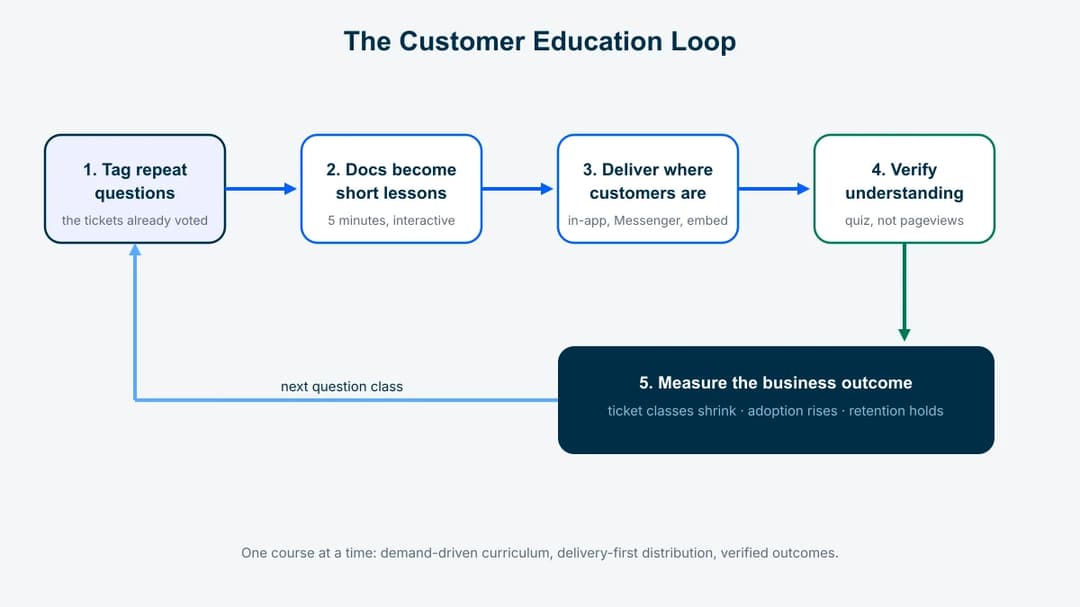
The blueprint below is deliberately small. The failure mode in this field is scoping a learning destination before proving a single course. Reverse it.
Step 1: Start from your repeat questions, not your content
Export 90 days of support tickets and tag the top recurring how-do-I questions. Those tags are your first curriculum, ranked by demand. You are not guessing what customers need to learn; the ticket queue already voted. Three to five question clusters make the right first scope.
Step 2: Turn existing material into short, interactive lessons
You already wrote the help articles, decks, and runbooks. Restructure each question cluster into a course of five-minute lessons with a quiz at the end. Interactive beats passive here. A quiz or scenario forces retrieval, which is what makes learning stick. It also gives you the completion and understanding data that pageviews never will. This is where AI course creation from your own documents earns its keep; drafting is minutes of work, and the customer training software handles delivery and tracking around it.
Step 3: Deliver where customers already are
This is the step that decides the program’s fate. Skilljar’s own 2022 benchmark survey found only 29% of a customer base engages with training annually; the missing 71% never visits the portal. So do not lead with a portal. Put the lesson inside the product with embedded courses. Put it in the support Messenger via the MCG App for Intercom, in the onboarding email sequence, or behind a magic link with no password. Meet the customer at the moment of confusion, and completion follows.
Step 4: Verify understanding, then measure the business outcome
Close every course with a short quiz, so you know who understood rather than who clicked. Then measure the thing you built the course to change. That means the tagged ticket class from step 1, activation rate for onboarding, or feature adoption for feature training. Course metrics tell you the program runs; business metrics tell you it works. Both go in the dashboard from day one.
What goes wrong
Five failure patterns account for most dead programs:
- The portal-first launch. Six months building an academy destination, then silence, because nobody navigates to a separate site to learn a tool they use in another tab. Delivery-first programs invert this and win.
- The 45-minute course. Built by an expert who wanted to be complete. Customers are volunteers; a lesson longer than a coffee break gets abandoned at minute six.
- Stale content decay. The product ships weekly; the course was recorded in March. One misleading screenshot costs more trust than ten missing lessons. This is an argument for course formats you can edit in minutes and against video-heavy production you cannot.
- The unowned program. Education launched as a project, not a function. Without a named owner watching the metrics, content decays, links break, and the program dies of neglect around month eight.
- Measuring attendance instead of outcomes. A dashboard of enrollments proves budget was spent. Only verified understanding tied to a business metric proves it was spent well.
Every one of these is avoidable, and all five are cheaper to avoid than to fix.
Segmenting Customer Education
One curriculum rarely fits all customers. The practical segmentation axes:
- By role: the admin who configures, the end user who operates daily, the executive who reads the dashboard. Three audiences, three depths.
- By lifecycle stage: onboarding content for month one, adoption content for the growth phase, advanced content for renewal-age accounts.
- By plan or use case: your enterprise tier uses features the starter tier never sees; their curricula should differ the same way.
- By skill level: a beginner path and a power-user path prevent the single course that bores half its audience and loses the other half.
Start with role and lifecycle; they carry most of the value. Plan-based segmentation matters once your tiers genuinely diverge, and skill-based paths are a scale-stage refinement. Access control does the quiet work here: Gateways that route the right audience to the right course keep segmentation real without manual enrollment.
Who Owns Customer Education?
In small companies, customer education starts as a fraction of someone’s job, usually in customer success or support. That works until the program needs consistency. Then the ownership question decides whether it survives.
The emerging role is the customer education manager: owns the curriculum, the delivery channels, the measurement, and the update cadence. In B2B SaaS the role typically reports into customer success (when the goal is retention) or, less often, into marketing (when the academy doubles as a demand asset). Both work; unowned does not.
The team around the owner stays lean when tooling is right. Subject-matter experts contribute source material, and the owner shapes it into courses (AI drafting removes most of the production labor). Support flags the new repeat questions; product notifies on changes that invalidate content. A one-person program with that loop outperforms a five-person program without it.
Measuring Customer Education
Two layers, in order of how much executives care:
Program metrics prove the machine runs: enrollment, completion rate, quiz pass rate, time-to-complete. Completion and pass rate matter most; enrollment alone is vanity. The uncomfortable benchmark to beat is reach: the 29% average annual engagement figure means most programs’ biggest lever is getting learning in front of customers at all.
Business metrics prove the machine matters. Track activation and time-to-first-value for onboarding courses, adoption of trained features, and the tagged repeat-ticket classes education was built to retire. Compare retention of trained versus untrained accounts. Pick one business metric per course when you build it, not after.
The bridge between the layers is verified understanding: quiz-validated knowledge, per learner. It converts “they watched” into “they know”, and it is the difference between reporting activity and reporting competence. Certificates make the verification visible to the customer; analytics make it visible to you.
Honesty note: trained-versus-untrained comparisons carry selection bias, because motivated customers both train more and succeed more. Use cohort comparisons directionally, pair them with the before/after movement of your tagged ticket classes, and resist claiming causation your data cannot carry.
Choosing the Customer Education Stack
The tooling question comes last on purpose: stack decisions made before curriculum decisions produce shelfware. When you get here, the market splits into three families.
Enterprise customer education suites (the Skilljar and Docebo class) offer deep certification engines and heavy integrations, with implementation projects to match. They fit large programs with dedicated teams. For everyone else, they are overkill. If one of those two is already on your shortlist, the Skilljar comparison and the Docebo comparison walk through where each one earns its price and where a lighter setup does the same job.
Course marketplaces and creator platforms are built for selling courses to strangers, not educating your customer base; the commerce features are the point. Wrong fit for product education.
Lightweight, delivery-first platforms are built for speed to first course and for meeting customers where they are: AI authoring from your own documents, embeds, in-product delivery, Messenger delivery, quiz verification, learner analytics. Right for SMB and mid-market teams that want education running this quarter, not next fiscal year. That category is what our customer training software page covers in depth, including what to check before you commit; plan structures and a free start live on the pricing page.
Whatever family you pick, test four things in a trial. How fast does an existing document become a live course? Do courses reach customers without a new login? Can you verify understanding rather than views? And do the analytics answer your business metric from the section above? A tool that passes all four in a two-week pilot with one real course is a safer bet than any feature-matrix comparison. Teams that need training embedded in their own product should also weigh the in-app training route.
Customer Education Examples Worth Studying
Three public programs, each illustrating one principle:
Salesforce Trailhead shows certification as an ecosystem strategy. Trailhead turned product education into careers: badges and certifications that practitioners put on their resumes. The lesson for smaller companies is not the scale; it is that credentials with real-world value recruit your customers into promoting your product.
Canva Design School shows education as adoption marketing. Canva teaches design skills, not just Canva features, and the courses pull in users who become customers along the way. The lesson: teaching the surrounding skill, not only the tool, widens the funnel.
HubSpot Academy shows the academy as a demand engine. Free certifications in inbound marketing built an audience that converts to product users for years. The lesson: education content can draw in people who have never heard of your product, and an academy can be a durable acquisition channel rather than a cost center.
None of these started at their current scale. Each began as a handful of courses answering real customer questions, which is the same place your program starts.
Conclusion: Start With Three Questions, Not a Platform Project
Customer education is teaching customers to succeed with your product, and the evidence says it pays. The 2024 Forrester Consulting study commissioned by Intellum found a 7.6% revenue lift, 38.3% adoption gains, 15.5% lower support costs, and 96% positive ROI. The constraint is not whether it works; it is reach and follow-through, which is why delivery-first beats portal-first and owned programs beat launched projects.
The first move fits in a week. Tag your top three repeat customer questions, turn the material you already have into three short verified courses, and put them where customers already are. Measure the ticket classes and the adoption metric they target. If the numbers move, you have a program; grow it one course at a time. The customer training software built for that loop gets you from documents to live courses the same day you start.
Frequently Asked Questions
What is customer education?
Customer education is the structured teaching of customers so they succeed with your product: onboarding courses, feature training, certifications, and academies. It differs from support, which reacts to individual problems; education builds competence proactively so whole classes of problems stop occurring.
Why is customer education important?
Because it measurably moves revenue, retention, and cost at once. A 2024 Forrester Consulting study commissioned by Intellum found a 7.6% average revenue improvement, 38.3% higher adoption of trained products, and 35% higher lifetime value per trainee. Support costs fell 15.5%, and 96% of organizations reported positive ROI.
What is the difference between customer education and customer training?
In practice they are used interchangeably, and this guide treats them as synonyms. Where teams do distinguish, “training” often means structured courses specifically, while “education” covers the broader program including documentation, community, and certification. Customer enablement is the wider umbrella covering education plus process and resources.
What are the types of customer education?
Five main types: onboarding education (the path to first value), feature and use-case training (adoption depth), certification programs (verified credentials), and academies (the branded collection of all of it). The fifth is just-in-time education: short lessons delivered at the moment of need, in-product or in the support conversation.
How do you build a customer education program from scratch?
Start from demand. Tag your most repeated support questions, then turn existing docs into short interactive lessons answering the top three clusters. Deliver them where customers already are (in-app, support Messenger, email, embeds), and verify understanding with quizzes. Measure the ticket classes and adoption metrics each course targets, then expand one course at a time.
How much does customer education cost to run?
Far less than it used to. AI authoring from existing documents removes most production labor. Lightweight platforms start under a hundred dollars a month (plan structures on the pricing page), versus five-figure annual contracts plus implementation for enterprise suites. The real budget line is an owner’s recurring hours, not tooling.