
Ticket deflection is the practice of resolving customer questions before they become support tickets, using self-service resources like help centers, chatbots, and community forums. Most teams build exactly that stack and still drown in repeat tickets. The reason sits upstream. Gartner found that 73% of customers use self-service at some point, yet only 14% of service issues get fully resolved there.
That gap is not a chatbot problem. It is a knowledge problem. Customers who were never taught your product keep asking the same questions, and no amount of interception catches them all.
This guide covers what ticket deflection is, where the standard stack stops, and the layer almost nobody builds: education-first deflection. You will get the honest math, the repeat-ticket taxonomy, and a six-step playbook for closing tickets before they exist.
Key Takeaways
- Ticket deflection resolves questions before they become tickets. The standard stack (bots, help centers, forums) intercepts questions; it does not prevent them.
- Gartner: 73% of customers try self-service, but only 14% of issues are fully resolved there. The leak is a knowledge gap, not a tooling gap.
- “Ticket deflection”, “case deflection” (Salesforce), and “call deflection” (contact centers) name the same concept in three ecosystems.
- Vendor benchmarks put healthy deflection at 20-40% of incoming volume, but those figures are vendor claims, not independent research. Measure resolution, not just deflection.
- The education-first playbook: audit repeat tickets, find the teachable class, turn docs into micro-courses, deliver them where users already are, and verify understanding.
What Is Ticket Deflection?
Ticket deflection is a customer support strategy that resolves questions through self-service before they reach a human agent. When a customer finds the answer in a help article, a chatbot reply, or a community thread instead of filing a ticket, that ticket was deflected. The goal is lower ticket volume without lower customer satisfaction.
The same idea wears different names depending on your stack. In Salesforce environments, it is called case deflection: the Experience Cloud measures how often a suggested article stops a case from being created. In contact centers, call deflection means routing a phone call to a digital channel, often through IVR (interactive voice response, the “press 2 for billing” menu). Chatbot vendors report a deflection rate for conversations their bot closed without escalation. Same concept, three vocabularies.
One distinction matters more than all the vocabulary: deflection is not resolution. A deflected ticket means the customer did not file one. A resolved question means the customer got their answer. Those are only the same thing when your self-service actually works, and that assumption deserves testing. We will measure it properly below.
The Standard Deflection Stack (and Where It Stops)
The standard playbook works, up to a point. Every serious support team should have most of it:
- A help center with searchable articles for known questions.
- An AI chatbot or agent answering conversationally from your docs.
- A customer self-service portal where users check status, billing, and account details without asking.
- A community forum where experienced customers answer newer ones.
- Proactive messages that answer a question right before it gets asked.
These are interception tools. They stand between the confused customer and the ticket form, and they catch a real share of the traffic. If you have none of this, build it first.
Then comes the plateau, and the Gartner numbers explain it. Nearly three in four customers already try self-service. Only 14% of issues end there. The remaining customers bounce from the help center into the queue, now slightly more frustrated than when they started. Gartner also found that 60% of service agents do not encourage self-service at all, so the loop keeps feeding itself.
Interception has a ceiling because it works one question at a time. The customer hits a wall, searches, maybe gets an answer, and learns nothing that prevents the next wall. To break the ceiling, you have to look at why the same tickets keep coming.
Why Support Tickets Really Repeat
Pull your last 200 tickets and sort them into three piles. Most support leaders who do this find the piles look roughly like this:
Pile one: knowledge tickets. “How do I connect the integration?” “Where did this setting move?” “Why can’t my teammate see the report?” The product works fine. The customer does not know how to use it. This pile also hides the fake bugs: tickets filed as defects that are really misuse, which cost your team the most triage time. If you get invalid technical tickets, they usually live here.
Pile two: account and transaction tickets. “Reset my password.” “Change my billing date.” “Where is my invoice?” These are specific to one customer and one moment. Bots and portals genuinely shine here, because the answer is a lookup, not a lesson.
Pile three: real issues. Actual bugs, outages, billing disputes, and edge cases. These belong with humans, and trying to deflect them damages trust.
The standard stack handles pile two well and pile three correctly. Pile one is where it underperforms, because a help article answers today’s question without building tomorrow’s competence. The customer who reads one article learns one fact. The customer who completes a five-minute course on that feature stops generating that ticket class entirely.
Pile one is usually the biggest pile. That is the deflection opportunity almost every team leaves on the table.
Education-First Deflection: Close the Ticket Before It Exists
Education-first deflection means treating structured customer training as a support channel. Instead of only answering questions at the moment of confusion, you teach the product proactively, in small doses. Whole classes of questions stop being asked.
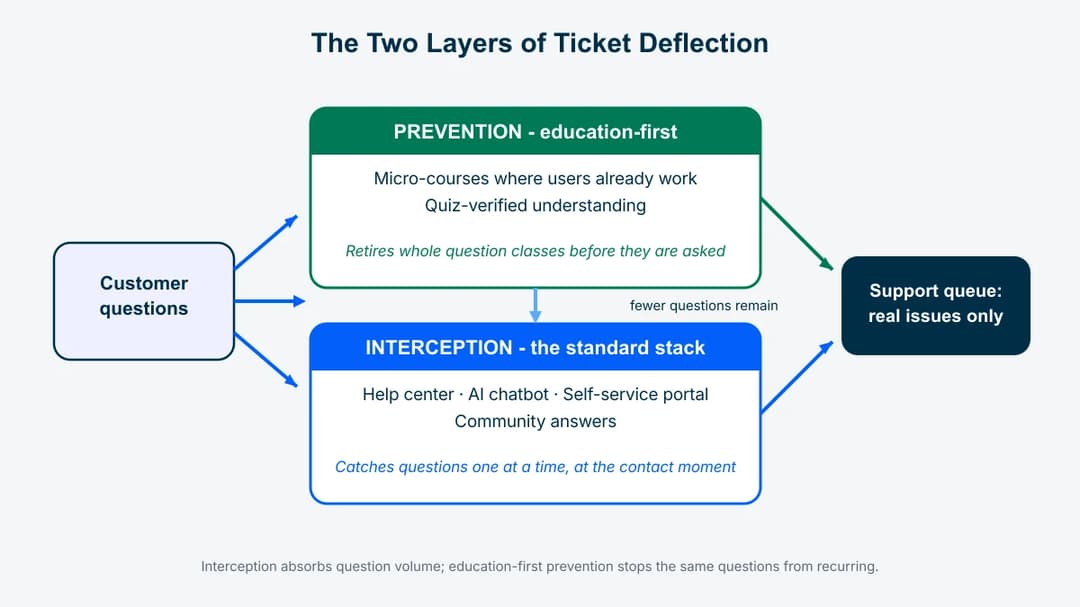
The mechanics differ from a knowledge base in three ways. First, sequence: a course orders the ten things a new admin must understand, while a help center waits to be searched. Second, completion: you can see who finished onboarding training, but nobody tracks who read the docs. Third, verification: a short quiz shows whether the customer actually understood. No pageview metric can tell you that. That last piece, quiz-verified understanding, is what separates teaching from tooltip tours. A guided walkthrough proves the customer clicked; it cannot prove they learned.
Where does this live? The honest answer: wherever your customers already are. A customer education program fails quietly when it sits in a separate academy portal nobody visits. It works when the lesson appears inside the product, in the onboarding email, or in the support Messenger itself. Timing beats polish: the lesson lands at the moment the topic is relevant. If your product has its own UI, embedding courses directly in your app removes the extra login that kills completion.
None of this replaces the interception stack. Bots keep handling pile two. Humans keep pile three. Education shrinks pile one, which is the pile that was defeating your help center anyway.
How to Measure Ticket Deflection (Honestly)
The basic ticket deflection rate formula is simple:
Deflection rate = self-service interactions ÷ (self-service interactions + tickets created)
If your help center and bot resolve 400 questions in a month and 600 tickets get filed, your deflection rate is 40%. Useful, directional, and easy to inflate.
Be careful whose math you borrow. Zendesk’s own guidance offers two different formulas. One counts help center users, the other counts bot escalations. They will not give you the same number. One helpdesk vendor, Capacity, suggests high-performing teams deflect 20-40% of incoming tickets, with AI-forward teams claiming 60% or more. Treat every such benchmark as a vendor claim. No independent study standardizes these figures, and every vendor counts “deflected” differently.
The bigger trap is bad deflection: numbers that go up while customers give up. A customer who bounces off three help articles and gives up without filing a ticket still counts as “deflected” in most dashboards. Gartner’s 14% full-resolution figure is exactly this gap made visible.
So pair the deflection rate with metrics that catch the lie:
| Metric | What it tells you |
|---|---|
| Deflection rate | How much volume self-service absorbs |
| Repeat-contact rate | Whether “resolved” questions come back |
| Tickets per active customer per month | Whether volume drops as you grow |
| Course completion on key topics | Whether customers are actually being taught |
| Quiz pass rate | Whether they understood, not just clicked |
The last two only exist if you run education as a channel. That is the measurement argument for it. Teaching is the one deflection layer you can verify directly, instead of inferring success from an absence of tickets.
The 6-Step Education-First Deflection Playbook
Here is how to reduce support tickets with education, in an afternoon-sized first pass:
- Audit your repeat tickets. Export 90 days of tickets and tag the top 20 recurring questions. Note which are knowledge tickets (pile one) versus account lookups or real issues.
- Pick the teachable class. Choose 3-5 recurring questions that come from not understanding a feature. High volume plus stable answer equals the best candidates. Skip anything that changes weekly.
- Turn existing material into micro-courses. You already wrote the help articles. Restructure each topic into a short lesson sequence with a quiz, not an hour-long webinar. Five minutes per lesson is the ceiling; shorter usually wins. Modern customer training software drafts that sequence straight from the article you already wrote.
- Deliver where customers already are. Trigger the course from the relevant product page, the onboarding flow, or the support Messenger. A lesson one click away gets finished; a portal login away gets ignored.
- Verify understanding. End each course with a 3-5 question quiz. A customer who passes has demonstrably learned the feature. A customer who fails just told you exactly what to teach next.
- Measure the ticket class, not just the course. Watch the tagged ticket category from step one. If “how do I connect the integration” tickets drop after the integration course ships, the loop works. Then repeat with the next ticket class.
The whole loop runs on material you already have. The work is restructuring, not writing from scratch, which is why the first pass fits in an afternoon rather than a quarter.
Running It in Intercom: Courses Inside the Messenger
If your support runs on Intercom, the delivery problem from step four has a direct answer: put the courses inside the Messenger your customers already open. The MCG App for Intercom delivers mini-courses right there. Courses trigger by page URL or real-time events, targeted by tags, user attributes, or lifecycle stage.
The pairing with Fin, Intercom’s AI agent, follows the pile logic from earlier. Fin intercepts the answerable questions in the moment. The courses work on prevention, teaching the features that generate your repeat tickets, with Knowledge Validation quizzes confirming the customer actually understood. Deflection handles today’s question; education retires the question class.
The same pattern works without Intercom too. Any in-app training setup that puts lessons inside your product, at the moment of relevance, beats a standalone academy for deflection purposes. The principle is the delivery, not the tool: teach where the confusion happens.
Conclusion: Deflection Is a Curriculum Problem
The standard ticket deflection stack intercepts questions at the moment of contact, and it should stay. But the Gartner numbers show where interception alone lands: 73% of customers trying self-service, 14% of issues actually resolved there. The repeat tickets filling your queue are mostly knowledge tickets, and knowledge tickets have a curriculum answer, not a chatbot answer.
Start small. Tag your top repeat questions this week and pick three that are really teaching problems. Turn the help articles you already wrote into short, verifiable lessons, delivered where your customers already are. Measure the ticket class, not the vanity rate. If the class shrinks, you have found a deflection channel that compounds: every customer you teach stays taught. That is the narrow, measurable end of customer enablement: teach the thing once, and stop answering it forever.
Frequently Asked Questions
How do I reduce support tickets?
Reduce support tickets in two layers. First, intercept: a searchable help center, an AI chatbot for instant answers, and a self-service portal for account tasks. Second, prevent: identify your most repeated how-do-I questions and teach those features proactively with short courses. Interception absorbs question volume; education stops the same questions from recurring.
What is a good ticket deflection rate?
There is no independently verified standard. Helpdesk vendors commonly cite 20-40% of incoming volume as a healthy range, with AI-heavy teams claiming more. These are vendor claims, and every vendor counts differently. A better target: pick one formula, keep it consistent, and pair it with repeat-contact rate so rising deflection cannot hide unresolved customers.
What is the difference between ticket deflection and ticket resolution?
Deflection means the customer did not file a ticket. Resolution means the customer got their answer. They overlap only when self-service genuinely works. Gartner’s research makes the gap concrete: 73% of customers attempt self-service, but only 14% of issues are fully resolved there. Track both, or your dashboard will count frustrated customers as successes.
What is case deflection in Salesforce?
Case deflection is Salesforce’s term for the same concept: resolving a question through suggested knowledge articles or community answers before a case gets created. Salesforce Experience Cloud measures it when a user starts creating a case, sees suggested content, and abandons the case form. If you work across ecosystems, ticket deflection, case deflection, and call deflection are interchangeable ideas with different plumbing.
Does self-service actually reduce tickets?
Partially, and less than most teams expect. Self-service absorbs account lookups and simple questions well. But Gartner found only 14% of issues get fully resolved in self-service, because reading one article does not build product competence. Teams that add structured customer education on top of self-service target the root cause: the repeat questions that documentation alone never retires.
Sources
- Gartner: only 14% of customer service issues are fully resolved in self-service (survey Dec 2023, PR Aug 2024)
- Gartner: 60% of customer service agents fail to promote self-service (PR Jun 2025)
- Gartner: self-service and live chat to surpass traditional channels by 2027 (PR Aug 2025)
- Zendesk: ticket deflection and self-service (deflection-rate formulas)
- Capacity: ticket deflection roadmap (20-40% benchmark, vendor claim)