
The customer onboarding process is the structured path a new customer follows from signup to their first real value, and then to habit. A working process has four stages (welcome, setup, first value, expansion), a named owner, and one metric that matters most: time-to-first-value. Get those right and retention follows; miss them and no amount of later effort recovers the account.
Here is the uncomfortable part. Most onboarding processes are built as checklists: a welcome email, a kickoff call, a product tour, done. The customer clicked everything and learned nothing. Weeks later the repeat questions arrive in support, the sticky features sit unused, and the renewal conversation starts from behind.
This playbook takes the education-first route instead: onboarding as the customer’s first course, not their first checklist. The stages, an 8-step process you can run next week, the honest metrics, and the point where product tours stop being enough.
Key Takeaways
- Customer onboarding is the signup-to-first-value path; its master metric is time-to-first-value, and its four stages are welcome, setup, first value, and expansion.
- Education-first onboarding outperforms checklist tours because customers need competence, not clicks: trained-on products see 38.3% higher adoption (Forrester Consulting study commissioned by Intellum, 2024).
- A tour shows where a button is; a course verifies the customer understood. Verified understanding is the onboarding metric nobody tracks.
- The term collides: SaaS customer onboarding, agency client onboarding, and banking KYC onboarding are different processes. This guide covers the SaaS/B2B kind.
- Run the 8-step build below in a week; measure activation and the “how do I start” ticket class from day one.
What Is Customer Onboarding?
Customer onboarding is the structured process of taking a new customer from signup to confident, habitual use of your product. It spans the welcome, the technical setup, the first moment of real value, and the transition into everyday usage. Done well, it compresses time-to-value; done poorly, it is where churn is quietly decided.
One disambiguation before anything else, because the term collides across industries. SaaS customer onboarding (this guide) gets a product’s end users to value. Client onboarding in agencies and services is about contracts, kickoff calls, and expectations with a new account. Onboarding in banking means KYC and identity verification. The advice does not transfer between the three, and most confusion about onboarding best practices comes from reading the wrong industry’s playbook. And within SaaS there is a fourth neighbor: employee onboarding, which is internal training for your own hires and belongs to a different stack entirely (see our onboarding LMS page).
Why Onboarding Decides Retention
Churn looks like a renewal-time event and is almost always an onboarding-time event. A customer who never reached first value in month one does not suddenly find it in month eleven; they leave quietly, and the exit interview says “we never really got going”.
The numbers back the intuition. A 2024 Forrester Consulting study commissioned by Intellum measured 38.3% higher adoption of trained-on products and a 35% higher lifetime value per trainee; adoption and lifetime value are onboarding outcomes before they are anything else. And the self-service data explains the mechanism: Gartner found 73% of customers try to self-serve while only 14% of issues fully resolve there. New customers are willing to learn on their own. Whether your onboarding gives them something that actually teaches is the variable you control. More figures, each with its source, are in our [customer education statistics](/blog/customer-education-statistics/) guide.
The Four Stages of Customer Onboarding
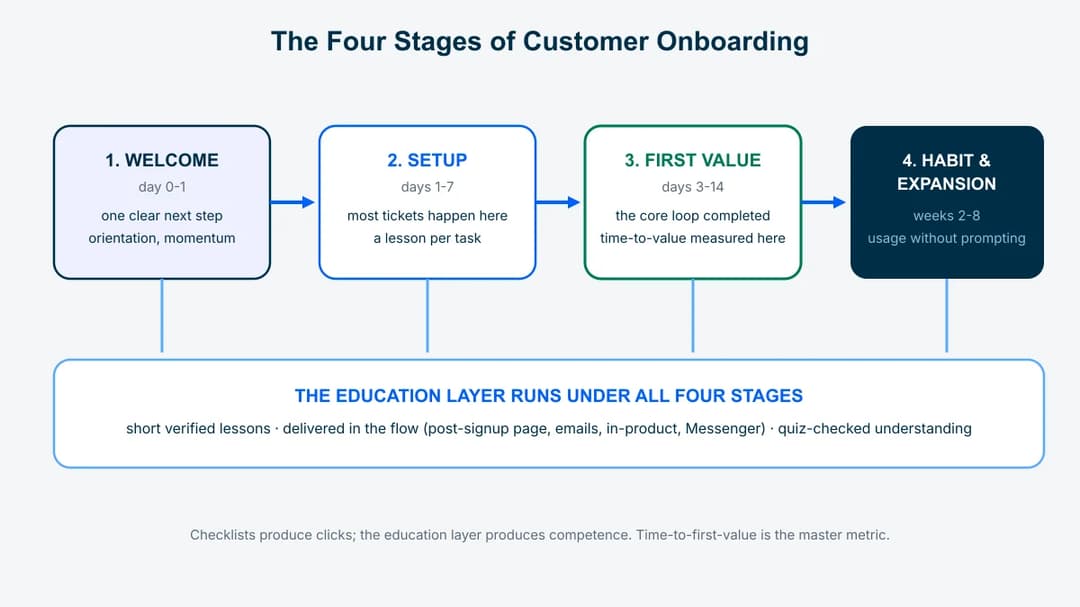
Stage 1: Welcome (day 0-1). The account exists; the goal is orientation and momentum. One clear next step beats five. The welcome email that says “do this one thing first” outperforms the feature parade.
Stage 2: Setup (days 1-7). Integrations connected, data imported, team invited. This stage generates the most support tickets of any onboarding phase, and nearly all of them are teachable: setup is where a five-minute lesson per task pays for itself immediately.
Stage 3: First value (days 3-14, product-dependent). The customer completes the core loop your product exists for: the first report shipped, the first campaign sent, the first course published. This is the moment time-to-first-value measures, and everything before it should be ruthlessly ordered toward reaching it.
Stage 4: Habit and expansion (weeks 2-8). Value repeats, the product enters the weekly routine, adjacent features get adopted. Onboarding does not end at first value; it ends when usage no longer needs prompting. Education here shifts from “how to start” to “how to get more”, which is where customer enablement takes over as the ongoing system.
Education-First Onboarding: Courses, Not Checklists
The standard onboarding stack leans on product tours: tooltip sequences that walk a new user through the interface. Tours are useful for orientation, and they share a ceiling with every checklist approach: they prove the customer clicked, not that the customer can.
Education-first onboarding treats the process as the customer’s first course. The differences are practical, not philosophical:
- Sequence over discovery. A course orders the ten things a new admin must understand; a tour reacts to whatever screen the user happens to open.
- Competence over completion. Each lesson ends with a short quiz. A customer who passes the setup module demonstrably understood it; verified understanding is the onboarding signal a tour cannot produce.
- Persistence over one-shot. Tours fire once and vanish. Courses wait, resume, and survive the customer who does onboarding in five sittings between meetings.
- Portability over UI-dependence. When the interface changes, tooltip anchors break silently. A lesson built from your docs updates in minutes.
When do tooltips stop being enough? The honest boundary: tours handle orientation (“where is the settings page”) and fail at capability (“how do I model my use case in this product”). If your setup-stage tickets are capability questions, the tour has hit its ceiling and the course is the fix. The two stacks coexist happily: tour for the first five minutes, course for the first two weeks.
Delivery decides whether any of this reaches the customer. Onboarding lessons belong where new customers already are: embedded on the post-signup page, in the onboarding email sequence, and in the support Messenger via the MCG App for Intercom, so the answer to a setup question arrives as a two-minute lesson instead of a doc link.
The 8-Step Customer Onboarding Process
A build you can run in a week, sized for a team without an onboarding department:
- Define first value precisely. One sentence: “The customer has succeeded when ___.” Everything else in the process serves this sentence.
- Map the current path. Walk a real signup from day zero. Note every step, every wait, and every point where customers currently ask for help.
- Tag the onboarding ticket classes. Pull 90 days of new-customer support tickets. The recurring setup and how-do-I questions are your curriculum, ranked by demand.
- Build the first-value course. Turn existing docs into a short lesson sequence that carries the customer from signup to the first-value moment, one five-minute lesson per step, each with a verification quiz. This is an afternoon with customer training software built for authoring from your own material.
- Place lessons in the flow. Post-signup page, welcome emails, in-product embeds, the support Messenger. No separate portal login; friction at this stage is measured in lost accounts.
- Assign an owner and an SLA. One named person owns onboarding, watches the dashboard weekly, and answers for time-to-first-value. Unowned onboarding decays into a stale email sequence.
- Instrument the metrics. Activation rate, time-to-first-value, course completion and pass rates, and the tagged ticket classes from step 3. Baselines first, then changes.
- Iterate on the drop-off. Every week, find the stage where most customers stall and fix that one thing: reorder a lesson, shorten a step, move a lesson closer to the moment of need.
Customer Onboarding Best Practices
The practices that consistently separate strong processes, beyond the build itself:
- One next step at a time. Choice is the enemy of momentum in week one. Every screen, email, and lesson ends with exactly one action.
- Segment by role from day zero. The admin configuring the account and the end user living in it need different first courses; a single generic path bores one and loses the other.
- Front-load the win, defer the tour. Reach first value before explaining advanced features. A customer with one win tolerates complexity; a customer with zero wins tolerates nothing.
- Make progress visible. Completed-lesson checkmarks, a progress bar, a completion certificate: visible progress is retention fuel during the weeks when value is still forming.
- Keep human touch for the moments that need it. Education scales the repetitive teaching; kickoff calls and check-ins spend human time where judgment matters. The mix shifts with your price point, but the teaching layer stays in both.
- Close the loop with support. New setup questions in the queue mean the curriculum has a gap; our ticket deflection playbook covers turning that loop into a system.
Measuring the Onboarding Process
Four numbers run the process; resist the rest.
- Time-to-first-value: median days from signup to the first-value event you defined in step 1. The master metric.
- Activation rate: share of new signups reaching first value within your window. The volume version of the same truth.
- Verified understanding: completion and quiz pass rates on the onboarding course, per lesson, so you can see exactly where customers stall or fail.
- Onboarding ticket classes: volume of the tagged setup questions. Falling classes prove the education works; rising ones point at the next lesson to build.
Cohort comparisons (onboarded-with-course versus before) carry selection effects; read them directionally and lean on before/after movement in the tagged classes. The full two-layer framework, including the selection-bias trap and the dashboard design, is in our customer education metrics guide.
Conclusion: Onboarding Is a Course You Have Not Built Yet
The customer onboarding process compresses to one design decision: checklist or curriculum. Checklists produce clicks and quiet churn; an education-first process produces verified competence, faster time-to-first-value, and a support queue that stops repeating itself. The stages are the same for everyone; the teaching layer is the difference.
Start with steps 1-4 this week: define first value, walk the path, tag the ticket classes, and turn your existing docs into the first-value course. The delivery and measurement mechanics are covered across our customer education guide and the SaaS customer training practices that pair with this playbook. The build takes days; the retention it protects compounds for the life of every account.
Frequently Asked Questions
What is customer onboarding?
Customer onboarding is the structured process that takes a new customer from signup to confident, habitual use of a product: welcome, setup, first value, and habit formation. Its master metric is time-to-first-value. In SaaS it is an education process at core; it differs from agency client onboarding (contracts and kickoffs) and banking onboarding (KYC checks).
How do you do customer onboarding?
Define first value in one sentence, map the real signup path, tag the recurring new-customer support questions, and build a short verified course that carries customers from signup to first value. Deliver lessons in the flow (post-signup page, emails, in-product, support Messenger), name an owner, instrument activation and time-to-first-value, and iterate weekly on the biggest drop-off.
How do you improve an existing customer onboarding process?
Find the stall, not the polish. Pull the funnel by stage, locate where most customers stop, and fix that single stage: usually by replacing a passive step (a doc link, a tour) with a short verified lesson delivered at that exact moment. Then watch the tagged setup-ticket classes; falling volume is the proof the fix landed.
What is the difference between customer onboarding and client onboarding?
In SaaS usage, customer onboarding gets end users to product value at scale, mostly through education and in-product experience. Client onboarding, in agencies and professional services, is an account-level process: contracts, kickoff meetings, expectations, and access. The terms get used interchangeably, but the playbooks barely overlap.
How long should customer onboarding take?
As long as reaching genuine first value takes, and no longer: days for simple products, two to four weeks for complex B2B platforms. The honest answer is a measurement, not a rule: track your median time-to-first-value, then work to compress it by removing steps and teaching the remaining ones better. Habit formation continues past first value, typically through week eight.