

Partner rosters are the most volatile learner population in software. Partners sign up in a wave, certify, go quiet for two quarters, then reappear when you ship something. Nobody tells you when they stop.
Every platform in this guide is priced on a headcount. So the question that decides your bill isn’t which features you get. It’s what the vendor counts: a person who logged in, a person who enrolled, or an account that merely exists.
We put that question to all ten. The answers come from their pricing pages, master agreements and, in one case, a cloud marketplace listing, because that vendor publishes nothing on its own site.
The answers are further apart than any feature comparison would suggest.
Nine of the ten publish no price at all. One contract states that fees are owed “whether or not applicable licenses are actively used”. One meters monthly active users and has a published entry point of roughly $41,590 a year. And the category’s default name publishes a page titled pricing that contains no price.
Build partner courses with Mini Course Generator – turn your product docs into partner training, no portal login required.
What Is Partner Training Software?
Partner training software is a partner training LMS: a learning platform built to onboard, educate and certify people who work for other companies, such as resellers, distributors, implementation partners and affiliates.
Four things separate it from an employee LMS, and each one shows up on the invoice:
- The learners are external, so they need their own portal, their own identity, and often their own branding.
- The roster churns, so any meter based on accounts-that-exist overcharges you within a year.
- Partners often sit in tiers, and training is what moves them between tiers, so completion data has to reach whatever system holds the tier. That is an integration requirement, not a reporting one.
- Certification usually expires, so recertification is a first-class requirement rather than a nice-to-have.
Still deciding whether you need this at all, or whether your problem is commercial rather than educational? Start with our guide to partner enablement. It covers the boundary between this category and partner relationship management.
The One Question That Decides Your Bill
Three meters exist in this market, and vendors rarely make it obvious which one you are buying.
Registered or provisioned users. You pay for every account that exists, whether or not anyone logs in. For a partner roster that’s the worst case: dormant partners bill exactly like active ones.
Active users. You pay for people who actually consumed training in a period, monthly or yearly. That’s the best structural fit for a channel, and it’s what you should push for.
Undisclosed. The vendor publishes no meter at all, so the definition lands in the order form. More platforms sit here than in either of the other two.
Here is what all ten actually meter, from their own pages and contracts:
| Platform | What it meters | Price published? | Entry reality |
|---|---|---|---|
| Mini Course Generator | Plan-based | Yes | Self-serve, 14-day trial |
| TalentLMS | User band | Yes | $119/mo for 1-40 users |
| AcademyOcean | Per learner, undefined | Yes | $200/mo billed annually, 50 learners |
| Skilljar | Active users, defined | No | Quote only |
| Intellum | Monthly active users | Marketplace only | ~$41,590/yr, 36 months |
| Docebo | MAU, YAU or RAU | No | Stated fit bar: 250+ learners |
| Thought Industries | Not disclosed | No | Quote only |
| CYPHER Learning | Provisioned licences | No | Quote only |
| LearnUpon | Not disclosed | No | 100-user floor, stated |
| Litmos | Per user licence | No | Quote only |
Three of ten publish a price. One of ten defines its own meter in plain language. That is the state of this category.
The 10 Best Partner Training Software Platforms
Ordered by how well the commercial model fits a channel, not by feature count, because features are where these platforms agree and pricing is where they diverge.
Our methodology. Every price, limit and contract term below comes from the vendor’s own page or published agreement, quoted verbatim or reported as absent, and was checked in August 2026. Where a vendor’s pages contradict each other, we say so.
Our disclosure. Mini Course Generator is our product. It is listed first because it is the only platform here you can buy and start using this afternoon, and its limitations for a large channel programme are stated in full below.
1. Mini Course Generator: The One You Can Buy This Afternoon
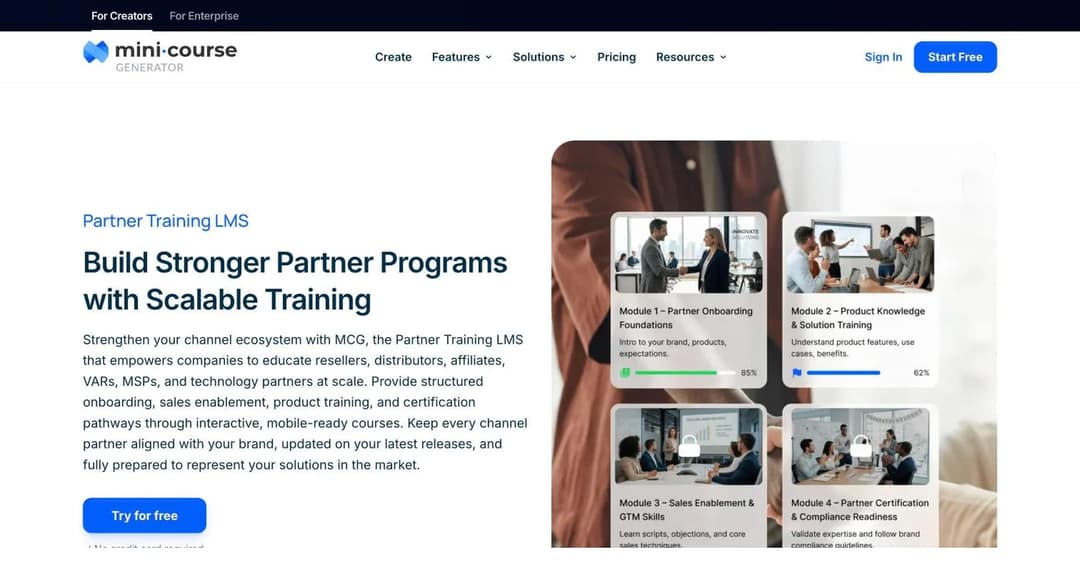
The gap this fills is specific. Partner training that gets consumed is short, current, and delivered without friction.
Meanwhile the training a partner most needs is the thing that changed last week. That’s exactly the training a heavyweight platform is slowest to produce.
Mini Course Generator turns a product document, a release note or a set of positioning points into an interactive mini course. You send it as a link the same day. Partners don’t create an account, don’t learn a portal, and can finish on a phone between meetings. The Agent Skills library covers the interactive formats, including branching scenarios for objection handling and adaptive quizzes for certification checks, and delivery works by link, embed or QR code.
Content exports as SCORM, which matters more in this category than most. Large partners often insist on running your training inside their own LMS. SCORM is how that happens without rebuilding anything.
Best for: vendors with a small or growing partner roster, product training that changes every release, and no appetite for a three-year contract before they know whether partners will engage.
What it is not:
- Not a PRM. No deal registration, no lead distribution, no commissions, no co-marketing funds.
- No partner portal or partner tiering as a commercial object.
- No multi-tenant branded academies per partner or region.
- No certification expiry automation. You can certify; recertification cycles are manual.
- No free plan, just a 14-day trial with no credit card. Figures are on the pricing page.
2. TalentLMS: The Cheapest Published Price in the Category
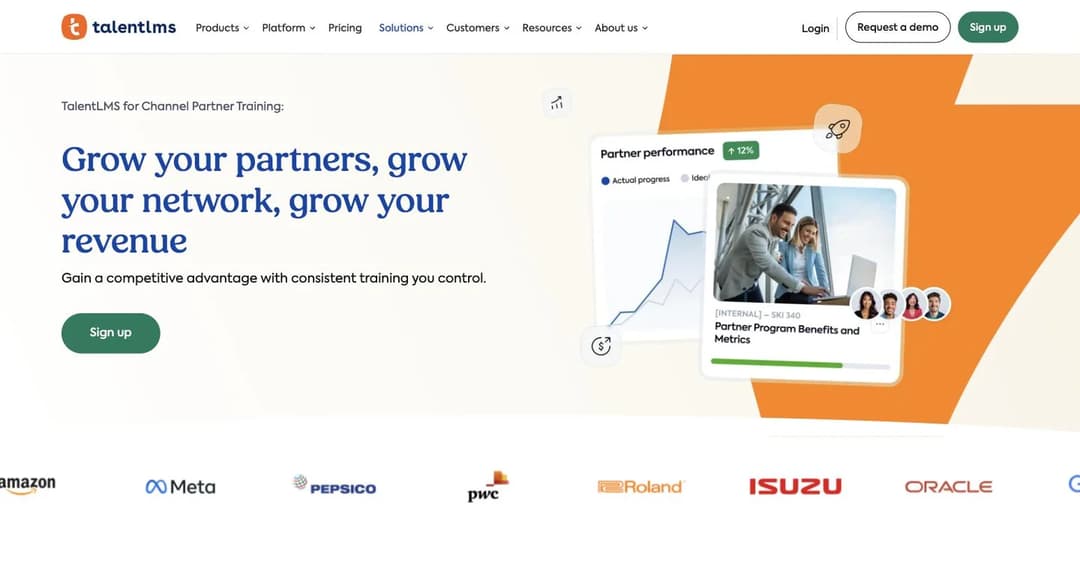
TalentLMS is the only conventional LMS here that publishes a price you can act on without a sales call, and it is the cheapest entry in this guide: $119 a month billed yearly for 1 to 40 users, which is $1,428 a year. Billed monthly it is $149. It also has a permanent free plan, capped at 5 users and 10 courses. That’s enough to build and test a partner onboarding course before you commit.
Channel partner training is a named use case for TalentLMS, and it’s one of the first names you’ll meet in this category, mostly on the strength of the company’s reach.
Watch two things. Seats are named users, so a churning roster bills at full price whether or not partners log in. And branches, which is how you give partners a separate portal, are tier-limited: 1 on Core, 3 on Grow, 15 on Pro.
Best for: a partner programme under 100 people that wants a conventional LMS, a published price, and a free tier to prototype in. Our small business LMS guide covers the same platform for internal use.
3. AcademyOcean: A Real Published Ladder
AcademyOcean publishes something almost nobody else in this guide does: a full price ladder for partner training, on the partner page itself. The entry point is $200 a month billed annually for 50 learners, which works out at $4.00 per learner per month or $2,400 a year. Monthly billing starts at $250, and the ladder runs $375 at 100 learners, $450 at 150, $500 at 200 and $550 at 300 or more.
Multi-academy support is genuine, and that’s what a tiered channel needs: a separate branded portal per partner, franchise or region. Named partner references include Loxone, which the vendor says trains over 10,000 partners, and Ajax Systems across more than 100 countries.
Two things to check:
- The tier that matters is not the entry tier. Multiple training portals, API, webhooks and SAML all start at Professional, which begins at $500 a month. SSO sits higher again, in Enterprise, which publishes no price.
- The meter is undefined. The pricing calculator says “per learner” and AcademyOcean does not define what makes a learner billable, or whether removing a departed partner frees the slot. Get that in writing.
Best for: mid-sized channel programmes that want per-portal branding and a price they can model before talking to sales.
4. Skilljar: The Clearest Meter in the Market
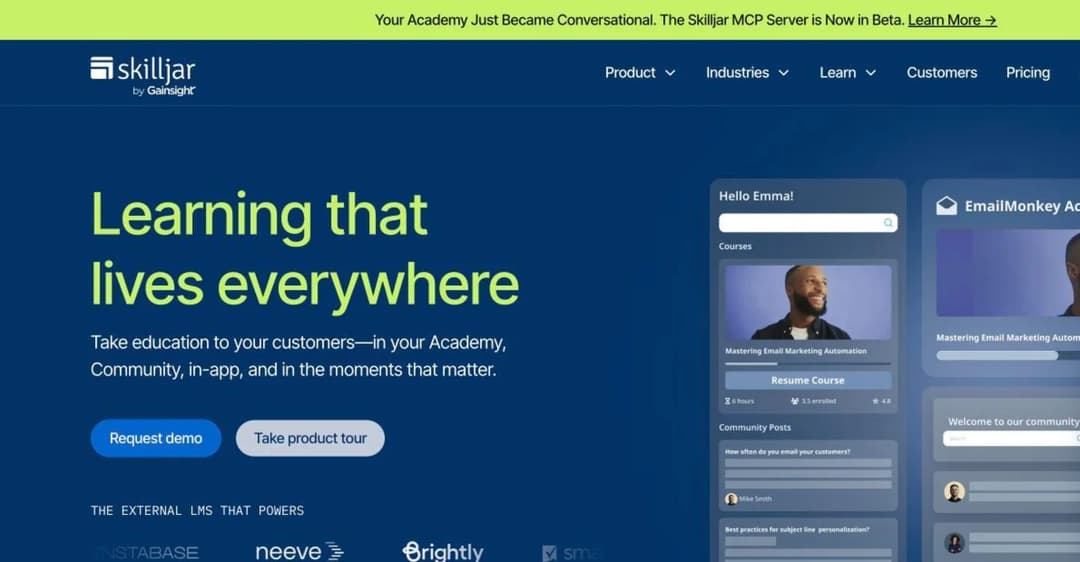
Now branded Skilljar by Gainsight, this is an external-first platform: customers and partners are the default audience rather than an extended-enterprise module bolted onto an employee system.
It also has the best-explained pricing model here, and it’s the right one for a channel. Every tier lists “Unlimited Seats and Courses”. Billing runs instead on “an active user fee based on the number of active users taking lessons in your Academy in one year”. Skilljar then does what nobody else does: it defines the term. “An active user is someone who consumes or interacts with a lesson”, counted “once per month, even if they log in and consume content multiple times”, against a yearly allocation.
For a roster where most people are dormant most of the year, that’s a very different bill from a per-seat vendor.
The catches:
- No price at any tier. All three read “Let’s talk pricing”. The only figures Skilljar publishes anywhere are add-ons: Content Syndication at $10k, a Data Connector starting at $25k, and language packs starting at $10k for 5 languages.
- Academy sites are hard-capped: 1 on Essentials, 2 on Professional, 3 on Enterprise. There is no unlimited-portal option at any tier, which is a real constraint for a tiered global channel.
- Professional is the practical floor for partner training, because Essentials has one academy site, standard integrations only, and no delegated partner administration.
- The definition is marketing, not contract. Skilljar’s subscription agreement contains no definition of an active user and defers to the order form. Get it written in.
An undefined meter that defers to the order form is the question worth putting to every vendor on this shelf, and the Skilljar alternatives comparison puts it to each of them.
Best for: software vendors running customer education and partner education together, with a large roster where only a fraction trains each year.
5. Intellum: Monthly Active Users, at an Enterprise Price
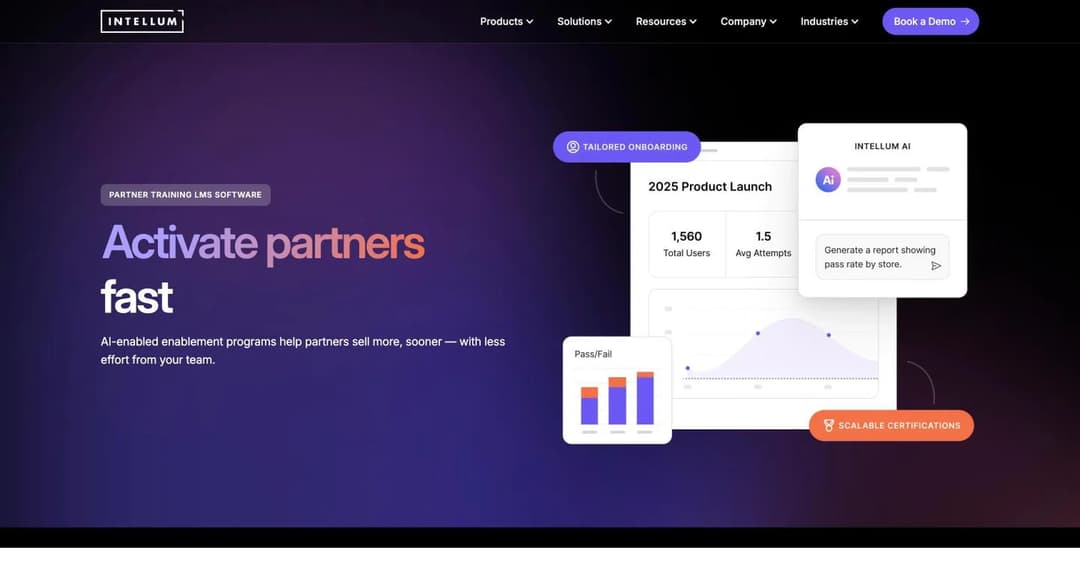
Intellum has the best structural fit in this guide and the highest floor, which is an unusual combination.
The meter is monthly active users. A partner who certifies in Q1 and goes quiet in Q3 stops consuming the meter. Growth is absorbed at a metered rate rather than forcing a seat-block upgrade. Multi-tenancy is the strongest published claim here, with “Organizations” giving each audience “its own branded subdomain, permissions, and access”. Recertification is genuinely automated: expiration tracking, reminders and re-enrolment, with proctoring through Honorlock and badges through Credly.
The price is the problem, and it is only published in one place. Intellum publishes no price on its own site. The numbers exist on its AWS Marketplace listing: $124,771 for 500 monthly active users on a 36-month agreement, billed annually in advance, which is roughly $41,590 a year. Marketplace terms state all fees are “non-refundable and non-cancellable except as required by law”, and only 36-month options are published.
Also note: Intellum never defines “active” either. And its platform terms license “Client’s authorized employees or as specifically contracted for Client’s third-party audience”, so external partner licensing is a contract question rather than a default.
Where third-party licensing is the blocker rather than the feature list, the Intellum alternatives comparison covers which platforms put their terms somewhere you can read them first.
Best for: enterprises with thousands of partners plus customers, a Salesforce-centred stack, and the ability to commit to three years.
6. Docebo: The Default Name, and the Contradiction
Docebo is the default name in partner training, and it is a genuinely capable platform. Its partner answers are among the most concrete here:
- Multi-domain portals with “different administrative rights and distinct branding elements”.
- “Completely separate authentication processes for different user groups”, through the Extended Enterprise Module.
- A Certification and Retraining app with configurable expiration policies.
- Monetisation through Shopify, Stripe and PayPal.
- More than 50 languages.
Then read the pricing page, and the two pages disagree.
The partner-training page promises that “Docebo’s pricing model is based on active users rather than registered users… This ensures you only pay for users who are actually consuming training.” The pricing page reveals that monthly activity is one of three options: “Monthly Active Users (MAU), Yearly Active Users (YAU), and Registered Active Users (RAU)”. RAU isn’t activity-based. Which model you get is a contract variable, so the promise on the partner page only holds if you negotiate for it.
The rest of the commercial picture:
- No price anywhere. The only currency figures on the pricing page are customer case-study savings.
- A stated fit bar, not a minimum: “Typically, Docebo is best suited for companies who are: Training at least 250+ learners, which can represent a combination of customers, partners and employees.” The partner page separately describes tiers “starting at 250 active users”.
- Extended Enterprise is a paid add-on on the entry Elevate tier, and it is the module that delivers multi-domain portals and split SSO. On Enterprise the entitlement is capped at 10 domains.
- Integrations are metered too: “Integration of up to 6 tools” on Enterprise.
- The published contract norm is three to five years, with no free plan and no trial.
- No CRM or PRM is named in Docebo’s partner-training or pricing material.
Three to five years with no trial is a long commitment for a channel program you haven’t tested, and the Docebo alternatives comparison reads the renewal and exit clauses across the rest of the field.
Best for: enterprises running employees, customers and partners on one platform, where the channel is large and stable enough to absorb a multi-year custom contract.
7. Thought Industries: Built External-First, Priced in the Dark
Thought Industries is external-first by design, which shows in the product. Its Panorama multi-tenancy lets each partner tier or region be a genuine tenant rather than a skinned portal, and each tenant can be a commercial licensee. Monetisation is the strongest here, with four named gateways: Stripe, Worldpay, Cybersource and Chase Paymentech. Salesforce integration is included at all three tiers, which is unusually generous.
The commercial opacity is total. Three tiers, no price at any of them, and no statement of what is metered, whether by user, learner, active user, registered user or seat. The only licence-count statement Thought Industries publishes is “Unlimited Administrator Licenses”, which meters admins rather than partners. No master subscription agreement or order-form terms are published.
And the entry tier cannot execute the vendor’s own pitch: the eCommerce Engine is excluded from Starter, so the paid-partner-certification story it markets requires at least Professional.
Paid partner certification is the feature most likely to sit a tier above the quote you were given, and the Thought Industries alternatives comparison reads what each competitor puts in writing about its own tiers.
Best for: technology vendors with hundreds to tens of thousands of partner sellers, running certification as a revenue line rather than a cost centre.
8. CYPHER Learning: Read Section 4.2 Before You Sign
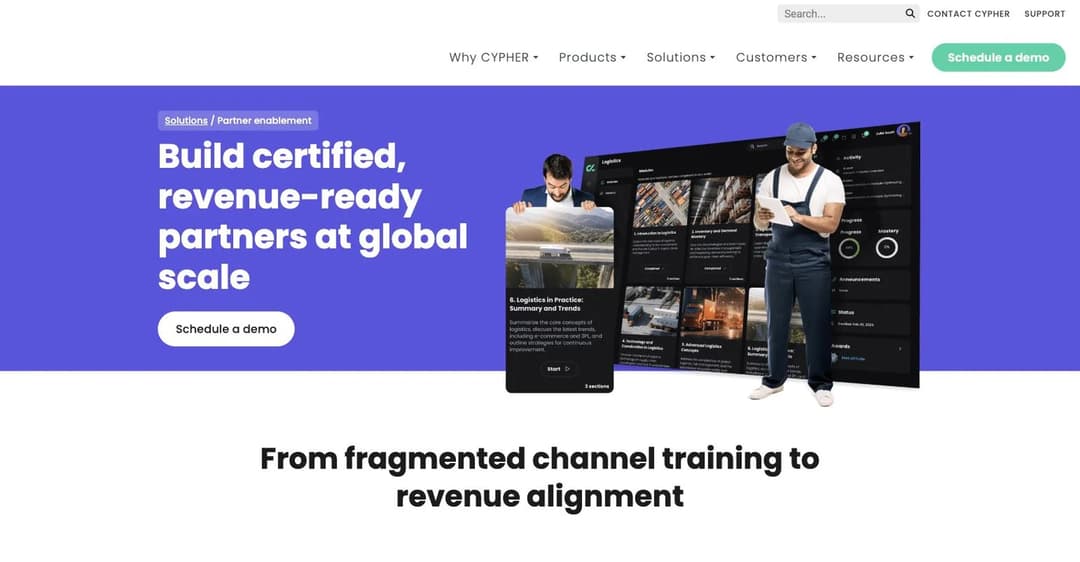
CYPHER Learning writes its partner features in channel language, which is rare and useful: named certification tiers of Authorized, Silver, Gold and Elite, role-based paths for Sales, Technical and Support, automated renewals and compliance expirations, and organisation-level analytics by partner or region. Commerce is genuinely global, with nine named gateways including PayU Latam, Conekta, Telr and YooMoney. White-labelling is total, with “no vendor references” remaining.
Then read the master agreement, because it contains the worst meter in this guide for a channel.
An authorised user is defined by the issuance of a username and password, not by any activity. And section 4.2 states that “all Fees are non-cancellable, non-refundable, and payable, regardless of Customer’s actual usage of the Services”, owed “whether or not applicable licenses are actively used”. A further clause requires a top-up order form within 30 days if you exceed your count.
In plain terms: every partner you ever provision keeps billing, and licences ratchet up but never down. The contract says so explicitly. For a workforce that churns by design, that’s the wrong shape.
Also: everything that makes CYPHER worth choosing, including multi-tenancy, sits in the Enterprise tier, and no price, trial or floor is published anywhere.
Best for: mid-size to enterprise channel programmes serving several audiences under separate brands and separate identity providers, with a legal team able to renegotiate the metering clause.
9. LearnUpon: Tells You Not to Buy
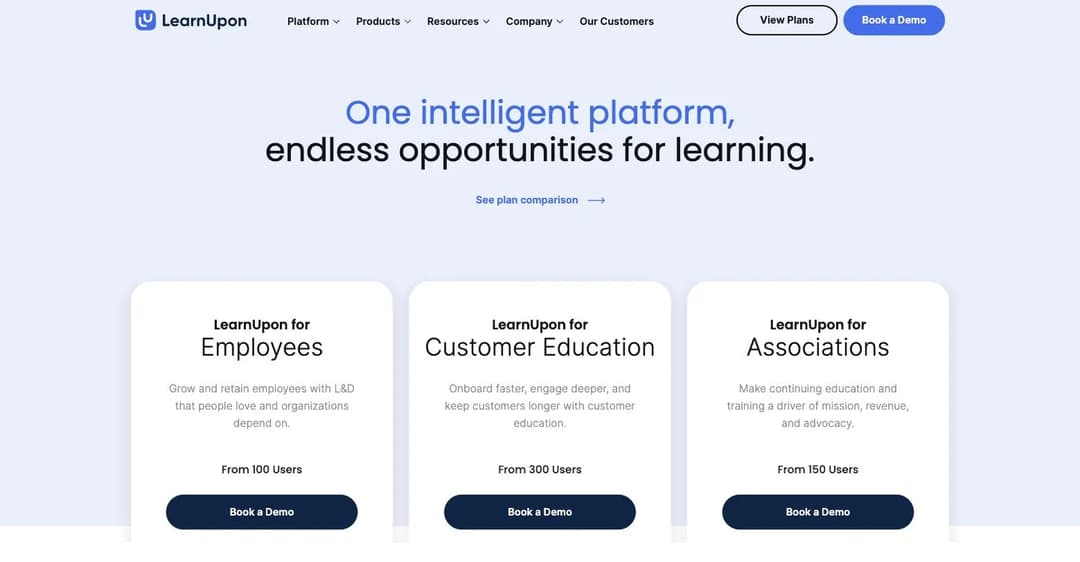
LearnUpon publishes no price, only seat floors: LearnUpon for Employees from 100 users, for Associations from 150, and for Customer Education from 300.
LearnUpon is unusually honest about who it’s not for. Its pricing FAQ states outright: “LearnUpon will not be a fit for companies looking for a solution for less than 100 users, an on-premise solution, or those requiring HIPAA compliance… K-12 and higher education organizations training student audiences are also not ideal for LearnUpon.”
That one sentence disqualifies most emerging partner programmes before anyone wastes a month in procurement. More vendors should write it.
On partners specifically: LearnUpon sells three audience-shaped products and partners are not one of them. Partner training falls under Customer Education, whose floor is 300 users.
Three hundred users is a hard floor for a channel program that starts with a dozen partners, and the LearnUpon alternatives comparison lists who sells below it.
Best for: established programmes above 300 partners that also run customer education.
10. Litmos: Fast to Deploy, Opaque to Price
Litmos sells speed, and for partner training that is a genuine argument: most customers are described as live within days rather than months, without IT involvement. Its content catalogue is large and its provenance traceable, and external audiences including partners are a marketed use case.
The commercial terms are the issue. All tiers read “Contact for Pricing”, and the published terms are tight:
- Subscriptions auto-renew for a year unless cancelled 90 days out.
- Payment obligations are non-cancellable.
- Quantities can’t be decreased mid-term.
- Excess users are billed at 1.5 times the per-user rate if no excess rate is written into the order.
For a roster that grows unpredictably, that overage multiplier is the clause to negotiate first.
Best for: mid-market vendors that need a partner academy live this quarter and can take a sales call.
The Category Next Door: PRM
If you went looking for partner training software and came across PartnerStack, Impartner, Channeltivity or ZINFI, you found a different category. Partner relationship management handles deal registration, lead distribution, co-marketing funds and commissions. No LMS does any of that.
But the training half of the boundary has moved. You might expect PRM “partner training” to mean a shelf for PDFs. It doesn’t.
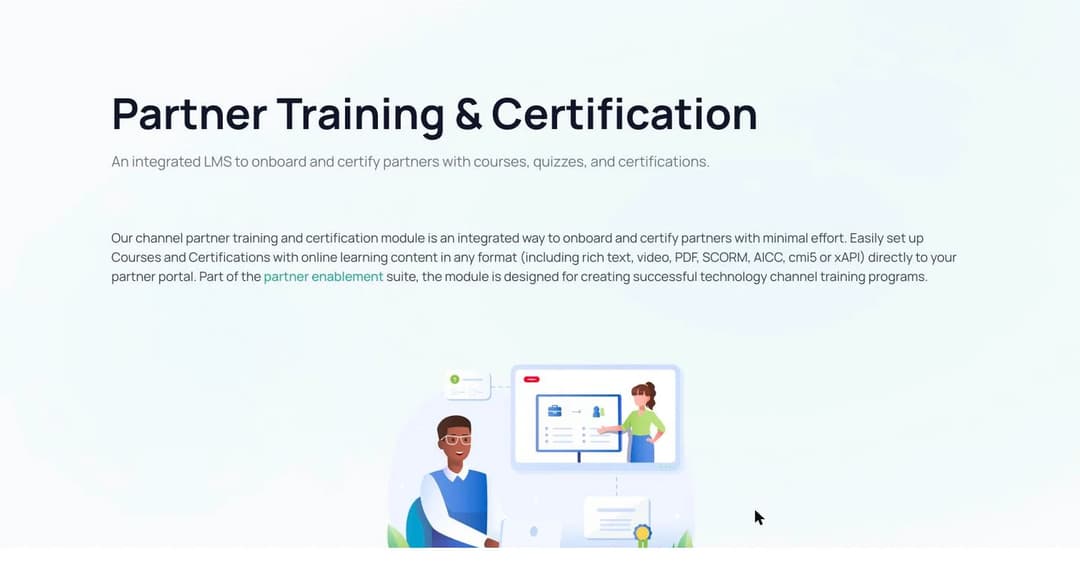
Channeltivity describes its module in its own words as “An integrated LMS to onboard and certify partners with courses, quizzes, and certifications“, accepting content “in any format (including rich text, video, PDF, SCORM, AICC, cmi5 or xAPI)”. Impartner publishes course and lesson authoring, quizzes, certification programmes with auto-expiry rules, and SCORM support.
PartnerStack, now an AppDirect company following its April 2026 acquisition, calls its module a “built-in learning management system (LMS)” that creates “interactive, media-rich courses” and tracks “course completion for all partner types”.
There’s still a depth gradient, and it’s the useful part:
- Channeltivity ingests four learning standards.
- Impartner does SCORM plus credential expiry.
- PartnerStack does completion events only. No SCORM, no pass mark, no retake policy, no certificate expiry.
So the honest decision rule:
- Buy PRM if your load-bearing problem is commercial, and check whether its training module is already enough before adding a second system.
- Buy an LMS if you need assessment depth, credentials that survive an audit, or the same content serving partners and customers and employees.
- Check the tier either way. PRM training modules are typically gated above the entry plan.
Neither category publishes prices. Impartner sends you to a quote form. Channeltivity’s pricing page carries no figure. PartnerStack publishes three tier names and no numbers.
How to Choose
What should a partner training platform cost?
Nobody can tell you, and that’s the finding. Three of ten publish a price:
- TalentLMS: $1,428 a year for up to 40 users.
- AcademyOcean: $2,400 a year for 50 learners.
- Intellum: roughly $41,590 a year for 500 monthly active users, on a three-year term.
Everything else is a quote.
Model your own cost from the meter rather than the sticker. A 200-partner roster where 40 train each quarter costs wildly different amounts under active-user billing than under provisioned licences. Run the arithmetic both ways before you shortlist, because it will reorder your list more than any feature comparison does. Our LMS pricing guide covers the wider market.
Do I need a separate portal for each partner?
Only if partners must not see each other, or if tiers get genuinely different content and branding. It is the most commonly oversold requirement in this category and it is expensive: multi-tenancy is an upper-tier feature almost everywhere, capped at three academies on Skilljar and ten domains on Docebo. On Docebo it also arrives bundled with the Extended Enterprise Module. On the entry tier that module is a paid add-on, so a portal requirement quietly moves you up a tier and then adds a line item.
If your partners all see broadly the same product training, one portal with role-based paths is cheaper and simpler.
How do I stop paying for partners who left?
Ask two questions in writing before you sign, and get the answers into the order form:
- What makes a partner billable? A login, an enrolment, or an account that exists.
- What happens when a partner goes dormant or leaves? Does the licence free up, and does deactivating them destroy their completion history.
Push for active-user billing. Skilljar and Intellum both offer it and Docebo will if you negotiate for MAU or YAU rather than RAU.
The second question is the one people forget. Some platforms count archived accounts, and some destroy a partner’s completion history when you deactivate them, which is the worst of both outcomes: you stop paying for the seat and lose the evidence that they were ever certified.
Should partner training live in my LMS or my partners’ LMS?
Both, usually. Large partners frequently insist on running your content inside their own system, and small ones want a link. SCORM export handles the first case and a shareable link handles the second, which is why portability matters more here than in employee training.
Want training to appear inside a product or portal partners already use? That’s a headless delivery question, not an LMS-selection one. Embedding usually beats sending partners to yet another login.
What about certification expiry?
This is where partner programmes quietly rot. The platform issues a badge, nobody renews it, and two years later your certified-partner count is fiction.
Automated recertification is real on Intellum, Docebo, CYPHER and Impartner. It’s manual or absent on most of the rest, including ours. If your tier benefits depend on current certification, make this a shortlist criterion rather than a nice-to-have. The same discipline applies to customer academies, covered in our customer education guide.
Can I charge partners for training?
Yes, on most of these, and it is a genuine revenue line for some vendors. Thought Industries names four payment gateways, CYPHER names nine, Docebo integrates Shopify, Stripe and PayPal, and Intellum supports Stripe.
Check the tier. Thought Industries excludes its eCommerce Engine from the Starter plan, which means the entry tier cannot execute the monetisation story the vendor markets.
The Bottom Line
This category sells on features and bills on headcount. The headcount question is the one nobody puts on a comparison chart.
If your roster is small or unproven, buy something you can start today and leave in a year: TalentLMS if you want a conventional LMS with a published price, AcademyOcean if you need per-partner portals early, Mini Course Generator if your training is product knowledge that changes constantly.
If your roster is large and mostly dormant, the meter is worth more than any feature. Push for active users. And read what the contract says rather than what the solutions page promises.
And if the real problem turns out to be deal registration rather than education, buy a PRM, not an LMS. Our partner enablement guide covers how to tell the difference.
A disclosure to close on: Mini Course Generator is ours, it isn’t a PRM, and it won’t run a tiered global certification programme. What it does is the part that changes every release. You can start free for 14 days with no credit card, and the plans are on the pricing page linked above.
Sources
Every price, limit and contract term above was read from the vendor’s own page or published agreement on 27 August 2026.
- Published prices quoted verbatim: TalentLMS pricing page; AcademyOcean pricing page and partner-training calculator; Skilljar add-on pricing; Intellum’s AWS Marketplace listing, the only place Intellum publishes a figure.
- Contract terms quoted with section references: CYPHER Learning Master Services Agreement §1.4 and §4.2; Litmos Cloud Terms of Service; Intellum Platform Terms of Service and AWS Marketplace refund policy; Skilljar Service Subscription Agreement.
- Metering language quoted from vendor pricing pages: Skilljar’s active-user definition; Docebo’s three user models (MAU, YAU, RAU) and the conflicting promise on its partner-training page; Docebo’s fit-bar FAQ.
- PRM training claims quoted from vendor product pages: Channeltivity partner training and certification; Impartner partner training and certification; PartnerStack platform activation page and its April 2026 AppDirect acquisition announcement.
Prices, tiers and contract terms change. Everything above was accurate on 27 August 2026, and anything that matters to your decision should be confirmed in writing before you sign.