

Partner enablement has a definition problem, and it’s expensive.
Ask five people what it means and you will get a marketing function, a training programme, a software category, and two arguments. That isn’t pedantry. Each confusion sends somebody to buy the wrong thing.
The clearest evidence is who answers the question. Nearly half of the published definitions of partner enablement come from partner relationship management vendors, answering what is usually a training question. A sales enablement platform offers another definition. A learning platform offers a third. Nobody can separate these categories cleanly, because the market does not separate them either.
So this guide does one job: it draws the three boundaries partner enablement keeps getting confused with, using what the vendors actually publish rather than what the category says about itself. Along the way it retires the statistic everyone in this category repeats, because it doesn’t hold up.
Build partner training with Mini Course Generator – turn your product docs into partner courses without a portal login.
What Is Partner Enablement?
Partner enablement is the practice of giving the companies who sell, implement, or support your product everything they need to do it well: the product knowledge, the sales messaging, the technical skills, and the credentials that prove they have them.
It differs from training your own staff in three ways that decide almost every practical question:
- You do not employ the learners. You can’t mandate attendance. You can’t put it in a performance review. And you can’t assume anyone will finish anything.
- Your product is not their only product. A reseller may carry twenty vendors. Attention is the scarce resource, not information.
- The roster churns constantly. Partners sign up, certify, go quiet, and lapse, often without telling you.
A partner training LMS is the delivery layer underneath that work. But enablement is broader than the platform, and that’s where the confusion starts.
Boundary 1: Partner Enablement Is Not Sales Enablement
This is the boundary the market argues about most, and the argument is still live among practitioners.
The mechanics that actually differ:
Your reps will absorb nuance. Your partners will not. An internal seller can be handed a positioning document that’s still evolving, and will fill the gaps from hallway conversation. A partner rep can’t. Messaging has to arrive finished, because there is no hallway.
Internal enablement can go deep. Partner enablement has to go narrow. The practitioner consensus here is that partners need “just enough” information: the two or three plays that win, not the full catalogue. Depth is a cost you are asking someone else’s employee to pay.
Feedback runs one way. You can ask your own reps what is landing. Getting the same signal out of a partner organisation is slow and indirect. It also runs through a relationship someone is managing commercially.
The measurement is different. Sales enablement measures ramp and quota attainment. Partner enablement measures activation: what share of recruited partners ever transacted at all.
Where they genuinely overlap is content. Both need messaging, objection handling, and demo skill, and building that twice is waste. If you already run sales enablement, our sales training LMS guide covers the platform side of that motion, and the LMS for sales training page covers what building that content looks like in practice.
Boundary 2: Partner Enablement Is Not Partner Training
This one is rarely stated, even though buyers ask it: Docebo, for one, answers “What is the difference between channel partner training and partner training?” on its own partner training page, which is a smaller version of the same question. If Docebo is the platform you’re weighing for partner work, the Docebo comparison puts it beside the other platforms in that field.
The distinction that matters commercially:
Partner training is the courses. Product education, certification paths, technical enablement, the onboarding curriculum. It is a deliverable, it has a platform, and it has a budget line.
Partner enablement is everything that makes the training get used. Recruitment and tiering, the incentive that makes certification worth a partner’s time, the co-selling material, the deal support, the partner manager who notices when a partner goes quiet.
The practical test: if you bought a platform and nothing changed, you bought training and skipped enablement. That’s the most common failure in this category, and it isn’t a software problem. Partners do not complete courses because a course exists. They complete courses when completing them unlocks something: a tier, a margin point, a lead, a co-marketing budget, a listing.
There is also a vocabulary trap worth naming. “Channel partner training” is narrower than “partner training”. Channel partners are the ones in your sales channel: resellers, distributors, affiliates, VARs. Partner training covers those plus technology, implementation and service partners. They may never sell anything, and they still need to know how your product works.
Boundary 3: PRM Is Not an LMS (But the Line Moved)
This is the boundary that costs the most money, and the one most definitions get wrong.
Nearly half of the definitions of “partner enablement” in circulation come from PRM vendors. Even Salesforce frames its own “What is Partner Enablement?” explainer as a partner relationship management topic.
What PRM does that no LMS does. Deal registration, which is the defining PRM function: a partner declares an opportunity and gets protected margin on it. Plus lead distribution, market development and co-op funds, commission and payout tracking, partner tiering as a commercial object, and the partner portal as a business system rather than a course catalogue.
What an LMS does that PRM does not. Deep assessment, structured learning paths, multi-audience delivery where the same content serves partners and customers and employees, and credentialing that survives an audit.
And here is where a common assumption is wrong. It’s easy to assume PRM “partner training” means a shelf for PDFs. On the vendors’ own pages, that’s no longer true.
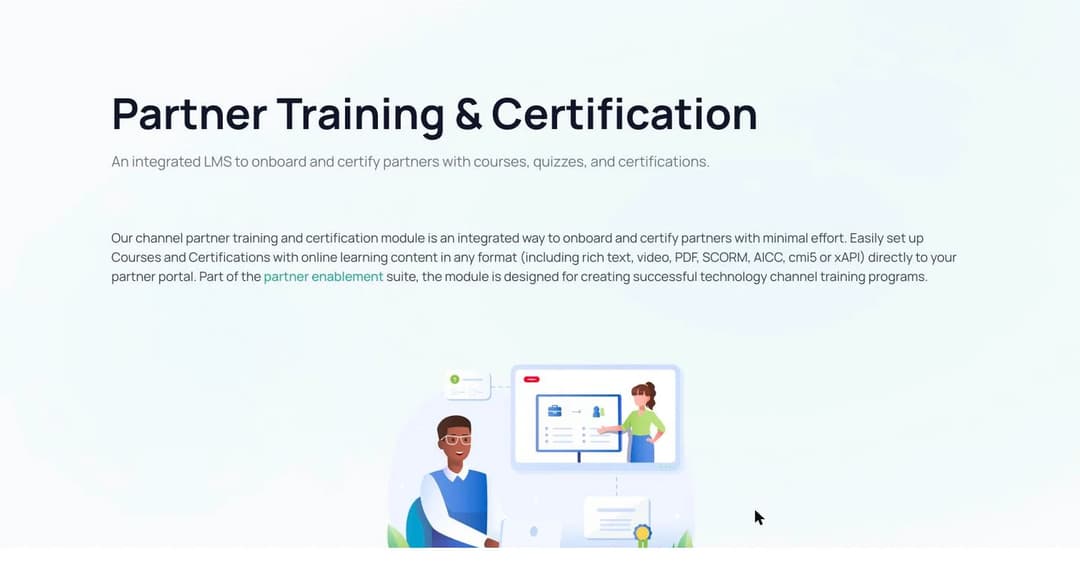
Channeltivity, a PRM, describes its training module in its own words as “An integrated LMS to onboard and certify partners with courses, quizzes, and certifications“, and states it accepts learning content “in any format (including rich text, video, PDF, SCORM, AICC, cmi5 or xAPI)”. That’s a real standards-compliant delivery engine, not a document library. Impartner, another PRM, publishes course and lesson authoring, quizzes, certification programmes with auto-expiry rules, and SCORM support.
So the honest version of this boundary isn’t “PRM can’t train partners.” It’s this:
| PRM | LMS | |
|---|---|---|
| Deal registration, leads, funds, commissions | Yes | No |
| Partner tiering as a commercial object | Yes | Rarely |
| Course delivery and completion tracking | Yes, on several | Yes |
| SCORM and standards ingestion | Yes, on several | Yes |
| Certification with expiry | Yes, on several | Yes |
| Deep assessment and learning design | Limited | Yes |
| Same content to partners, customers and employees | No | Yes |
| Published price | Almost never | Almost never |
The decision rule that follows. If your load-bearing problem is commercial (registering deals, routing leads, paying commissions), buy PRM, and its built-in training may genuinely be enough. If your load-bearing problem is educational (assessment depth, several audiences, credentials that must hold up), buy an LMS. Buying a full partner revenue platform to get quizzes and certificates is paying for the wrong ninety percent. Impartner’s training module sits above its entry tier anyway.
Two traps to note. First, the PRM training modules are usually gated to upper tiers, so the demo you saw may not be in the plan you are quoted. Second, neither category publishes prices: Impartner routes you to a quote form, and Channeltivity’s pricing page carries no figure at all.
If you already own one and need the other to talk to it, the practical question is data flow rather than category, and our LMS integration guide covers what to ask for.
The Numbers Everyone Repeats, and Where They Come From
Partner content has an unusually bad relationship with evidence. Take the three statistics that appear most often in this category and follow each one back to its source. All three fail. How they fail is more useful than a number would have been.
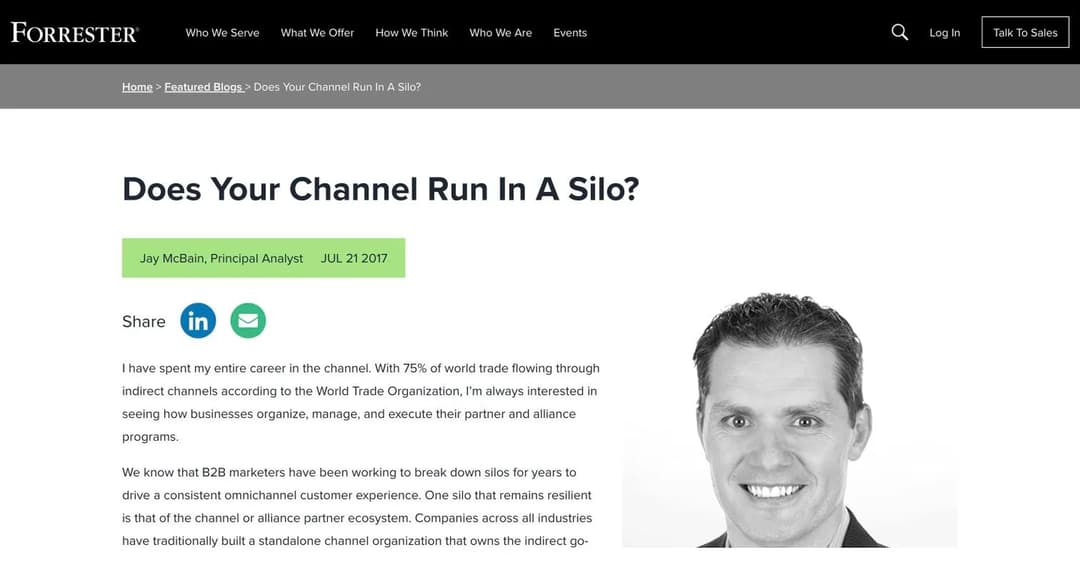
“75% of world trade flows through indirect channels.” This is the number that opens half the decks in this category. It traces to a single Forrester blog post published on 21 July 2017, where the sentence reads: “With 75% of world trade flowing through indirect channels according to the World Trade Organization, I’m always interested in seeing how businesses organize, manage, and execute their partner and alliance programs.”
There is no link behind that attribution. No footnote, no report number, no WTO publication is named. And the WTO does not measure this: its statistics cover merchandise and commercial services trade broken down by economy, sector and time period, not by distribution channel. A marketing blog claim borrowed an intergovernmental body’s authority by having its name typed next to it. Nine years later the number is still circulating. We do not use it, and neither should anyone else.
“Partner certification drives partner revenue.” There is no published, dated, methodologically described study testing this, independent or vendor-funded. The closest defensible fact is structural rather than correlational: Microsoft’s Solutions Partner programme requires a partner capability score of at least 70 points across performance, skilling and customer success, with every metric above zero. But Microsoft’s own public scoring table redacts the weights, printing literal “xx” placeholders in the maximum-points column for certifications. The operator of the largest certification-linked partner programme in the industry won’t say how much certification counts.
“Most partners never sell anything.” The nearest measurable figure is PartnerStack’s own chart showing 43% of Network-approved partners earn commissions against 3% of non-Network partners. It is stamped May 2024, publishes no sample size, no denominator, and no observation window, and the favourable half of the comparison measures partners inside the gated network PartnerStack sells. It’s a sales argument, not research, and we label it as one.
The useful conclusion is not that partner programmes fail. It’s that this category asks you to make a real budget decision on numbers nobody can source. Build your case on your own activation data instead.
What a Partner Enablement Programme Actually Contains
Five components, in the order they usually get built:
- Recruitment and tiering. Who qualifies as a partner, what tiers exist, and what each tier earns. Everything downstream hangs off this, because tiers are what make certification worth anyone’s time.
- Onboarding. The first 30 to 60 days: who you are, what the product does, how deals work, who to call. This is the piece with the highest completion rate and the biggest payoff, because a partner who stalls here never restarts.
- Product and technical education. The part that never finishes, because the product ships every few weeks. Design for re-issue rather than for a launch.
- Certification. The credential and, more importantly, its expiry. Recertification is where most programmes quietly die. The platform issues a badge, nobody renews it, and two years later the certified population is fiction.
- Co-selling material and measurement. Battlecards, demo scripts, and the reporting that tells you which partners are active rather than merely registered.
The customer onboarding process discipline transfers well to steps 2 and 3, and the wider customer enablement playbook covers the same “training people you do not employ” problem from the customer side.
The Licensing Problem Nobody Prices For
Here is the practical trap, and it is the same one that catches nonprofits with volunteers.
Partner rosters are the most volatile learner population in software. Partners onboard in a wave, certify, go quiet for two quarters, then reappear for a product launch. Meanwhile every learning platform is priced per seat and built on the assumption of a stable employee headcount.
What the vendors actually meter, from their own pages and contracts, checked in August 2026:
- Intellum bills monthly active users, which is the best structural fit here: a partner who certifies and goes quiet stops consuming the meter. It publishes no definition of “active”, and its cheapest published package is $124,771 for 500 monthly active users on a 36-month agreement, roughly $41,590 a year, non-refundable and non-cancellable. If that commitment is the thing you’re deciding about, the Intellum comparison puts the same metering question to every platform beside it.
- CYPHER Learning does the opposite, and puts it in the contract. Its agreement defines an authorised user by the issuance of a username and password, and states fees are “payable, regardless of Customer’s actual usage” and owed “whether or not applicable licenses are actively used”. For a churning roster, that is the worst possible meter.
- AcademyOcean publishes a real ladder, from $200 a month billed annually for 50 learners ($4.00 per learner per month), but never defines what makes a learner billable.
- Skilljar, now branded Skilljar by Gainsight, is the clearest of the lot. It states “Unlimited Seats and Courses” and bills instead on “an active user fee based on the number of active users taking lessons in your Academy in one year”. It even defines the term: “An active user is someone who consumes or interacts with a lesson”, counted “once per month” against a yearly allocation. The catch is that its own subscription agreement contains no such definition and defers to the order form. If Skilljar is the incumbent you’re leaving, the Skilljar alternatives comparison asks its field the same billing questions.
- Thought Industries publishes no price at any tier. It doesn’t say what it meters either, whether users, learners, active users or seats. Where that silence is the sticking point, the Thought Industries comparison covers how the platforms beside it handle the same question.
So ask two questions in writing before you sign, and get the answers into the order form:
- What exactly makes a partner billable? A login, an enrolment, or an account that exists.
- What happens when a partner goes dormant or leaves? Does the licence free up, and does deactivating them destroy their completion history.
Our LMS pricing guide has the wider picture on seat floors across twenty platforms, and the best partner training software guide compares the partner-specific options directly.
How to Build a Partner Enablement Programme
A sequence that survives contact with a real channel:
Start with the incentive, not the content. Decide what certification unlocks before you build a single course. If the answer is “nothing”, partners won’t complete it, and no platform will fix that.
Make the first course finishable on a phone in fifteen minutes. Partner attention is borrowed. A 90-minute onboarding module has a completion rate you won’t enjoy reading.
Do not make partners create an account to learn. The most common practical failure in partner enablement is a login wall between a partner rep and a ten-minute product update. Delivery by link, embed or QR code removes it, which is one reason embedded delivery tends to beat portals for this audience.
Design for re-issue from day one. Your product changes; your training has to change with it. If updating a course means re-recording a video, it won’t get updated. If your content has to move between systems later, our SCORM and xAPI explainer covers what actually transfers.
Measure activation, not enrolment. The number that matters is what share of partners who started a certification finished it, and what share of those transacted. The same measurement discipline is covered for customers in our customer education metrics guide. Enrolment counts flatter everyone and predict nothing.
Then buy the platform. In that order. The category’s failure mode is buying first and finding the incentive problem afterwards.
Frequently Asked Questions
What is partner enablement in simple terms?
It is everything you do to make the companies selling or supporting your product good at it: training them, certifying them, giving them sales material, and giving them a reason to bother. The training is the visible part. The reason to bother is the part that decides whether it works.
What is the difference between partner enablement and partner training?
Partner training is the courses and certifications. Partner enablement is the programme around them: tiering, incentives, co-selling support, and partner management. Training is a deliverable you can buy. Enablement is a programme you have to design, and buying the first without the second is the most common way this fails.
What is the difference between partner enablement and channel enablement?
They are used interchangeably in practice, with a slight difference in scope. Channel enablement refers specifically to the sales channel: resellers, distributors, VARs, affiliates. Partner enablement covers those plus technology, implementation and service partners who may never sell anything but still need to understand the product.
Do I need a PRM or an LMS for partner training?
Decide by which problem is load-bearing. If it is commercial (deal registration, lead routing, commissions, funds), buy PRM, and check whether its training module is enough before adding a second system. Several PRMs now ship genuine course delivery, quizzes, SCORM ingestion and certification with expiry.
If it is educational (assessment depth, credentials that must survive an audit, or serving partners and customers and employees from the same content), buy an LMS. And check the tier: PRM training modules are typically gated above the entry plan.
How do you measure partner enablement?
Four numbers, in increasing order of usefulness: enrolment, completion, certification currency, and activation. The last one is the only one that matters commercially, and it is the share of partners who transacted at all. Certification currency, meaning the share of certified partners whose credential has not lapsed, is the one most programmes never look at and the one that quietly rots.
How long does partner onboarding take?
Nobody credible publishes a figure. No primary source or named analyst house publishes a partner ramp time, so treat any specific number you see in this category as unsourced. Measure your own: time from partner agreement signed to first registered deal is the version worth tracking.
What does partner enablement software cost?
Almost nothing in this category publishes a price. Of the learning platforms named above, AcademyOcean publishes a usable ladder starting around $200 a month for 50 learners, Intellum publishes only through a cloud marketplace at roughly $41,590 a year on a three-year term, and the rest publish nothing at any tier. Neither of the PRM vendors named above publishes a price either.
The Bottom Line
Partner enablement is not a synonym for sales enablement, not a synonym for partner training, and not a software category you can buy in one purchase.
The three boundaries are worth internalising because each one has a distinct failure mode. Treat it as sales enablement and you’ll send partners depth they won’t read.
Treat it as training and you’ll build a course library nobody has a reason to finish.
Treat it as PRM and you’ll buy a revenue platform to get quizzes, or buy an LMS when what you needed was deal registration.
Get the incentive right first, keep the first course short enough to finish on a phone, and make sure you know what the vendor is counting before you sign anything.
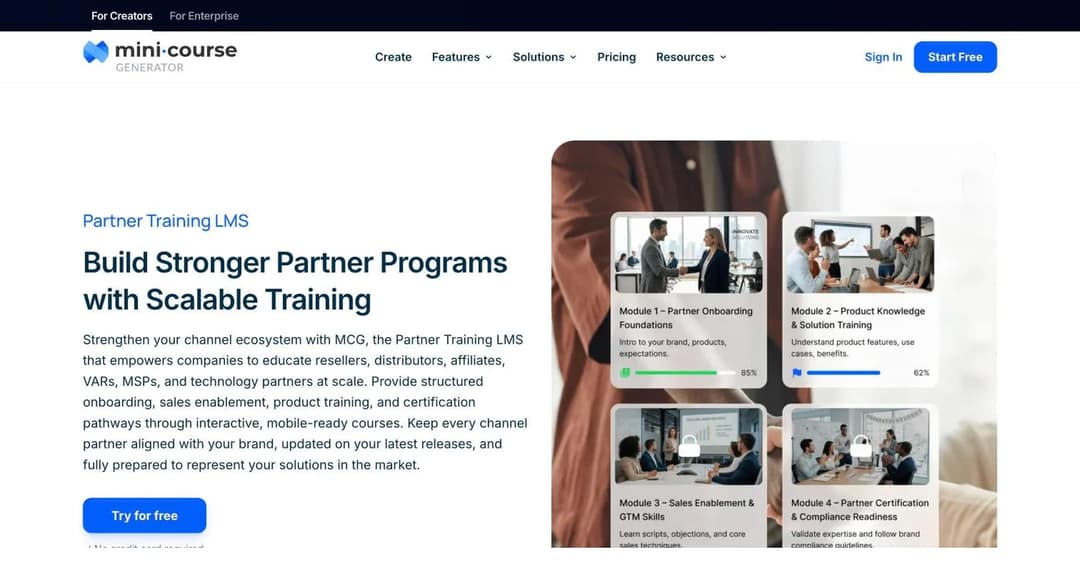
A disclosure: Mini Course Generator is our product, and it is not a PRM. No deal registration, no lead distribution, no co-marketing funds, no commission tracking. If that is what you need, buy one of the platforms named above.
What it does is the part of partner enablement that changes every release: turning your product documentation into short, interactive courses your partners can finish on a phone without another portal login, and exporting them as SCORM into whatever your partners already run. You can see the interactive formats or start free for 14 days with no credit card.
Sources
- The 75% claim: Forrester blog, “Does Your Channel Run In A Silo?”, Jay McBain, 21 July 2017. The attribution to the World Trade Organization carries no link, footnote or report reference. WTO statistics cover merchandise and commercial services trade by economy, sector and period, not by distribution channel.
- Certification and revenue: Microsoft Partner Center documentation, “Solutions Partner program Partner Capability Score”, document date January 2025, page updated May 2026. Cited only for what the programme requires. The public scoring table redacts the point weights.
- Partner activation: PartnerStack Research Lab chart, stamped May 2024, published with no sample size, denominator or observation window. Labelled in-copy as vendor research.
- Vendor capability and pricing claims: quoted verbatim from the vendors’ own pages and published agreements, read on 27 August 2026. Channeltivity partner training and certification page; Impartner partner training and certification page and pricing request page; Intellum AWS Marketplace listing and Platform Terms of Service; CYPHER Learning Master Services Agreement; AcademyOcean pricing page; Thought Industries pricing page; Docebo partner training solution page; Salesforce partner enablement guide.
- Note on a source others still cite: Canalys no longer exists as an independent analyst firm. Its domain now resolves into Omdia under Informa. Guides published in 2026 that cite “Canalys” as a live source are out of date.
Prices, tiers and contract terms change. Anything that matters to your decision should be confirmed in writing.