

A new account executive takes 6.2 months to reach full productivity. That figure comes from The Bridge Group’s 2026 AE Models, Motions and Metrics report, its tenth edition, published in June 2026 from 158 B2B companies (The Bridge Group, 2026). Sales development reps ramp faster, about 3.0 months, but they also leave faster: median tenure is 1.9 years against 40% median annual attrition (The Bridge Group SDR report, 2025).
Put those numbers side by side and the business case writes itself. If a rep needs half a year to become productive and stays for two, then the ramp period is a quarter of their entire tenure with you. Every week you shorten it is a week of quota you get back.
So teams go shopping for an “LMS for sales training” and get handed three completely different kinds of product at three completely different prices: training platforms that cost a few hundred dollars a month, enablement suites that cost tens of thousands a year, and AI roleplay tools that did not exist as a category three years ago. Nobody tells you which one you are actually shopping for. That is what this guide is for, and it starts with the distinction, then names the seat floors, then reviews the ten platforms that matter.
Try Mini Course Generator free – turn the product doc your reps keep ignoring into a course they will finish.
What Is a Sales Training LMS?
A sales training LMS is a learning platform used to onboard, certify and continuously coach a sales team: it delivers product and methodology training, verifies that reps can actually perform the pitch rather than just watch it, and reports on readiness in a way a sales leader can act on. The difference from a general LMS is not the course player. It is what gets measured: ramp time, pitch certification and win rate rather than course completions.
That distinction matters because the market has split into three product families that all answer to the same name, and buying the wrong family is the most expensive mistake in this category.
The Three Categories Every Buyer Confuses
Here is the map. Without it, teams end up in a demo for a product built for a company ten times their size.
| 1. Training LMS | 2. Sales enablement and readiness | 3. AI roleplay practice | |
|---|---|---|---|
| What it is for | Building and delivering courses, then proving completion | Managing GTM content, coaching, call analysis and readiness scoring for a whole revenue org | Letting a rep practise a live conversation against an AI buyer and get scored |
| Core unit of work | A course | A programme across content, coaching and calls | A simulated conversation |
| Typical buyer | L&D or an ops-minded sales leader | A dedicated enablement function | A sales manager who wants reps rehearsing |
| Published pricing? | Usually yes | Almost never | Almost never |
| Realistic entry | $119 a month | Five figures a year | Quote only |
| In this guide | Mini Course Generator, TalentLMS, Litmos, Docebo | Mindtickle, Seismic, Highspot, Allego | Second Nature, Hyperbound |
Category 1, training LMS, is what most teams under 50 reps actually need. You have product knowledge that changes every release, an onboarding sequence that currently lives in one manager’s head, and no way to prove a new hire absorbed either. A course platform solves that, and it is the only one of the three you can buy this afternoon with a credit card.
Category 2, sales enablement and readiness, is a different business. These platforms manage the content sellers use in deals, record and analyse calls, run coaching workflows and score readiness across a large revenue organisation. They are excellent and they are sold to companies with a dedicated enablement team. Their pricing reflects that, when you can find it.
Category 3, AI roleplay practice, is the newest and the most misunderstood. These tools do not deliver courses. A rep talks to an AI buyer persona, and the system scores the conversation against a rubric, the same mechanism behind the wider agent-authored practice skills now appearing across the category. They solve the single problem the other two categories historically handled worst: reps can watch training forever without ever practising the actual conversation.
One important 2026 development: category 3 is being absorbed into the other two. Docebo ships Docebo Roleplay, Mindtickle has an AI Role Play Simulator, Highspot has AI Role Play, Allego sells AI Role Play as a package, and Seismic builds roleplay into Learning and Coaching. The purpose-built tools are still sharper, but “does it have AI roleplay” is no longer a question that separates the categories.
A market event you need to know before you shortlist
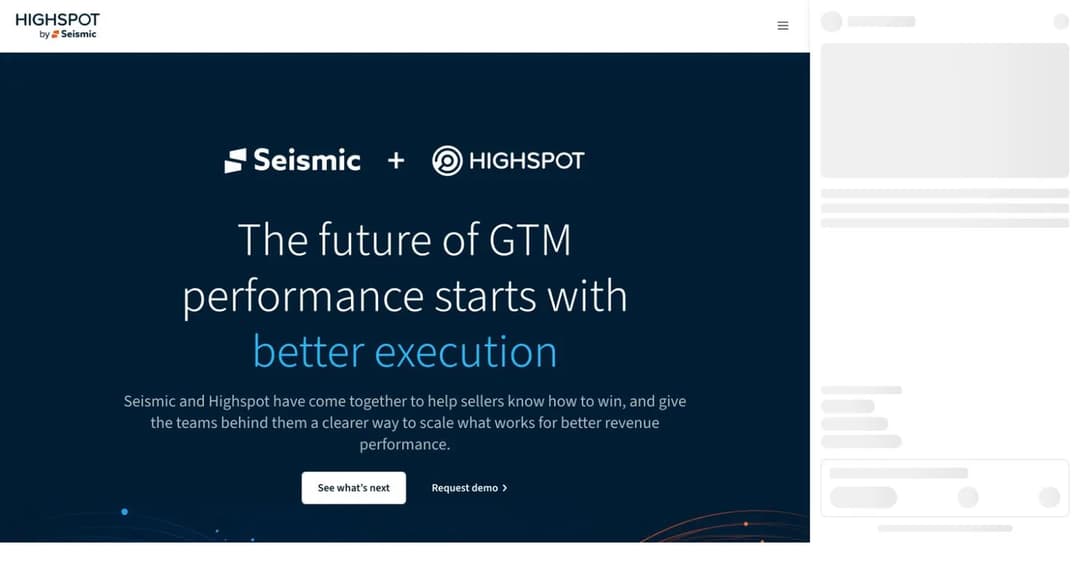
On 18 August 2026, Seismic completed its merger with Highspot. The combined company operates under the Seismic name, led by Seismic CEO Rob Tarkoff, with Permira as controlling shareholder (Seismic press release). Highspot’s own homepage now reads “Highspot by Seismic”, and the banner across seismic.com says the same thing from the other side.
This is not a footnote. Two of the three biggest names in category 2 are now one company with two overlapping learning and coaching products, and the roadmap that decides which one survives is not being shared until Seismic Shift in October 2026, after most 2026 buying decisions are made. If a comparison you are reading puts “Highspot vs Seismic” in a table, it was written before the merger.
What Sales Training Software Actually Has to Do
Six jobs. Judge any platform in any of the three categories against these rather than against a feature matrix.
Keep up with a product that changes every sprint
Sales content goes stale faster than any other training content in a company. A platform that takes two weeks to update a module is a platform whose content is always one release behind, and reps learn to ignore it. Test this directly: ask how long it takes to change one slide in a live course and republish it to everyone. Teams that publish training into several destinations at once should also check whether the platform supports a headless delivery model, because that is what makes one edit reach every surface.
Prove the rep can do it, not that they watched it
Completion is not competence. The verification layer is what separates training from content distribution, and it takes one of three forms: a knowledge check, a recorded pitch reviewed by a human, or an AI-scored roleplay. Any of the three beats a progress bar, and the same verification logic applies to any employee training programme you expect to defend in an audit.
Give feedback on behaviours, not scores
A number out of ten tells a rep nothing, whether it comes from a manager or from an AI-built interaction. Feedback that says “you pitched before asking a discovery question” tells them what to change. When you evaluate roleplay scoring, look at whether the rubric names discrete behaviours, because that is the difference between a tool reps learn from and a tool they game.
Live where the rep already works
Sales reps live in the CRM, the inbox and the dialler. A training platform behind a separate login becomes another tab they do not open, which is the single most common failure mode teams report. Ask for a walkthrough of a rep’s actual day and count the clicks between their normal work and the training. Options that embed training in the tools people already use sidestep the problem entirely, and CRM integration is the difference between assignment lists that maintain themselves and ones somebody updates by hand.
Fit the ramp, not the calendar year
Onboarding a rep is a 90-day sequence, not an annual curriculum. The platform should support a path with stages, checkpoints and a defined finish line, the same structure that works for any onboarding process worth measuring. If it can only assign courses one at a time, you will rebuild that structure in a spreadsheet.
Report in the language of the sales leader
Ramp time, certification pass rate and the win rate of certified versus uncertified reps are the numbers that get budget renewed. Course completion percentages are the numbers that get training programmes cancelled. If the reporting cannot be pointed at a business outcome, you will be defending it every year, and the discipline of measuring learning against outcomes applies here exactly as it does anywhere else.
How We Picked These 10 Platforms
Published prices only. Every figure below comes from the vendor’s own pricing page; prices, plan details and review scores were checked in August 2026. Seven of the ten publish no price at all, so those entries say “quote only” rather than repeating third-party estimates. That matters here more than in most categories, because the third-party estimates in circulation for these platforms disagree with each other by an order of magnitude.
Seat floors, stated up front. The most useful fact about an enterprise platform is often that it will not sell to you. Where a vendor publishes or states a minimum, we lead with it.
All three categories represented. A list of training platforms alone would leave out two of the three product families that answer to this name.
Disclosure. Mini Course Generator is our product and it is listed first because this is our publication; weigh that accordingly, and check us against the prices we publish.
The Seat Floor Table: What It Takes to Start
The question a 20-rep team should ask first.
| Platform | Category | Published price | Seat floor | What a 20-rep team pays to start |
|---|---|---|---|---|
| Mini Course Generator | Training LMS + roleplay | Yes, see pricing | None | Self-serve, 14-day trial |
| TalentLMS | Training LMS | Yes: $119/mo (1-40 users) | None | $1,428/yr, self-serve |
| Docebo | Training LMS | No price published | Stated fit bar: 250+ learners | Unknowable without a quote |
| Litmos | Training LMS | No: “Contact for Pricing” | None stated | Quote only, 14-day trial available |
| Mindtickle | Enablement/readiness | No pricing page exists | Not stated | Quote only |
| Seismic Learning | Enablement/readiness | No | Reported 25-seat minimum | Quote only |
| Highspot by Seismic | Enablement/readiness | No: “Contact sales” on all tiers | Not stated | Quote only |
| Allego | Enablement/readiness | Page says “Priced at per user per month” | Not disclosed | Quote only |
| Second Nature | AI roleplay | No price published | Not stated | Quote only |
| Hyperbound | AI roleplay | Free tier + “Custom” | None stated | Free demo sandbox, then quote |
Read the third column and the shape of this market is unmistakable: seven of the ten platforms in this category will not tell you what they cost. Read the fourth and it gets sharper. Docebo publishes no price at all and tells smaller buyers its platform suits companies training 250+ learners.
1. Mini Course Generator
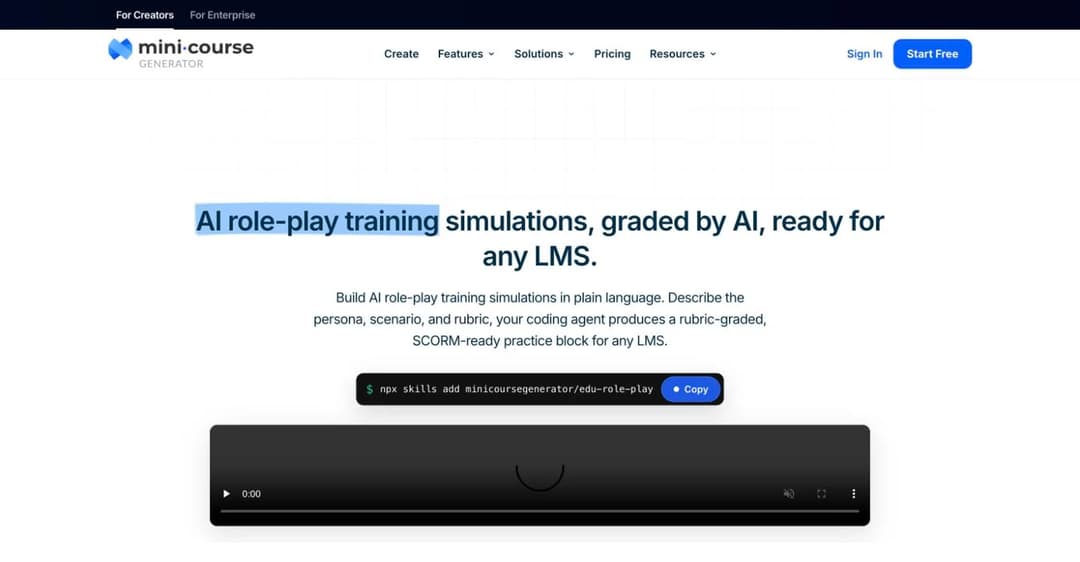
Disclosure: Mini Course Generator is our product.
Top Features
- AI Role-play simulations authored in plain English, graded turn by turn against your own rubric.
- SCORM 1.2 export, so practice activities run inside whatever LMS your company already owns.
- AI Course Creator that drafts a course from the product doc, battlecard or release note you already have.
- Interaction types built for practice: branching scenarios, dialogue simulations and diagnostic interviews.
- Delivery without a portal: embed a module in a page, send a share link, or drop it where reps already work.
Mini Course Generator sits deliberately across two of the three categories, and the honest framing matters more than the feature list. It is a course platform with an AI role-play layer, not a sales readiness suite. There is no conversation intelligence, no call recording analysis, no revenue dashboard, and if those are your requirements the right answer is in category 2.
What it does that the category-2 platforms make hard is turn a document into a practice conversation quickly. Product knowledge in most sales orgs lives in docs nobody reads; the AI Course Creator drafts a structured course from one, and the AI Role-play skill turns the objection-handling part into a simulated buyer conversation with a rubric you write in plain language.
The portability point is the one most buyers miss. Because roleplay activities export as SCORM 1.2, a team that already owns Docebo or Litmos can add practice conversations to the LMS they are already paying for rather than buying an eleventh platform. That is a genuinely different purchase from anything else on this list.
Limits, stated plainly: no free-forever plan, only a 14-day trial with no card; no native CRM-triggered coaching workflows; and reporting is learning-side, so pairing it with your CRM’s own reporting is on you.
Pros
- Authoring starts from documents that already exist, which is how sales content actually arrives.
- Roleplay is rubric-graded and authored in plain English rather than scripted.
- SCORM export means practice content can live inside an LMS you already own.
- Self-serve from minute one: no demo call, no implementation project.
Cons
- No free-forever plan; evaluation is a 14-day trial.
- No conversation intelligence or call recording analysis.
- Not a readiness platform: no revenue dashboards or CRM-native coaching workflows.
Best for: teams of 5-50 reps who need product knowledge and objection practice live this quarter, and teams who want to add roleplay to an LMS they already own.
See plans
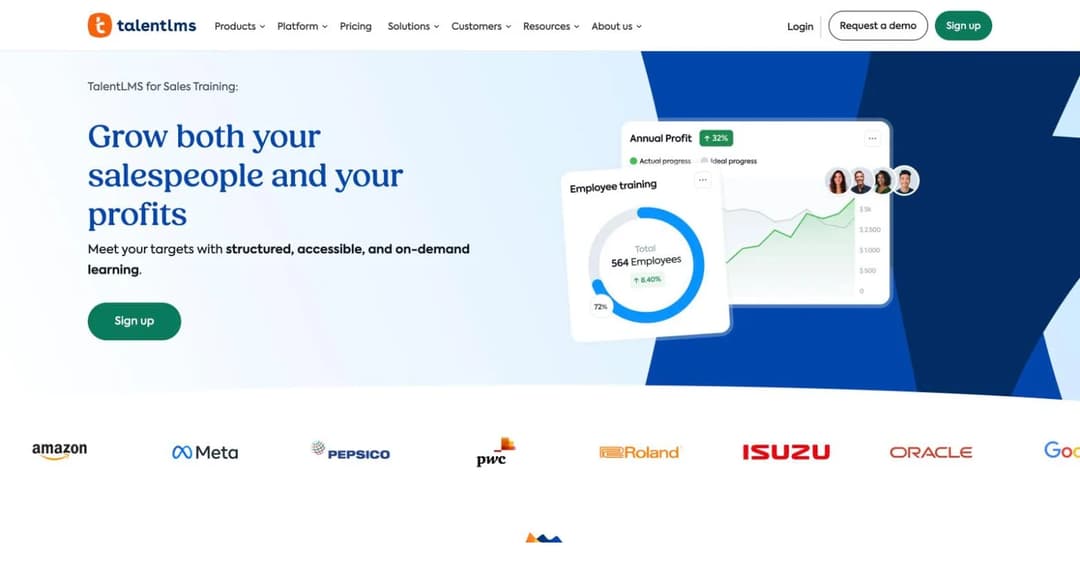
2. TalentLMS
Top Features
- Published seat-band pricing: $119 a month billed yearly for 1-40 users.
- A free forever plan for 5 users and 10 courses, no credit card.
- Salesforce integration for assigning courses by role and syncing user data.
- SCORM and xAPI support for content you already own.
- Branches for separating sales, partners and customers into distinct portals.
TalentLMS is the most straightforward answer on this list for a small sales team, and it earns the position by being the only conventional LMS here besides ours that you can buy without a conversation. Core is $119 a month billed yearly for 1-40 users, which covers most sales orgs that would read this article, with Grow at $229 and Pro at $449.
It is a general-purpose LMS with a sales solution page rather than a sales product, and you should read it that way. There is no roleplay, no call analysis and no AI authoring; the vendor’s own sales page leads on structured, accessible, on-demand learning, which is exactly what it delivers. For a team whose problem is “our product training is a Google Drive folder”, that is the right size of solution.
The Salesforce integration is more useful than it sounds for this use case: courses can be assigned based on CRM role or activity and training reports surface inside Salesforce, which removes the “another tab” objection at least partway.
Pros
- The only conventional LMS on this list with a published, self-serve entry price.
- A real free plan makes evaluation genuinely free rather than time-boxed.
- Salesforce integration for role-based assignment and in-CRM reporting.
- Strongly reviewed for setup speed and ease of administration (G2 4.6 from 797 reviews, Capterra 4.7 from around 600).
Cons
- No AI roleplay, no call recording analysis and no pitch scoring.
- Custom reporting is excluded from the entry Core plan.
- Sales-specific content and structure are yours to build; the platform supplies the container.
Best for: sales teams under 40 who need structured product and process training with a price they can read off a page.
TalentLMS
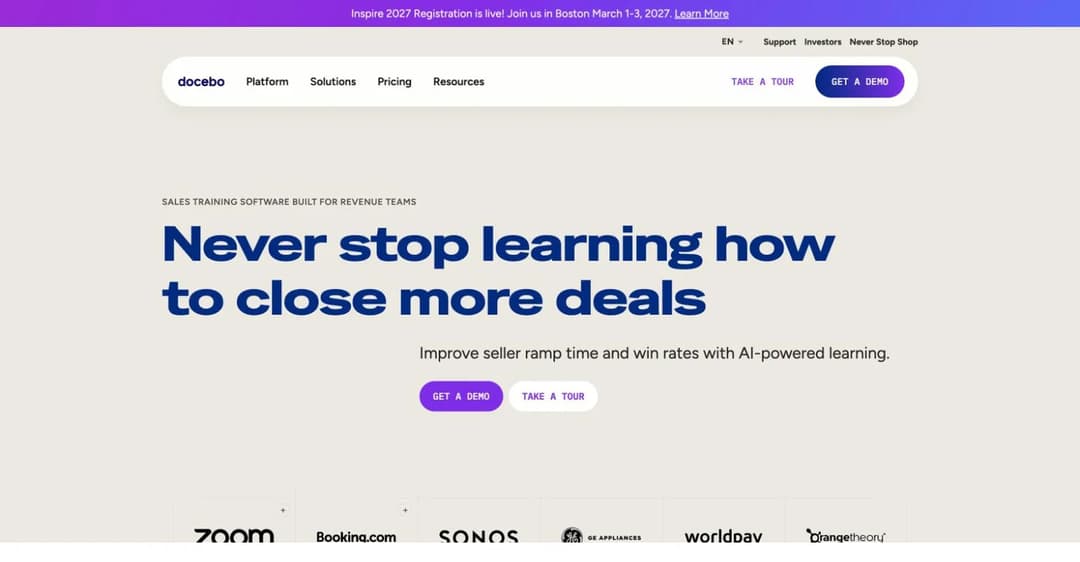
3. Docebo
Top Features
- Docebo Roleplay: first-party AI practice with 1-5 rubrics, weighting, pass thresholds and quote-level evidence.
- Enterprise LMS with multi-audience portals for employees, partners and customers.
- Published per-user pricing, which is rare at this tier.
- Deep integration and API layer for CRM-linked assignment and reporting.
- Certification and compliance workflows suited to regulated selling.
Docebo is the platform most guides put first, and it is the most capable pure LMS on the list, with a genuinely good AI roleplay module that grades objection handling, cold calling and discovery against configurable rubrics with evidence quoted from the transcript. If you are an enterprise with a real enablement function and a mixed audience of staff, partners and customers, it belongs on your shortlist.
Then read the floor. Docebo publishes no price anywhere on its pricing page. What it does publish is a fit bar, in its own FAQ: “Typically, Docebo is best suited for companies who are: Training at least 250+ learners, which can represent a combination of customers, partners and employees,” and its partner page describes tiers “starting at 250 active users.” A 20-rep sales team is therefore buying into a band sized for an organisation twelve times larger, at a price it cannot learn without a sales cycle. There is no free plan and no free trial. Docebo Roleplay is a usage-based add-on on top of that.
This is the clearest illustration of why the seat floor deserves its own column. The product is not wrong; the fit is, for anyone who arrives at this article from a search phrased around a small team.
Pros
- Docebo Roleplay is one of the strongest first-party AI practice modules in the category.
- Published per-user pricing, which most of category 2 refuses to offer.
- Multi-audience portals genuinely solve training staff, partners and customers from one platform.
- Mature integrations and reporting for organisations with an enablement team.
Cons
- A stated fit bar of 250+ learners, which is well above the size of most teams shopping in this category.
- No free plan and no free trial: evaluation is demo-only.
- Roleplay is a usage-based add-on rather than included.
- Reviewers rate it lower than its category peers on ease of use (G2 4.3, Capterra 4.4 from around 240 reviews).
Best for: enterprises of 250+ users training multiple audiences, with staff to run the platform.
Below that size the fit argument gets harder to make, and the Docebo alternatives comparison covers which platforms sell to smaller teams and what their contracts commit you to.
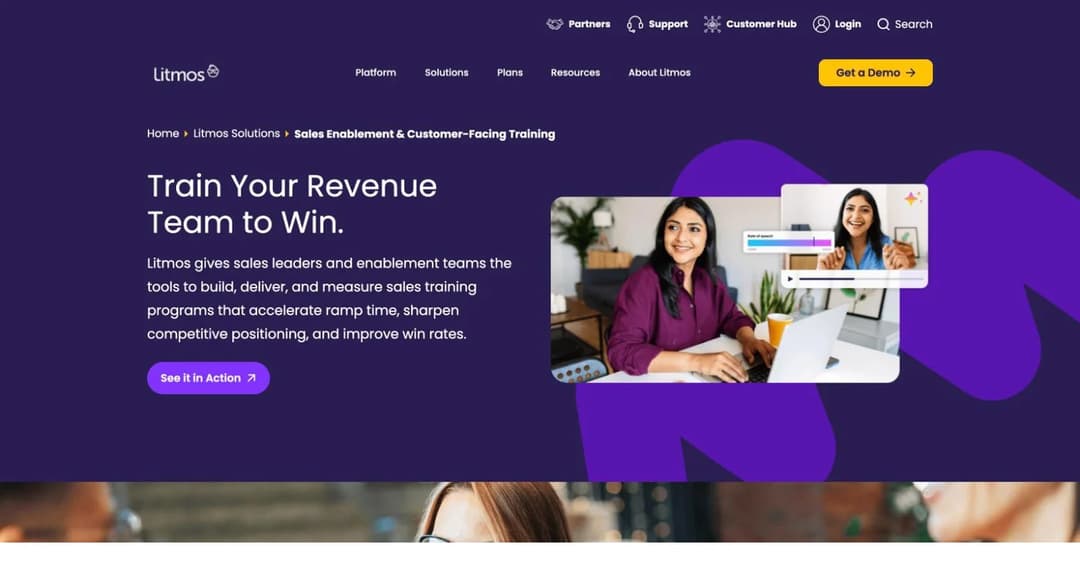
4. Litmos
Top Features
- Video practice and pitch assessment: reps record a pitch, managers review and score it.
- A large off-the-shelf course library alongside your own content.
- SCORM and xAPI authoring and delivery.
- 14-day free trial, which is unusual among quote-only vendors.
- Compliance and certification tracking built in.
Litmos is a mature general-purpose LMS with a well-developed sales solution page, and its distinguishing capability is video pitch assessment: a rep records their pitch or objection response, a manager reviews it, and the assessment is structured rather than ad hoc. Note what that is and is not. It is asynchronous human review, not AI roleplay – a real capability, and a different one from what Second Nature or Hyperbound do.
Pricing is not published: Foundation, Platinum and Platinum AI all read “Contact for Pricing”, and no seat minimum is disclosed. The 14-day trial is worth taking precisely because the price is not visible; it is the cheapest way to find out whether the platform fits before you spend an hour on a discovery call.
Ownership has moved repeatedly, from CallidusCloud to SAP to Francisco Partners, which is worth knowing when you evaluate roadmap promises.
Pros
- Video pitch assessment is a genuine practice mechanism with manager feedback attached.
- A 14-day trial exists, unlike most quote-only vendors here.
- Large content library reduces the build burden for generic skills.
- Standards support means content you build is portable.
Cons
- No published pricing on any tier.
- Practice is human-reviewed video, not AI-scored conversation, so it costs manager time to run.
- Reviewers rate it below the category average on interface and support (G2 4.3 from around 700 reviews, Capterra 4.2 from around 285).
Best for: mid-market teams that want a conventional LMS plus manager-reviewed pitch practice, and can accept a sales-led purchase.
Litmos
5. Mindtickle
Top Features
- AI Role Play Simulator running full end-to-end call simulations with scoring.
- Conversation Intelligence: call recording, transcription and analysis with auto-generated follow-ups.
- Readiness scoring across a whole revenue team.
- Digital Sales Rooms, absorbed from the Enable.us acquisition.
- Structured onboarding programmes with certification milestones.
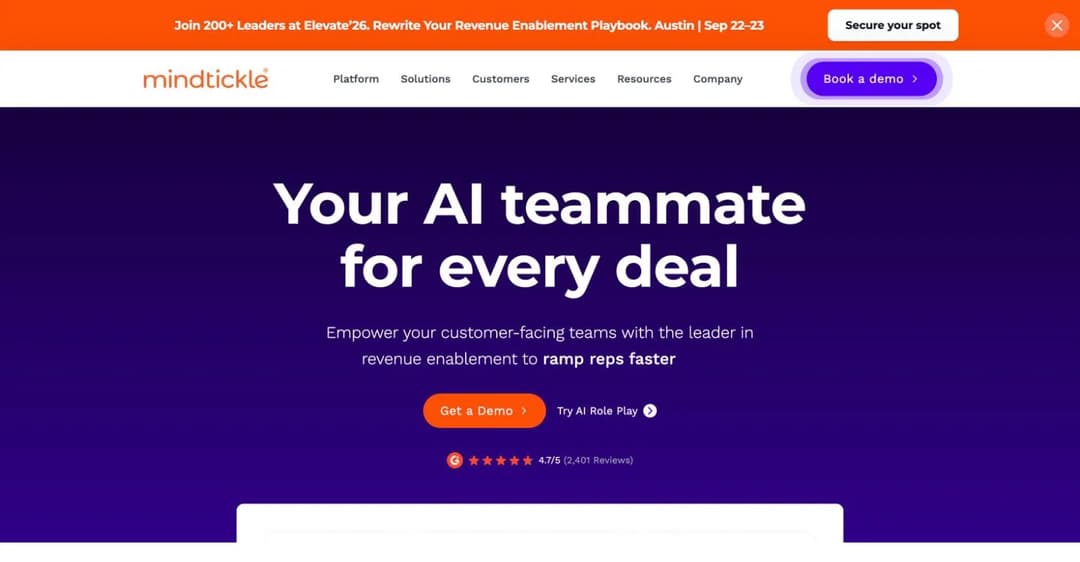
Mindtickle defined the sales readiness category and remains its most complete expression. If you have an enablement function and want one system for onboarding, certification, coaching, call analysis and readiness scoring, this is the benchmark others are measured against. Its homepage displays a G2 rating of 4.7 from more than 2,400 reviews, which is the largest review base on this list by a wide margin.
It also publishes no price of any kind. There is no pricing page at all. Third-party estimates in circulation contradict each other by roughly an order of magnitude, from tens of dollars per user per month to six figures a year for a mid-sized team, which means at least one of them is badly wrong and neither should be repeated.
Read it as the enterprise benchmark rather than an option for a 20-rep team. That is not a criticism of the product; it is a statement about who it is sold to.
Pros
- The most complete readiness platform in the category: training, coaching, calls and scoring in one system.
- AI Role Play Simulator is mature rather than newly bolted on.
- The largest review base here, with consistently high scores (G2 4.7 from around 2,400 reviews, Capterra 4.8 from around 125).
- Conversation intelligence removes the need for a separate call-analysis purchase.
Cons
- No pricing page exists at all, so budgeting requires a sales process.
- Built and priced for organisations with a dedicated enablement team.
- The April 2026 ElevateOS repositioning changed the platform narrative and some capabilities were announced as phased rollouts, so verify what is generally available.
Best for: revenue organisations large enough to employ someone whose whole job is enablement.
Mindtickle
6. Seismic Learning
Top Features
- AI-powered roleplays with automated scoring inside the Learning and Coaching module.
- Pitch certification through recorded video practice with manager feedback.
- Coaching workflows tied to the wider Seismic content platform.
- Lesson authoring inherited from Lessonly, still among the friendliest in category 2.
- Full enablement suite around it: content management, digital sales rooms, meeting intelligence.
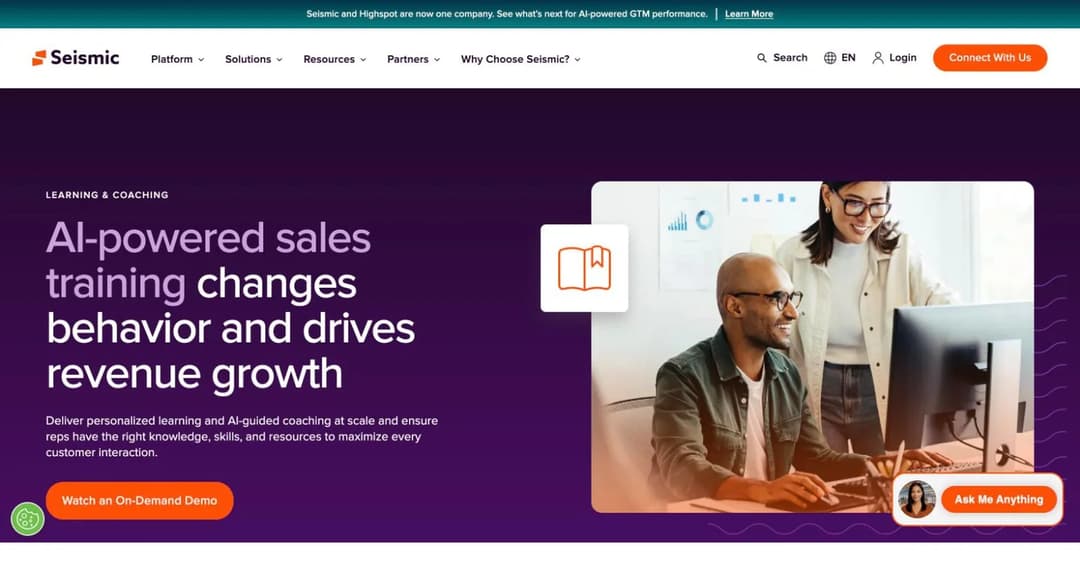
Seismic Learning is what Lessonly became. Seismic acquired Lessonly in August 2021 and folded it in as the Learning and Coaching module, and the authoring experience that made Lessonly popular with enablement teams largely survived the transition.
Two things every buyer needs before a demo. First, the merger with Highspot completed on 18 August 2026, which means this product and Highspot’s coaching module now sit inside the same company with overlapping roadmaps, and no public statement yet says which survives. Second, there is no pricing page: evaluation is demo-gated, no trial, no free tier. Third-party contract data puts the median annual contract around $32,000 with a reported 25-seat minimum, which we cite as third-party observation rather than vendor fact.
Naming is a practical problem too. The vendor calls it “Seismic Learning and Coaching”, G2 lists it as “Seismic Learning”, and Capterra still calls it “Lessonly (by Seismic)” five years after the acquisition. If you are gathering reviews, you are gathering them from three listings.
Pros
- Authoring inherited from Lessonly remains unusually approachable for an enterprise platform.
- AI roleplay with automated scoring is built in rather than added on.
- Well reviewed across listings (G2 4.7 from around 600 reviews, Capterra 4.7 from around 160).
- Sits inside a full enablement suite if you need content management as well as training.
Cons
- The Highspot merger completed on 18 August 2026; product overlap is unresolved and the roadmap is not public until October 2026.
- No published pricing, no trial and no free tier.
- A reported 25-seat minimum and a median contract in the low five figures put it out of reach for small teams.
- Review data is split across three differently-named listings.
Best for: mid-market and enterprise enablement teams already invested in the Seismic platform.
Seismic
7. Highspot by Seismic
Top Features
- AI Role Play generated from your own sales methodology and scored automatically.
- Meeting Intelligence: call capture, transcription, summaries and delivery analysis.
- Content management and governance for the material reps use in deals.
- Coaching workflows tied to observed rep behaviour.
- Digital sales rooms for buyer-facing collaboration.
Highspot is the canonical sales enablement platform and its training and coaching modules are strong: AI Role Play generates scenarios from your own methodology rather than from a generic library, and Meeting Intelligence closes the loop between what a rep practised and what they actually said on the call.
The headline fact overrides the feature list. Highspot no longer exists as an independent company. Seismic completed the merger on 18 August 2026, the combined business runs under the Seismic name, and highspot.com now brands itself “Highspot by Seismic”. Its G2 listing has already been retitled, and the roughly 1,200 G2 reviews on file describe a pre-merger product.
Pricing is not published. The three tiers all read “Contact sales”, and the pricing page asks for GTM headcount and existing integrations before routing you, which is a qualification gate rather than a pricing page.
Pros
- AI Role Play built from your own methodology, with automated scoring.
- Meeting Intelligence connects practice to real call behaviour.
- Deep content governance, the capability the enablement category was built on.
- Large, positive review base (G2 4.7 from around 1,200 reviews, Capterra 4.6 from around 75).
Cons
- The company merged into Seismic on 18 August 2026; two overlapping learning products now sit under one roof with no published roadmap.
- No pricing anywhere; the pricing page is a qualification form.
- Existing review data describes the independent, pre-merger product.
- Call analysis is gated to the top tier.
Best for: large revenue organisations buying enablement first and training second, with the appetite to sign into a merger year.
Highspot
8. Allego
Top Features
- Modern Learning plus Conversation Intelligence in one package.
- AI Role Play sold as its own package alongside learning and content.
- Call recording and transcription across meeting platforms and diallers, with AI summaries.
- Pitch certification with badges and certificates.
- Named a Leader in Gartner’s 2025 Magic Quadrant for Revenue Enablement Platforms.
Allego is the independent alternative in category 2, and after the Highspot-Seismic merger that independence is worth something: it is not merging, not being absorbed, and shipped a major release (Allego 9) in May 2026. The product bundles learning, conversation intelligence, content and digital rooms, and unusually for this category it includes its AI capabilities rather than charging separately for them.
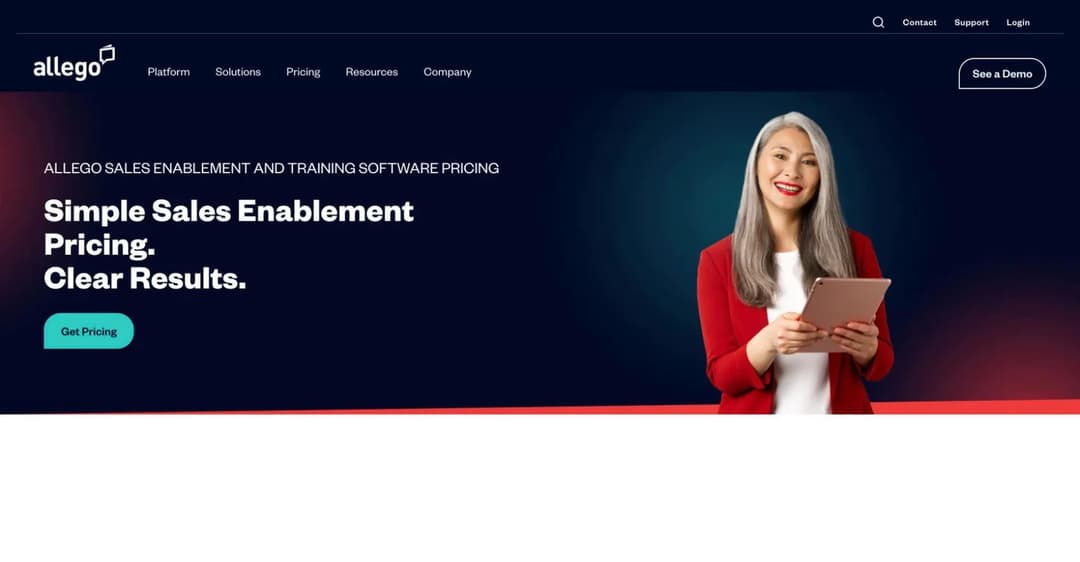
Its pricing page deserves a special mention. It is headlined “Simple Sales Enablement Pricing. Clear Results.” and shows four package cards. Each card prints the line “Priced at per user per month” with the number simply absent, and the only button is “Get Pricing”. Its own FAQ raises the seat-minimum question and then does not answer it.
It is the exact moment a 20-rep team should decide whether it wants to spend the next fortnight in a procurement conversation.
Pros
- Independent and actively shipping, which is a differentiator in a consolidating category.
- AI capabilities are included in the package rather than metered separately.
- Conversation intelligence is native, inherited from its Refract acquisition.
- Gartner Magic Quadrant Leader for revenue enablement, November 2025 (G2 4.6 from around 676 reviews).
Cons
- No price appears anywhere on the pricing page.
- Seat minimums are asked about in their own FAQ and left unanswered.
- Capterra review volume is thin (around 11 reviews) compared with its G2 base.
- Full value depends on adopting several modules, which raises the entry cost.
Best for: mid-market and enterprise revenue teams that want an independent enablement vendor with AI included.
Allego
9. Second Nature AI
Top Features
- Conversational AI buyer personas reps practise against in voice or video.
- Objective scoring of simulated conversations with per-rep comparison across a team.
- Gamified certification programmes built on repeated practice.
- Scenario library covering discovery, objection handling and multi-persona meetings.
- Manager dashboards showing practice volume and score movement.
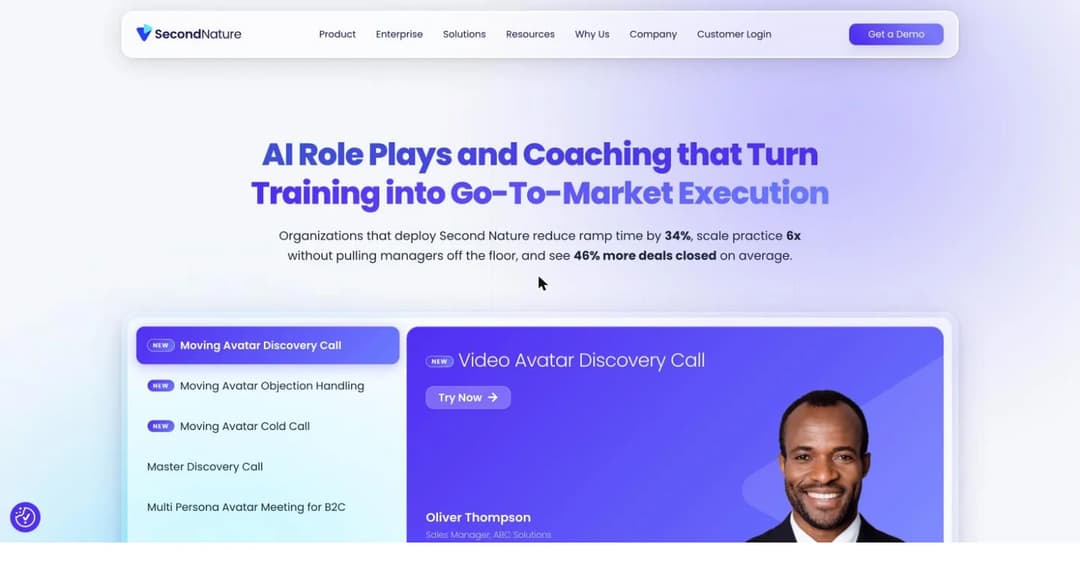
Second Nature is the most established of the purpose-built AI roleplay tools, founded in 2018 and funded with a $22M Series B in October 2025. The product does one thing: it puts a rep in a realistic simulated conversation with an AI buyer and scores how they handled it. If the gap in your team is that reps understand the pitch but fall apart when a prospect pushes back, this category exists for exactly that gap and Second Nature is its most mature product.
It is not an LMS. There is no course library, no compliance tracking and no content management, and it is designed to sit alongside those things rather than replace them, typically an LMS you already run.
Pricing is quote-only: there is no pricing page, there is no self-serve trial, and evaluation runs through a demo. The vendor publishes strong outcome claims on its homepage – a 34% reduction in ramp time, six times more practice, and 46% more deals closed – and every one of those is a vendor claim published without methodology or sample size, which is how you should treat it.
Pros
- The most mature purpose-built AI roleplay product on this list.
- Objective, comparable scoring across a team rather than manager opinion.
- Practice volume increases without consuming manager time, which is the actual constraint in most teams.
- Well reviewed by users (G2 4.6 from around 300 reviews).
Cons
- Not an LMS: no courses, no compliance tracking, no content management.
- No pricing page at all.
- Published outcome claims carry no methodology or sample size.
- Capterra review volume is very thin (4 reviews).
Best for: teams that already have training content and need reps to practise the conversation.
Second Nature
10. Hyperbound
Top Features
- AI buyer roleplay in voice, covering cold calls, discovery and objection handling.
- Custom scorecards with concept-based grading and criterion-level feedback citing the transcript.
- Hyperbound Perform, which scores real customer calls, not only simulations.
- A free tier with nine pre-built bots you can try without talking to anyone.
- Certification flows that continue reinforcing after the certificate is issued.
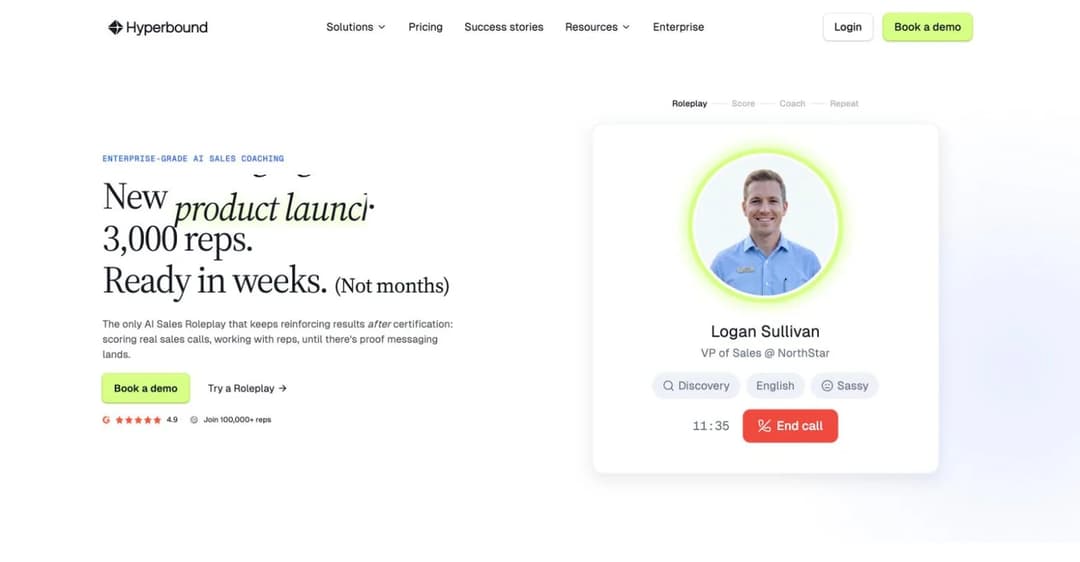
Hyperbound is the newer challenger in category 3 and the most candid product on this list about what it is: its own FAQ asks whether Hyperbound is an LMS and answers that it is not. It is a practice and scoring engine, and the thing that distinguishes it from Second Nature is that it scores real calls as well as simulated ones, which closes the loop between rehearsal and performance.
It is also the only platform in category 2 or 3 with anything you can touch before a sales call: a free tier with nine pre-built bots, no password and no credit card. For a sales manager who wants to know whether AI roleplay is real or hype, that is a 20-minute answer instead of a two-week procurement exercise.
The caveats are the ones you would expect from a young company. Paid pricing is “Custom” with no figure, the review base is small (a 4.9 G2 rating from 39 reviews, displayed on its own homepage), and buying a category-defining tool from a recently-funded startup carries the risk that category consolidation eventually reaches it.
Pros
- A genuinely usable free tier, which nothing else in categories 2 or 3 offers.
- Scores real calls as well as roleplays, connecting practice to performance.
- Criterion-level feedback quotes the transcript rather than returning a bare score.
- Highest rating on this list, albeit on a small base (G2 4.9 from 39 reviews).
Cons
- Paid pricing is quote-only with no published figure.
- Small review base makes the score less reliable than it looks.
- Not an LMS by its own admission: no courses, no compliance, no content library.
- Young vendor in a consolidating category.
Best for: sales managers who want reps rehearsing this week and want to test the idea before buying it.
Hyperbound
What It Actually Costs to Start With 20 Reps
Put the categories and the floors together and the buying reality for a small or mid-sized sales team looks like this.
Category 1 is buyable today. TalentLMS is $1,428 a year at this size. Mini Course Generator is self-serve with a 14-day trial. Litmos requires a conversation but offers a trial first. Docebo publishes no price and sets its stated fit bar at 250+ learners.
Category 2 is a procurement project. None of Mindtickle, Seismic, Highspot or Allego publishes a price. Third-party contract data for Seismic Learning puts the median around $32,000 a year with a reported 25-seat minimum, which is the only concrete figure available anywhere in this category and should be treated as an observation rather than a quote. Expect a discovery call, a scoping call, a demo and a proposal before you see a number.
Category 3 is cheap to try and opaque to buy. Hyperbound’s free tier costs nothing and takes 20 minutes. Second Nature’s pricing page does not exist. Neither publishes a paid price.
The practical sequence for a 20-rep team, then: start in category 1 because you can start today, add category 3 when the gap is practice rather than knowledge, and only enter category 2 when you have hired someone whose whole job is enablement. Buying in the reverse order is how teams end up with a platform 15% of them log into.
The Statistic This Category Repeats Without Checking
You will meet this line in almost every sales training article: “84% of sales training content is forgotten within 90 days.” It is usually presented as research. It is not.
The figure originates in a January 2011 white paper by Sales Performance International, a sales training vendor, titled “The Future of Sales Training”. The paper states the number and cites nothing: no study, no sample, no method. Harvard Business Review repeated a rounded version in 2017 (“more than 80 percent”), which is where most modern citations pick it up, and a competing variant (“87% within 30 days”) circulates with at least three mutually exclusive attributions across vendor blogs.
So do not cite it, and be sceptical of any vendor page that does. There is real research on this question, and it is less dramatic and more useful. The CSO Insights 5th Annual Sales Enablement Study surveyed 918 organisations in May and June 2019 and found win rates of 42.5% for companies with no enablement discipline against 49.0% for those with it, rising along a ladder from random (39.2%) through informal (43.3%) and formal (48.4%) to formal-with-a-charter (55.1%). Two labels belong with that number every time it is used: CSO Insights was the research arm of Miller Heiman Group, a sales training vendor, so this is vendor-owned research; and it is correlational survey data now seven years old.
That is what honest evidence looks like in this category. It supports the case for structured enablement without pretending to a precision nobody measured.
What Sales Teams Actually Say About These Tools
The liveliest discussion of this question is not an article. It is an r/techsales thread asking what sales training software actually made reps better, and its answers are more useful than most of the vendor pages above.
The single most repeated recommendation is AI roleplay. Roughly six separate commenters land there independently, naming different tools, and the reason is consistent: reps who watch training do not get better, and reps who practise do.
The most repeated complaint is the gap between demo and reality. One commenter describes rolling out a well-known enablement platform at significant cost and finding that about 15% of the team ever logged in. Others describe reps starting strong for a week and stopping. The mechanism they name is always the same: the training sits outside the CRM, so it becomes another tab.
Three pieces of practitioner buying advice worth more than a feature matrix:
- Session length beats library size. Five to ten minute practice reps on one scenario beat 40 to 90 minute video courses. Several commenters say to skip anything that is only video, because passive learning does not transfer to a live call.
- Run the two-week test. Ask whether the team will still want to use this after the novelty wears off. If the honest answer is no, adoption will collapse regardless of the contract.
- Close the loop. Retrain each rep on the category they scored lowest in rather than pushing everyone through the same module again, then re-score.
One dissenting view in the thread deserves airtime because it is often right: if your playbooks and SOPs are scattered, you may not need a 50-feature AI platform at all. Documenting what good looks like, and making it findable, fixes more than software does. That argument is the enablement discipline in its cheapest form.
How to Choose the Best LMS for Sales Training
Which LMS is best for sales training at my size?
Under 50 reps, start in category 1 with a platform that publishes its price: TalentLMS if you want a conventional LMS, Mini Course Generator if your content lives in documents and you want practice built in, Litmos if you want manager-reviewed pitch video and can take a sales call. Between 50 and 250, the same options still work, Docebo becomes buyable at the top of the range, and channel teams should check whether partner training needs its own portal, a decision we work through in our guide to partner enablement. Above 250 reps with a dedicated enablement function, category 2 is where you belong and the question becomes Mindtickle versus Allego versus the merged Seismic and Highspot entity.
What’s the best software for training new sales reps?
Onboarding is a sequencing problem before it is a content problem. You need a path with stages and a defined finish line, a knowledge check at each stage, and one practice conversation before the rep talks to a real prospect. Any category 1 platform can carry the path; only category 3, or a category 2 platform with roleplay, gives you the practice conversation. The combination that covers both without an enterprise contract is a training LMS plus a roleplay layer, which is why the SCORM-portability route matters: practice activities that export as SCORM can be dropped into whatever platform is already carrying your onboarding path.
Who has the best sales training programme, and can software replace it?
No. Software delivers, verifies and measures a programme; it does not design one. The evidence supports that division of labour: the CSO Insights ladder shows the biggest win-rate gap between informal enablement and formal enablement with a written charter, and a charter is a document, not a feature. Decide what a certified rep must be able to do, then buy the platform that can prove it. Writing that definition down is the same first move as defining first value in any onboarding process.
What is the easiest of these platforms to use?
For an admin, the self-serve platforms are easiest by definition: you can have TalentLMS or Mini Course Generator configured before a demo would have been scheduled. For a rep, ease of use is decided by where the training appears and how long it takes. The reliable test is the practitioner one above: walk through a rep’s actual day, count the clicks from their normal work to the training, and if the answer is more than two, adoption is already in trouble.
Frequently Asked Questions
What are the top 5 LMS systems for sales training?
By capability and market position: Docebo and Litmos as enterprise-grade training platforms, Mindtickle and the merged Seismic and Highspot entity as readiness platforms, and TalentLMS as the accessible option with published pricing. If your requirement is practice rather than course delivery, substitute Second Nature or Hyperbound for one of the enterprise entries; they solve a different problem and cost a different amount.
How much does sales training software cost?
For a 20-rep team in 2026, the only price published by a vendor itself is TalentLMS at $119 a month ($1,428 a year). Mini Course Generator publishes its plans on its pricing page. Docebo, Mindtickle, Seismic, Highspot, Allego, Litmos and Second Nature publish no price at all. Third-party contract data puts a typical Seismic Learning contract around $32,000 a year, which is an observation rather than a quote. The five different bases vendors bill on, and which one punishes a team with seasonal headcount, are set out in our breakdown of what an LMS actually costs.
Is an LMS the same thing as sales enablement software?
No, and confusing them is the most expensive mistake in this category. An LMS builds, delivers and verifies training. A sales enablement platform manages the content reps use in live deals, analyses their calls and coaches against what it finds. They overlap on training and diverge everywhere else, and enablement platforms cost roughly an order of magnitude more. Buy the LMS if your problem is “our reps do not know the product”. Buy enablement if your problem is “our reps cannot find the right deck and nobody reviews their calls”.
Do I need AI roleplay, or is that a gimmick?
It is the most-recommended thing in practitioner discussions of this category, which is unusual for a young feature. The underlying logic is sound: reps get better by practising the conversation, and manager time for roleplay has always been the scarce resource. The useful test is the feedback quality, not the voice quality. If the scoring names discrete behaviours (“asked a discovery question before pitching”) it will change behaviour; if it returns a number out of ten, reps will learn to game it. Structured diagnostic interview formats are the closest non-voice equivalent if your team is not ready for live roleplay.
Can I add sales roleplay to the LMS I already have?
Yes, and it is an easy option to overlook. Practice activities built as SCORM 1.2 packages run inside any standards-compliant LMS, which means a team already paying for Docebo, Litmos or TalentLMS can add rubric-graded roleplay without buying an eleventh platform or migrating anything. It is also the cheapest way to test whether roleplay changes your ramp numbers before committing to a dedicated tool, and it keeps the practice content embedded where reps already work.
What happened to Highspot and Seismic?
They merged. Seismic completed its acquisition of Highspot on 18 August 2026; the combined company operates as Seismic under CEO Rob Tarkoff with Permira as controlling shareholder, and highspot.com now brands itself “Highspot by Seismic”. Both companies’ learning and coaching products currently exist inside one organisation, and the roadmap deciding their future is scheduled to be shared at Seismic Shift in October 2026. If you are evaluating either, ask directly which learning product is being invested in and get the answer in writing.
How long should sales onboarding take?
The measured benchmark is 6.2 months to full productivity for an account executive and about 3.0 months for an SDR (The Bridge Group, 2026 and 2025 respectively). Those are outcomes, not plans, and they are the numbers your training metrics should be pointed at. A structured onboarding programme usually runs 30 to 90 days of active training against that longer ramp curve, with certification checkpoints at intervals rather than one exam at the end.
Now Over to You: Choosing the Right Sales Training Platform
Start by naming which of the three categories you are actually shopping in, because that decision eliminates seven of the ten platforms here before you look at a single feature. If your reps do not know the product, you want a training LMS. If they know it but crumble on the call, you want roleplay. If you have an enablement team and a content governance problem, you want a readiness platform and a budget to match.
Then check the floor before the features. Docebo has a 250-seat minimum, seven of these ten vendors will not tell you what they cost, and the two biggest enablement brands merged in August 2026. None of that appears in a feature comparison, and all of it decides whether you can buy.
If the fastest route from your existing product doc to a rep practising the objection is what you need, start free with Mini Course Generator and build the first scenario today. If you want to see the same method applied to adjacent teams, our call centre training guide covers agent practice at volume, the small business LMS guide runs the price arithmetic for teams under 100, and the customer education platforms guide covers training people outside your company.
Sources
- The Bridge Group, “AE Models, Motions & Metrics” 2026 research report – 6.2 month AE ramp to full productivity, 10th edition, 158 B2B companies, published June 2026.
- The Bridge Group, “SDR Models & Metrics” 2025 report – 3.0 month SDR ramp, 1.9 year tenure, 40% median annual attrition, published February 2025.
- CSO Insights 5th Annual Sales Enablement Study (2019) – win rate by enablement formality, n=918, fieldwork May-June 2019. Vendor-owned research: CSO Insights was the research division of Miller Heiman Group, a sales training vendor.
- Seismic press release, “Seismic Completes Merger with Highspot” – merger completed 18 August 2026.
- The “84% of sales training forgotten in 90 days” figure traces to a January 2011 Sales Performance International white paper that states it without citation; it is not research and is not cited here as such.
- Vendor pricing pages for all ten platforms, captured 27 August 2026 and linked in each entry.
- Review scores as listed on G2 and Capterra in August 2026; where counts vary across those sites’ own surfaces we have said “around”.