

The best customer training software in 2026 depends on your scale: enterprise programs with dedicated teams shop the Skilljar-Docebo-Thought Industries tier, mid-market teams get more speed per dollar from LMS platforms with strong customer-education modes, and small SaaS teams increasingly skip the portal entirely with lightweight, embed-first tools. This list covers all three tiers, with screenshots and public pricing where it exists.
One naming note before the list, because it decides half the shortlists we see. Customer training software, customer education platform and customer training LMS are three names for the same shelf. Vendors pick whichever suits their positioning, and there’s no feature line between them.
What does separate products here is who the learner is. Software built for customers assumes a voluntary learner with no company login, a branded academy that has to look like your product, and results your customer-success team can actually see. Software built for employees assumes someone who’s already been assigned the course and already has an account. Every product below is judged on the first assumption.
The market just consolidated: Gainsight now owns both Skilljar and Northpass, folding the category’s two best-known independents into one company. Two names you may expect are missing from this list; the methodology section explains why.
Disclosure up front: Mini Course Generator is our product. It is listed first, judged by the same standard, and its limits are stated like everyone else’s.
Key Takeaways
- Customer training software, customer education platform and customer training LMS are the same category under three names. Compare on learner type, not on the label.
- The market consolidated: Skilljar and Northpass are both Gainsight properties now. Lists showing them as separate alternatives are out of date.
- Three tiers, three buys: enterprise CE suites (Skilljar, Docebo, Thought Industries, Intellum), mid-market LMS with CE strength (LearnUpon, Absorb, TalentLMS, LearnWorlds), and lightweight embed-first tools (Mini Course Generator, Trainn).
- Only three of ten publish usable pricing. Entry pricing for the enterprise tier commonly starts around $500-$1,000/month per one vendor’s own market framing (MeltingSpot’s claim), before implementation.
- Review scores are quoted with their platform and review counts; two products have no meaningful third-party review base yet.
- Match the tool to your program stage: a two-person education function does not need the platform a 40-person one does.
The Market at a Glance
| Platform | Tier | Best for | Pricing | Review score |
|---|---|---|---|---|
| Mini Course Generator | Lightweight, embed-first | Fast micro-course education without a portal project | Public plans, free start | G2 4.3; AppSumo 4.76 (210 reviews) |
| Skilljar (by Gainsight) | Enterprise CE suite | Dedicated CE teams, certification programs | Quote | G2 4.6 (387 reviews) |
| Docebo | Enterprise learning suite | Multi-audience enterprise learning incl. customers | Quote | G2 4.3 (746 reviews) |
| Thought Industries | Enterprise CE suite | Complex B2B learning businesses | Quote | G2 4.1 (162 reviews) |
| Intellum | Enterprise CE suite | Large-scale education programs | Quote | G2 4.4 (50 reviews) |
| LearnUpon | Mid-market LMS | Multi-portal customer + partner training | Quote | Gartner Peer Insights 4.6 (24 reviews) |
| Absorb LMS | Mid-market/enterprise LMS | AI-heavy admin, external training | Quote | G2 4.6 (808 reviews) |
| TalentLMS | Mid-market LMS | Structured programs on a budget | Public, free plan | Gartner Peer Insights 4.5 (25 reviews) |
| LearnWorlds | Course platform + LMS | Selling and delivering polished courses | Public, from $24/mo annual | G2 4.7 (379 reviews) |
| Trainn | Lightweight CE platform | Video-first SaaS customer training | Quote | no established review base |
How We Picked
Prices, plans, and review scores were checked in August 2026. No paid placements, no affiliate links. Pricing appears only where a vendor publishes it; review scores are quoted with their source platform and review count, because an unlabeled “4.6 stars” is marketing, not evidence.
Two names you may expect are missing. Northpass no longer exists as a standalone product (it became Gainsight Customer Education, and Gainsight has since acquired Skilljar too; the combined entity is covered under Skilljar). WorkRamp is not reviewed here: it now points buyers to Confirm’s “Learn:Up” product rather than a standalone WorkRamp platform, so there is nothing independent to evaluate.
The three tiers we use throughout: enterprise CE suites built specifically for large customer education programs, mid-market LMS platforms whose external-training modes are genuinely strong, and lightweight platforms that trade suite depth for speed and embedded delivery. If you want the strategy context before the tools, our customer education guide covers the program side; this list stays on the platforms.
1. Mini Course Generator
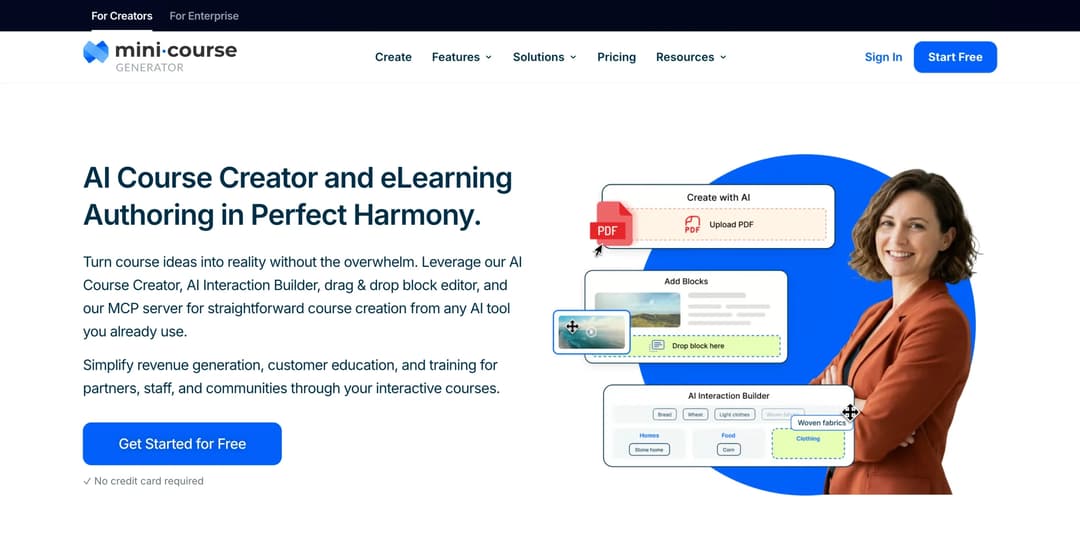
Disclosure: Mini Course Generator is our product. Judge this entry hardest.
Top Features
- AI Course Creator and PDF to Course Creator: existing docs become interactive micro-courses in minutes.
- Delivery where customers are: embeds, Headless LMS, share links, and the MCG App for Intercom.
- AI Quiz Builder with Certificates & Badges for verified understanding.
- Learning analytics with B2B2B learner data (your customers’ admins see their team’s progress).
- Branded academy Collections without a portal project.
Mini Course Generator is the lightweight tier’s argument: most customer education fails on production time and portal friction, so it attacks both. Courses are AI-drafted from your own material (95% hallucination-free generation from your own resources, MCG’s claim), and lessons ship inside the product, the support Messenger, or any page, rather than in a destination customers must remember to visit. For SMB and mid-market SaaS teams whose “education department” is one owner with an afternoon a week, that trade is the point.
Honest limits: no enterprise certification engine, no Salesforce-grade admin hierarchy, and no professional-services team; if you run a 40-person education function with compliance-grade requirements, the enterprise tier below is your shortlist. Pricing is public with a free start; details on the pricing page.
Pros
- Fast document-to-course loop and embed-first delivery; built for the reach problem the whole category struggles with.
- Rated 4.3/5 on G2 and 4.76/5 across 210 AppSumo reviewers.
Cons
- Authoring-and-delivery platform, not a prebuilt content library.
- Smaller review footprint than the enterprise suites.
2. Skilljar (by Gainsight)
Top Features
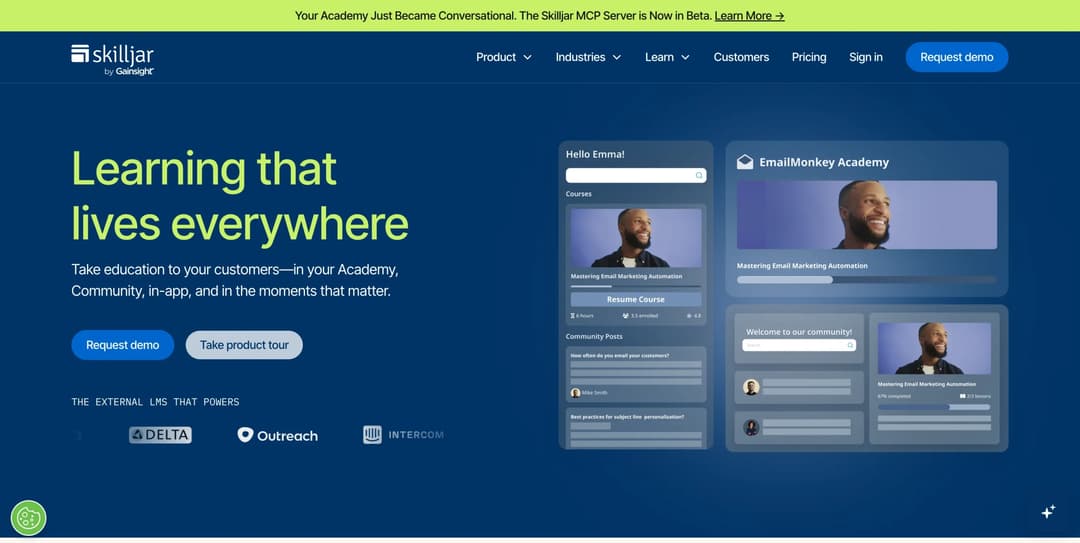
- Purpose-built customer education LMS: courses, paths, certifications.
- Certification engine with assessments and credentialing.
- Salesforce/CRM integrations tying learning data to account health.
- Multi-catalog architecture for customer and partner audiences.
- Now part of the Gainsight customer-success ecosystem.
Skilljar has been the category’s reference product for years, and its 2026 story is ownership: Gainsight acquired it, having already absorbed Northpass, which makes Gainsight the consolidated home of dedicated customer education. For buyers, the integration promise is learning data next to customer-success data; the risk to price in is the roadmap churn that follows any acquisition. Pricing is quote-based; rival vendor MeltingSpot frames the category’s entry range at “$500-$1,000/month” rising to six figures (their claim, not Skilljar’s published number). If Skilljar is the platform you’re thinking about leaving, our Skilljar alternatives comparison puts its field through these same tests.
Pros
- Strongest pure-CE feature depth in the category; G2 4.6 from 387 reviews.
- Certification and analytics built for dedicated education teams.
Cons
- Quote-gated pricing and implementation-project onboarding.
- Post-acquisition product direction is a live question buyers should ask about directly.
3. Docebo
Top Features
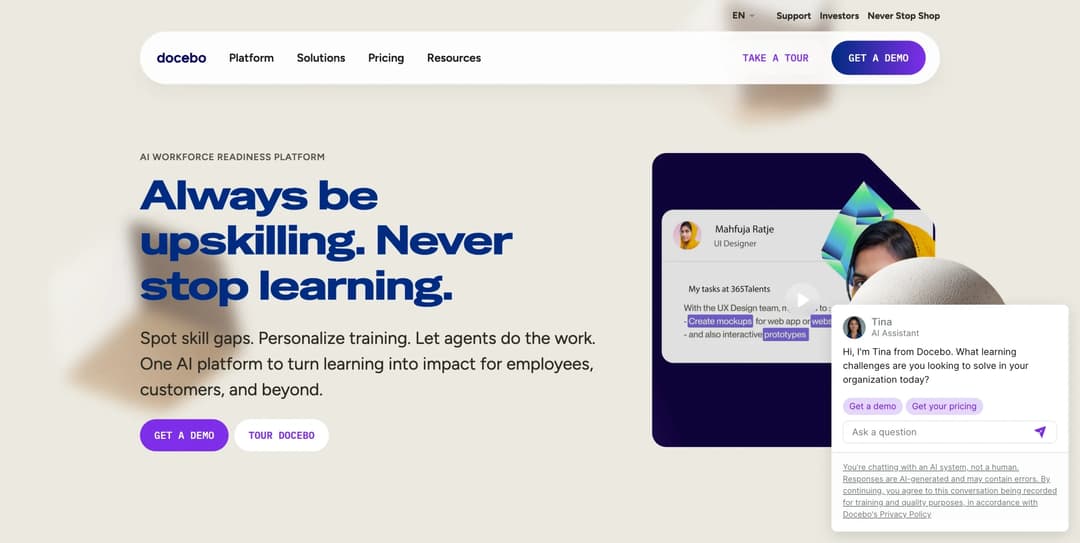
- One platform spanning employee, customer, and partner learning.
- AI-driven content suggestions and automation.
- Extensive integration ecosystem (their claim: 400+ third-party tools).
- Multi-domain branding for separate audience academies.
- Strong analytics and reporting layer.
Docebo is the enterprise generalist: one learning suite for every audience, with customer education as a first-class mode rather than the whole product. That breadth wins when the same company also needs employee and partner learning under one roof, and it costs you in configuration weight when all you wanted was a customer academy. Pricing is quote-based. If you’re weighing whether that breadth is worth the weight, our Docebo alternatives comparison lines it up against the lighter options.
Pros
- Category-scale platform with the largest review base here: G2 4.3 from 746 reviews.
- One vendor for all learning audiences, with mature admin tooling.
Cons
- Heavier and costlier than a dedicated-CE or lightweight buy for customer-only programs.
- G2 reviewers’ score sits below the dedicated CE leaders’.
4. Thought Industries
Top Features
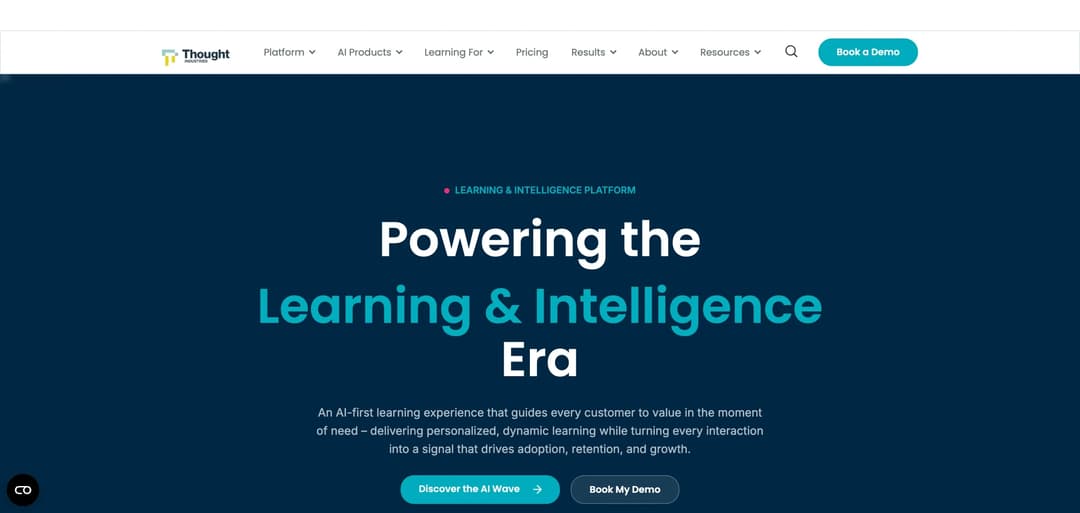
- External learning platform aimed at customer training and learning businesses.
- Monetization tooling for selling training (commerce, subscriptions).
- Multi-tenant “panorama” architecture for many branded academies.
- AI layer for personalized learning journeys.
- Strong fit for training-as-a-business models.
Thought Industries targets companies for whom learning IS a revenue line: certification businesses, paid training arms, and complex B2B customer programs. Its commerce and multi-tenant depth are the differentiators; if you sell training at scale, it belongs on the shortlist. If you educate customers to reduce churn rather than to invoice them, its machinery may exceed the mission. Pricing is quote-based. If it’s already your platform and the mission has changed, our Thought Industries alternatives comparison covers what else fits.
Pros
- The strongest training-commerce story in the enterprise tier.
- Multi-tenant architecture serves many-audience, many-brand programs well.
Cons
- G2 4.1 from 162 reviews, the lowest of the enterprise tier here.
- Overkill for internal-metric-driven (retention, deflection) education programs.
5. Intellum
Top Features
- Enterprise education platform serving very large audiences.
- Strong instructional/authoring layer alongside delivery.
- Personalization and engagement tooling at scale.
- The vendor behind the Forrester-conducted customer education ROI research.
- Services-heavy implementation model.
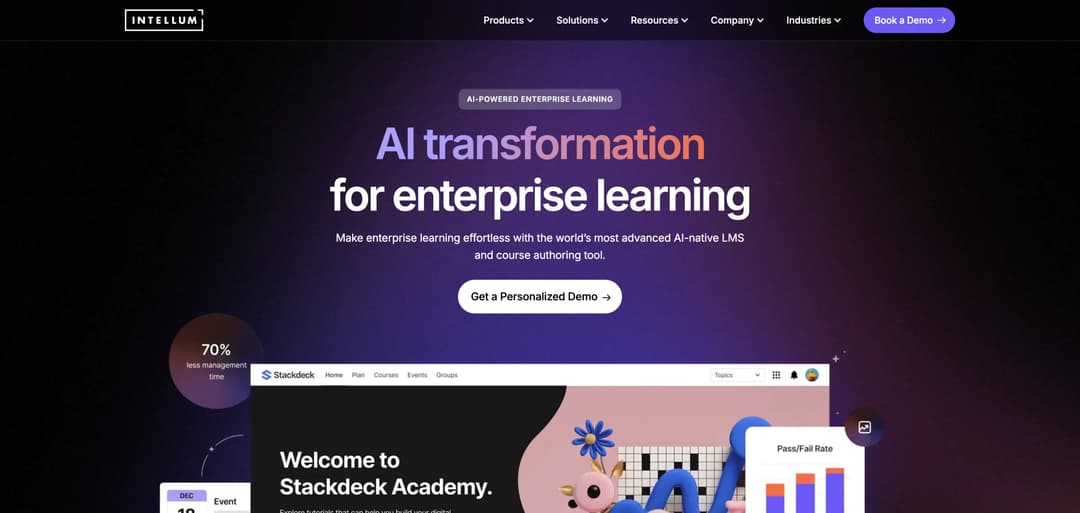
Intellum runs education for some of the biggest programs in tech, and it commissioned the research this whole category quotes: the 2024 Forrester Consulting study measuring 7.6% revenue lift and 38.3% adoption gains from formalized customer education (the full sourced dataset is in our customer education statistics). The platform itself is enterprise-scale with services to match. Pricing is quote-based. If Intellum is the platform you’re pricing against or moving off, our Intellum alternatives comparison sets its field side by side.
Pros
- Proven at very large audience scale; G2 4.4 (50 reviews).
- The strongest research/thought-leadership footprint in the category.
Cons
- Small review base relative to its market presence.
- Enterprise-only motion; not a fit below dedicated-team scale.
6. LearnUpon
Top Features
- Multi-portal LMS: separate branded environments per audience.
- Strong customer and partner training modes.
- Clean admin experience with automation.
- New agentic-AI platform direction (2026 repositioning).
- Solid integration set (CRM, webinar, SSO).
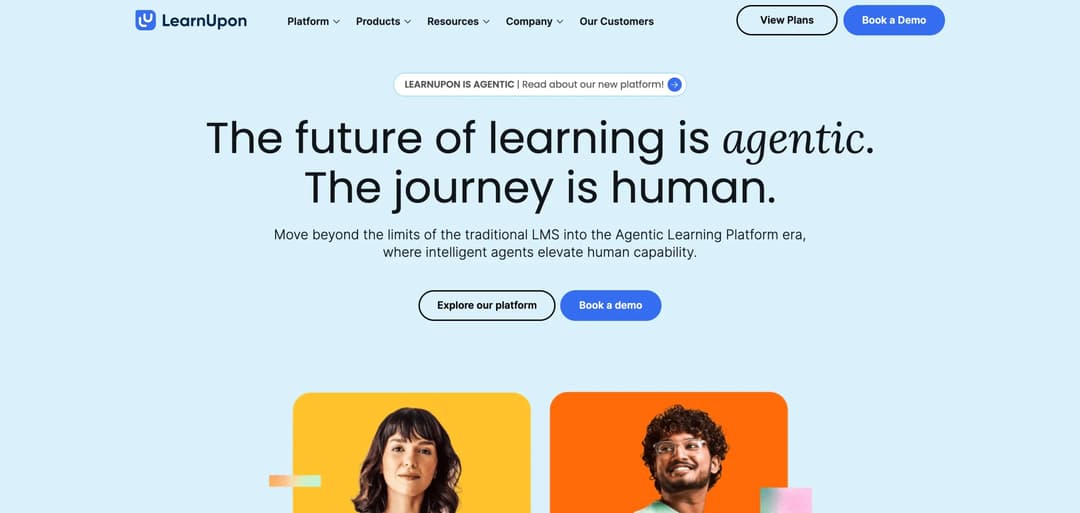
LearnUpon is the mid-market multi-portal specialist: customer, partner, and employee audiences each get their own branded portal from one system, without enterprise-suite pricing. Its 2026 “agentic learning platform” repositioning signals an AI-forward roadmap; the underlying multi-portal strength is what earns the shortlist spot. Pricing is quote-based. If you’re comparing it with the other multi-audience options, our LearnUpon alternatives comparison sets them next to each other.
Pros
- Best-in-tier multi-portal architecture for mixed audiences; Gartner Peer Insights 4.6 (24 reviews).
- Mid-market pricing posture with enterprise-style separation of audiences.
Cons
- Quote-gated pricing.
- Thin public review volume on major platforms relative to peers.
7. Absorb LMS
Top Features
- AI-heavy admin: content generation, smart recommendations, automation.
- Strong external-training (customer/partner) configuration.
- Enterprise-grade reporting and compliance tooling.
- Large partner/integration ecosystem.
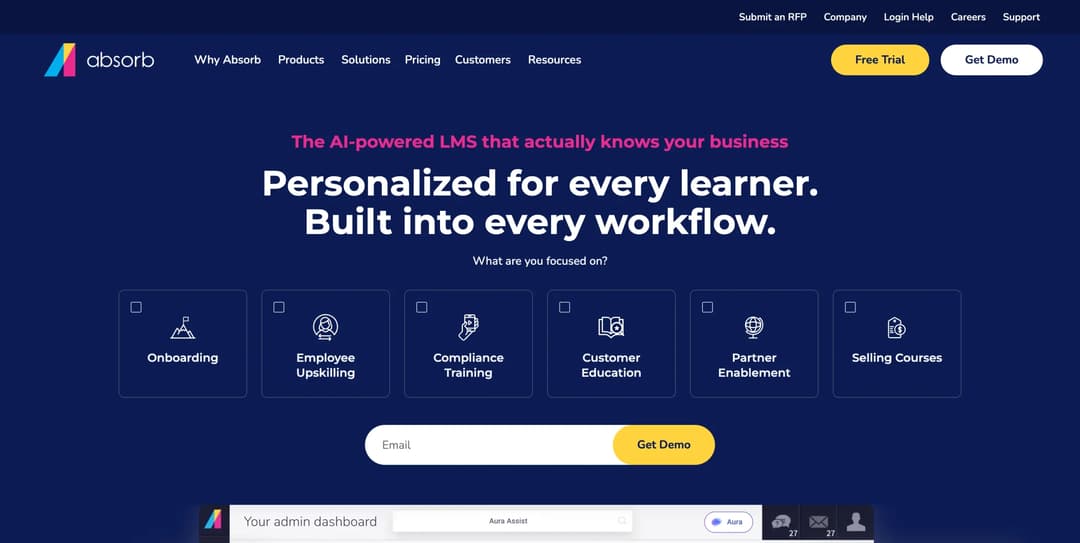
Absorb sits between mid-market and enterprise: a general LMS whose customer-education deployment is genuinely strong. Its AI-heavy admin tooling shows where its product investment is going. For teams that want one serious LMS covering internal and external learners with heavyweight reporting, it is a safe consolidated choice. Pricing is quote-based.
Pros
- Big, healthy review base: G2 4.6 from 808 reviews.
- Strong balance of admin power and usability for external training.
Cons
- Quote-gated pricing and sales-led onboarding.
- Generalist platform; customer education is a mode, not the product’s core identity.
8. TalentLMS
Top Features
- Fastest honest entry point in the category: free plan (5 users, 10 courses).
- Public pricing: Core $119/mo, Grow $229/mo, Pro $449/mo (+$6 per extra user, 20% off annually).
- Learning paths, automations, and mobile apps.
- TalentLibrary ready-made course add-on.
- Branches feature for separate audience portals.
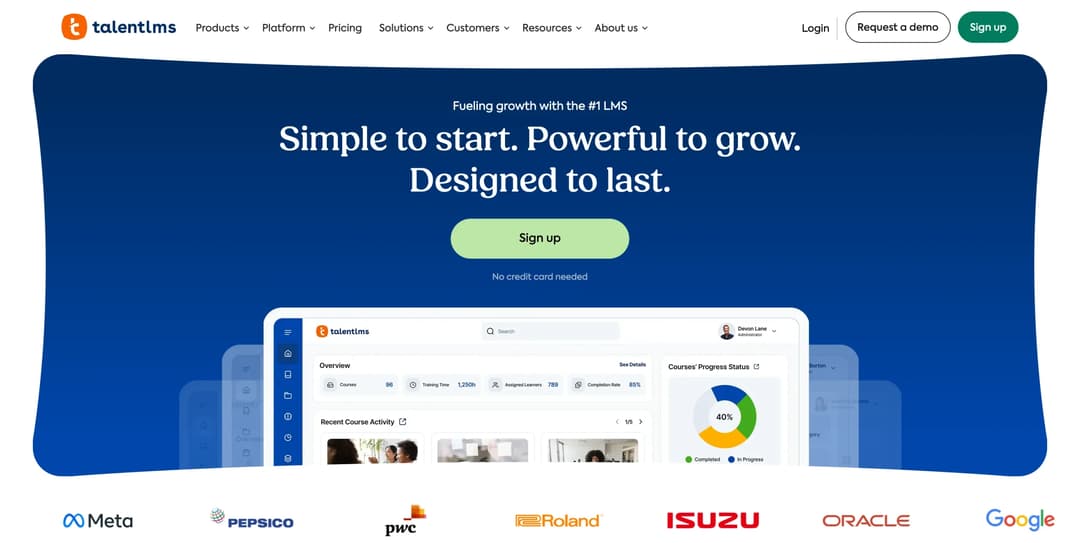
TalentLMS earns its place for a simple reason: it is the transparent, competent mid-market default. For customer education specifically, its Branches give you separated customer audiences, and the free tier makes it the cheapest way to pilot a real program this week. It lacks the CE-specific depth (certification engines, CS-data integration) of the dedicated tier.
Pros
- Public pricing plus a genuine free plan, unique in this list’s mid-tier.
- Gartner Peer Insights 4.5 (25 reviews); consistently strong ease-of-use reputation.
Cons
- Customer education is a use case here, not the product’s specialty.
- Content and certification depth trail the dedicated CE suites.
9. LearnWorlds
Top Features
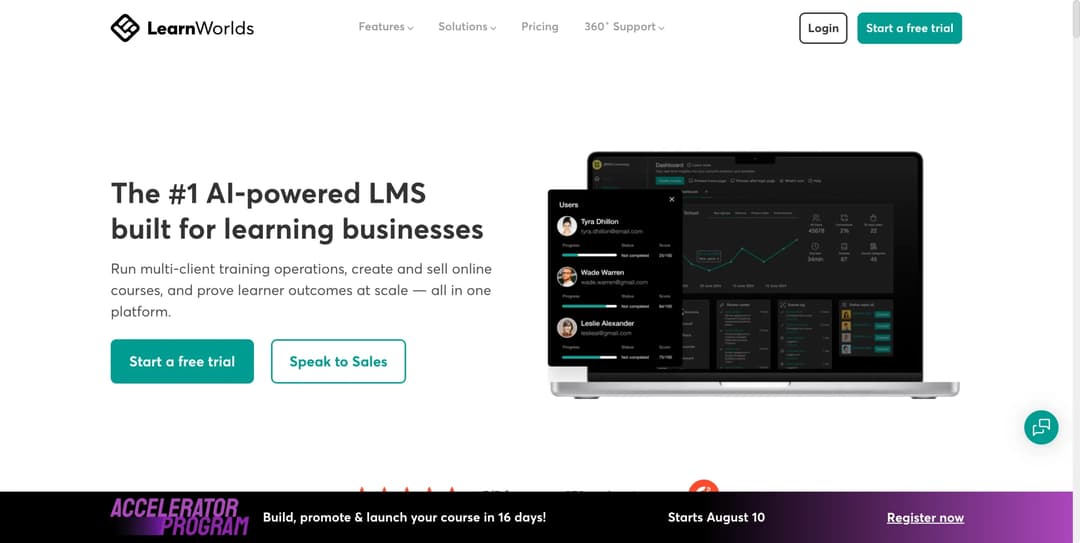
- Polished course experiences: interactive video, assessments, certificates.
- Public pricing from $24/mo (annual) to $299/mo, Corporate custom.
- Website/academy builder with strong branding control.
- Commerce built in (note: Starter plan carries a $5 per-enrollment fee).
- 30-day trial.
LearnWorlds comes from the course-selling world and brings its strengths across: the learner experience and academy polish are excellent for the price, and public pricing makes budgeting real. For customer education, it fits teams that want a beautiful branded academy fast, and its commerce DNA shows in details like enrollment fees on the entry plan. If you’re already on it and the academy model isn’t the fit, our LearnWorlds alternatives comparison covers that choice.
Pros
- Highest G2 score in this list: 4.7 from 379 reviews.
- Public pricing with a real low-cost entry tier.
Cons
- Built around the academy-destination model; in-product/in-support delivery is not its center of gravity.
- Entry-plan enrollment fees surprise teams using it for free customer education.
10. Trainn
Top Features
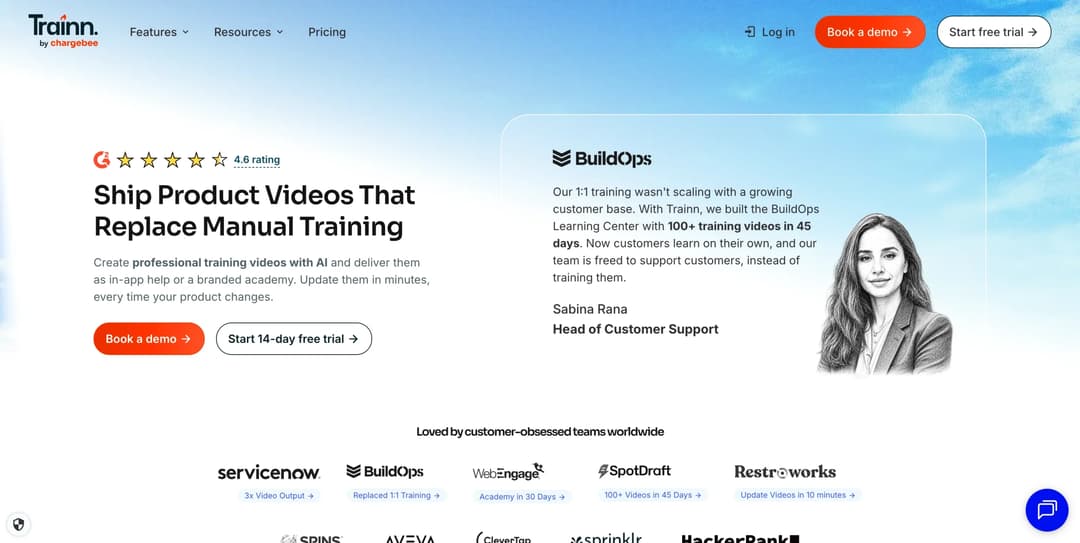
- Customer-education-specific platform for SaaS teams.
- Video-first: product walkthrough creation tooling built in.
- Academies, in-app guides, and knowledge-base delivery.
- Lightweight footprint versus the enterprise tier.
- SaaS-native positioning end to end.
Trainn is the other lightweight specialist here: customer education for SaaS, with video creation as its distinctive tool (record, edit, and publish product walkthroughs inside the platform). It is a young product with honest scope; for video-centric education programs at SMB scale it earns evaluation. Pricing is quote/contact-based, and no established third-party review base exists yet, so pilot against your own bar. If Trainn is the one you’re testing or the one you’re leaving, our Trainn alternatives comparison covers what else fits a video-first program.
Pros
- Genuine CE focus at lightweight scale; video tooling reduces production friction for walkthrough-style content.
Cons
- No meaningful independent review base to cite yet.
- Contact-gated pricing despite the SMB positioning.
How to Choose (the Short Version)
The long-form selection frameworks live in our other guides: the customer training software page carries the buyer checklist, the measurement guide covers the evaluation-by-numbers, and the onboarding playbook shows the first program you will build on whatever you pick. Here, just the routing logic:
- Dedicated CE team, certification programs, CS-data integration → Skilljar; Intellum at very large scale; Thought Industries if you SELL training.
- One platform for employees + customers + partners → Docebo at enterprise, Absorb or LearnUpon at mid-market.
- Real budget constraints, want to pilot this week → TalentLMS (free plan) or LearnWorlds (public pricing, polished academies).
- No education department, education must live in-product and in-support → Mini Course Generator; Trainn if video walkthroughs are your core format.
- Whatever the tier: run a two-week pilot with one real course against one real metric, and read our weekend academy build before scoping anything bigger.
Frequently Asked Questions
What is the best customer training software?
There is no single best, but there is a best per tier: Skilljar leads dedicated enterprise customer education (G2 4.6), Absorb and LearnUpon lead the mid-market LMS route, TalentLMS and LearnWorlds lead transparent-pricing budgets, and Mini Course Generator takes the lightweight embed-first route for teams without an education department. Match the tier to your program’s stage first, then compare within it.
What is the difference between customer training software and an LMS?
Customer training software is an LMS specialized for external, voluntary learners: frictionless access instead of company logins, branded multi-audience academies, certification for customers, and integrations with customer-success data. A general LMS assumes internal, assigned learners. The specialized tier earns its premium when customer education is a dedicated function; a strong general LMS or lightweight tool covers the job before that.
How much does customer training software cost?
As of August 2026, only the mid-tier publishes numbers: TalentLMS runs free to $449/month and LearnWorlds $24 to $299/month. The dedicated enterprise tier is quote-only; MeltingSpot, a vendor in the space, frames typical entry at $500-$1,000/month rising to six figures for enterprise programs (their claim). Budget implementation and admin time alongside license cost.
Did Gainsight really acquire Skilljar?
Yes. Gainsight now markets the product as “Skilljar by Gainsight”, and it had previously absorbed Northpass as Gainsight Customer Education. The category’s two best-known independent platforms are now one company’s portfolio, which matters if you were weighing Skilljar against Northpass: that comparison no longer exists.
Do small SaaS teams need dedicated customer training software at all?
They need customer education; they rarely need the enterprise platform. Put another way, the discipline is not optional and the software tier is. A lightweight setup (short verified courses, delivered in-product and in the support flow, measured on ticket classes and activation) covers the job at one-owner scale. The strategy is in our customer education guide; the platform choice follows the program, not the other way around.