

Buying a healthcare LMS looks like one decision. It’s actually three, and they have different answers.
Can the platform award continuing education credit, or does it only record credit that somebody else awarded? Will it handle protected health information, or does the contract quietly forbid it? And can an organisation your size actually buy the thing, or does every path end at a sales form?
We put all three questions to ten healthcare LMS platforms. Not the marketing pages. The accreditation statements, the security and trust pages, the published Master Service Agreements, and the live course catalogues.
The answers don’t line up the way the guides suggest. **Only one of the ten publishes a price a clinic could act on**. Two of the ten are genuinely accredited to award CE credit in their own name. One of them markets a healthcare LMS while its own Terms of Service prohibit putting patient data in the product. And the market incumbent’s dedicated trust and security page does not mention HIPAA.
Here is what each platform is really for, what it costs, and which of the three questions it fails.
Onboard clinical staff with Mini Course Generator – turn a protocol or policy document into training you can send out today.
What Is a Healthcare LMS?
A healthcare LMS is a compliance training platform built to handle the specific obligations of a clinical workforce: mandatory annual training tied to regulator requirements, continuing education credit for licensed staff, competency validation at the point of care, and evidence that survives an audit.
That last part is what separates it from a general learning platform. A corporate LMS proves someone finished a course. A healthcare LMS has to prove the right person finished the right training before the right date, in a form a surveyor will accept.
Three capabilities do most of that work:
- CE credit handling. Recording continuing education hours against a learner’s licence, and reporting them to the state board or national registry that needs to see them.
- Competency validation. Skills checklists and observed sign-offs, not just quiz scores, because a nurse passing a test on central line care is not the same as a preceptor watching them do it.
- Regulatory content maintenance. Somebody has to keep the HIPAA course current when the rule changes, and keep the state-specific variations straight across every state you operate in.
Most platforms marketed as healthcare LMS software do one or two of these well. Almost none does all three, and the gaps are rarely where the sales deck says they are.
The Three Questions That Actually Decide This Purchase
We built this guide around three questions rather than a feature checklist, because features are where these vendors agree and the three questions are where they diverge sharply.
Question 1: Can it award CE credit, or only record it?
This is the single most blurred claim in the category, and the difference is worth real money.
Being an accredited provider means the vendor holds accreditation from a body like the Accreditation Council for Continuing Medical Education (ACCME), the American Nurses Credentialing Center (ANCC), or the Accreditation Council for Pharmacy Education (ACPE). It can issue credit under its own name. You buy the platform and the credit arrives with it.
Being a platform that handles CE means it can record hours, generate certificates, and report to a registry. The credit itself comes from somewhere else, which you either hold yourself or license separately.
Of the ten platforms here, exactly two are accredited providers:
- Relias holds Joint Accreditation across ACCME, ACPE, and ANCC, which is the designation awarded by all three bodies together. It issues physician CME, nursing contact hours, and pharmacy CE in its own name.
- Medbridge is an ANCC Accredited Provider with Distinction for nursing, and lists accreditation across twelve named therapy and allied-health disciplines.
Two more hold something that reads like accreditation and is not. HealthStream and MapleLMS are both ACCME Premier Technology Partners. That is a designation for software vendors who support accredited providers well. It says nothing about the vendor’s own ability to award credit. Both companies describe it accurately on their own pages. In a sales conversation, or in a competitor’s comparison table, the distinction tends to evaporate.
The remaining six make no accreditation claim at all, and most of them are honest about it.
Watch the phrasing. “Courses meet rigorous ACCME and ANCC standards” is not the same claim as “we are accredited by ACCME and ANCC.” “Accredited by 250 trusted bodies” usually means the individual courses carry credit from various providers, not that the vendor awards it. Ask which entity’s accreditation number appears on the certificate your staff receives.
Question 2: Will it handle protected health information?
Almost every healthcare LMS page mentions HIPAA. Almost none of them is making a claim about the platform when it does.
There is a difference between HIPAA as a training topic and HIPAA as a platform posture. “Deliver HIPAA training to your staff” is a content claim. “We will sign a Business Associate Agreement and handle PHI” is a compliance claim. The first appears everywhere. The second is rare.
What the security, trust, and legal pages actually say:
- symplr publishes a standing Business Associate Agreement anyone can read before a sales call, written to self-execute when the customer is a covered entity. That is the strongest posture in the set, and it is not a negotiation.
- Medbridge states the platform is HITRUST CSF Certified. But its own FAQ scopes the BAA to the plans that include patient-facing Care features, not to the Educate plans that are the LMS on its own.
- HealthStream identifies itself in its privacy policy as a business associate when it processes PHI, while also stating that most of its services are not designed to hold PHI in the first place.
- Relias publishes a dedicated trust and security page that does not mention HIPAA, BAA, PHI, or HITRUST anywhere on it. Its Master Service Agreement bars customers from uploading PHI to any service Relias has not specifically designated as suitable for it, and it does not publish which services those are.
- Litmos goes further in the other direction. Its Cloud Terms of Service state that the customer “shall not process or submit to the Cloud Services any Customer Data that includes any … patient, medical or other protected health information regulated by the Health Insurance Portability and Accountability Act.” It sells a healthcare LMS page. The contract behind it bars patient data.
- Absorb makes no HIPAA claim, offers no BAA, and its terms decline to warrant compliance with specific data privacy regulations.
- Moodle makes no HIPAA claim and offers no BAA. Any such term would come from whichever partner hosts your instance.
- MedTrainer states in a security document that PHI is not stored in the platform, so it “maintains HIPAA compliance” without holding a certification. Its Terms of Service contain no BAA and no mention of HIPAA at all, even though its privacy policy points there for PHI obligations.
- MapleLMS states in a FAQ that it is “fully committed to meeting the stringent requirements for HIPAA compliance.” It offers no business associate agreement and claims no HITRUST certification. Its actual third-party attestation is SOC 2 Type 2.
- Mini Course Generator, ours, publishes no HIPAA claim and no BAA either. Details are in its own entry below.
The practical takeaway is simpler than it sounds. Most LMS platforms are workforce systems that should never hold patient data, and the well-run ones say so plainly. The problem is not that Litmos bars PHI. The problem is that a healthcare LMS page pitched at clinical readiness does not mention that the contract bars it.
If your use case genuinely involves PHI, ask for the BAA in writing before the demo, not after the quote.
Question 3: Can you actually buy it?
This is where the category is at its worst, and where a small provider gets stuck.
Of the ten platforms, one publishes a price that a small organisation can act on: Medbridge Business Essentials at $49 per seat per year, minimum two seats, payable by card in an online cart. That is a floor of $98 a year.
Everything else in the healthcare-native group is quote only:
- Relias publishes no prices.
- HealthStream has no pricing page. Its only self-serve checkout is a $49.99-a-year individual CE catalogue for nurses, which is not an LMS.
- MedTrainer publishes three named tiers with no price on any of them, and its own FAQ states it “is the answer for healthcare organizations with more than 100 employees.”
- symplr publishes no prices.
- MapleLMS publishes a request-for-quote form whose smallest employee bracket is “Under 500.”
- Litmos and Absorb both publish tier names with “Contact for Pricing” against every one.
Moodle is the exception in the other direction. Self-hosted Moodle costs nothing to license, and MoodleCloud Starter is $170 a year for 50 users on a self-serve button. But the healthcare features Moodle markets sit in Moodle Workplace, which is quote only, partner-delivered, and in the US implementable only by Moodle’s own services team.
Why this matters more than it looks. Quote-only pricing is not just an inconvenience. It means you cannot budget before you are in a sales cycle, cannot compare two vendors without running two sales cycles, and cannot walk away cheaply once you have spent six weeks on procurement. In a category where the published contracts contain five-year default terms and automatic annual increases, that asymmetry is the product. Our full LMS pricing guide has the wider picture across twenty platforms.
The Compliance Matrix
Everything above, condensed. Read the CE column and the PHI column together, because a platform that is strong on one is often weak on the other.
| Platform | Accredited provider? | BAA offered? | Clinical content | Entry floor | Buy self-serve? |
|---|---|---|---|---|---|
| Mini Course Generator | No | Not published | None (you author it) | 14-day trial | Yes |
| Relias | Yes (ACCME + ACPE + ANCC) | Not published | ~9,000 courses, ~4,500 accredited | Quote only | No |
| HealthStream | No (ACCME tech partner) | Implied, not published | 35,000+ from 60+ publishers | Quote only | No |
| Medbridge | Yes (ANCC with Distinction) | Care plans only | 2,500+ CE, 150+ compliance | $49/seat/yr, 2 seats | Yes |
| MedTrainer | No | Not published | 811 in live catalogue | Quote only | No |
| symplr Learning | No | Yes, published | 8,500+ from 13 partners | Quote only | No |
| MapleLMS | No (ACCME tech partner) | Not published | None clinical | Quote only | No |
| Litmos | No | No (contract bars PHI) | 450 AMC + 200 SIMTICS | Quote only | No |
| Absorb | No | No | Via partner libraries | Quote only | No |
| Moodle | No | Not published | None | $0 or $170/yr hosted | Yes (LMS only) |
All figures come from the vendors’ own pages and published contracts.
The 10 Best Healthcare LMS Platforms
This list is not ranked best to worst. A ranking would be dishonest here, because these platforms are not competing for the same job. Relias and a course authoring tool are not alternatives to each other, and any list that pretends otherwise is selling something.
Instead, the order runs by the job each platform is built to do. It starts with the training every healthcare employer has to produce itself. Then it moves through the accredited CE incumbents and the compliance operations platforms. It ends with the general-purpose systems and the build-it-yourself route.
Our methodology. Every figure comes from each vendor’s own pages, security and trust documentation, published contracts where available, and live course catalogues, checked in August 2026. Prices are quoted verbatim or reported as absent, never estimated. Accreditation claims are quoted in the vendor’s own words. Where a vendor’s own pages contradict each other, we say so and cite the page.
Our disclosure. Mini Course Generator is our product. It is listed first because of the job it does, not because we judged it better than platforms that do a different job. Its limitations for healthcare buyers are stated in full, including the ones that will disqualify it for some readers.
1. Mini Course Generator: For the Training You Have to Write Yourself
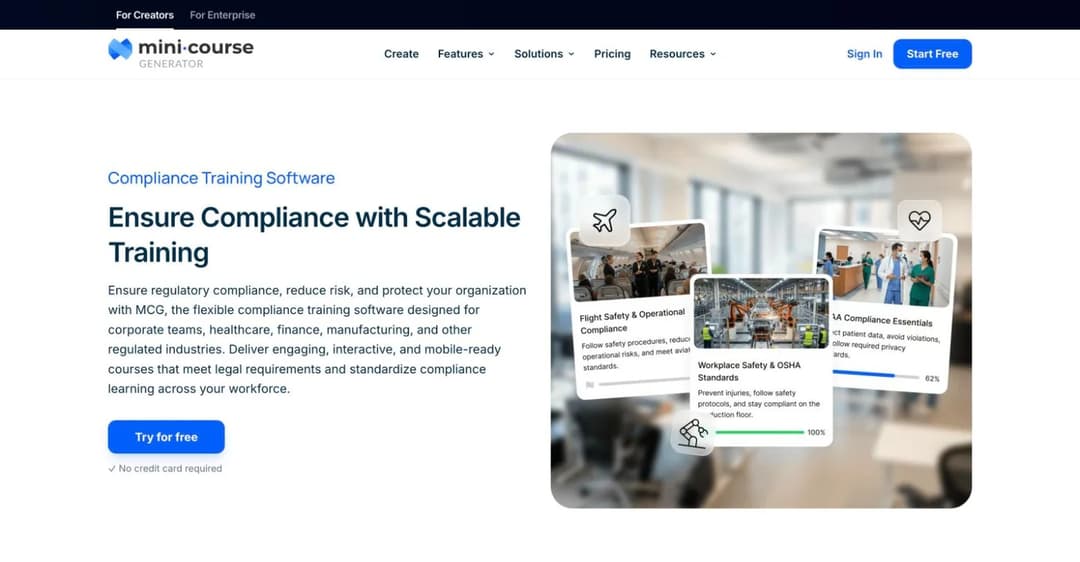
Every healthcare employer runs into the same gap. The library covers HIPAA, bloodborne pathogens, and infection control. It does not cover your new sepsis protocol, your changed hand-off procedure, the workflow at the clinic you just acquired, or the corrective action your last survey generated.
That material has to be written by someone inside the organisation, usually a nurse educator or a compliance manager with no instructional design background and no time. It is also the material that changes most often.
Mini Course Generator is built for that job. Point it at a policy document, a protocol PDF, or a set of notes. It produces an interactive mini course you can edit, brand, and send out as a link the same afternoon. No implementation project, no course-building software to learn.
For a healthcare team, the parts that matter most are the practice formats. Branching scenarios let you build a clinical decision walkthrough where the wrong turn plays out instead of being marked wrong. Interactive case studies work for morbidity and mortality review or care-plan reasoning. Adaptive quizzes adjust to what the learner already knows, which matters when the same annual refresher goes to a first-year nurse and a twenty-year veteran. The full set is in the Agent Skills library.
Courses are delivered by link, embed, or QR code, so staff can complete them on a phone between patients without an LMS login. And content exports as SCORM, which means the courses you build here can be loaded into whichever compliance platform your organisation already runs. That is the realistic pattern for most healthcare buyers: keep Relias or HealthStream for accredited CE, and use something faster for the material only you can write. If you are new to that idea, our SCORM and xAPI explainer covers how the handoff works.
Best for: nurse educators, clinic managers, and compliance leads who need to turn a policy change into training this week, and organisations that already have a compliance LMS but cannot get content into it fast enough.
What it is not, stated plainly:
- Not an accredited CE provider. MCG does not award ANCC contact hours, ACCME CME, or any other credit. If you need accredited CE, you need one of the platforms below.
- No clinical content library. There are no prebuilt HIPAA, OSHA, or infection control courses. You bring the content.
- No published HIPAA posture. MCG does not publish a HIPAA compliance claim, does not publish a Business Associate Agreement, and has no published security page. Keep patient data out of it, as you should with any LMS that does not publish a BAA.
- No credentialing or licensure tracking. No licence expiry monitoring, no primary source verification, no exclusion screening.
- No free plan. A 14-day trial with no credit card required, then paid plans. Current figures are on our pricing page.
Pricing: published on our pricing page, with a 14-day free trial and no setup fees.
2. Relias: The Accredited CE Incumbent
Relias is the category’s centre of gravity, and it earns that position on one capability that almost nothing else in this guide has.
Relias is itself the accredited provider. Its own words: “Relias LLC is jointly accredited by the Accreditation Council for Continuing Medical Education (ACCME), the Accreditation Council for Pharmacy Education (ACPE), and the American Nurses Credentialing Center (ANCC), to provide continuing education for healthcare teams.” That is Joint Accreditation, awarded by all three bodies. It means Relias issues CME, nursing contact hours, and pharmacy CE under its own name rather than reselling somebody else’s credit.
For a multi-disciplinary workforce, that removes an entire sourcing problem. A behavioural health provider with nurses, social workers, and behaviour analysts on staff would otherwise be buying CE from three different accredited sources.
The content library is the other half of the pitch. Relias states roughly 9,000 courses of which about 4,500 carry accreditation, plus more than 350 regulatory courses covering HIPAA, OSHA, CMS, and state-specific requirements, with state-by-state crosswalks maintained on the customer’s behalf. Competency assessment is genuinely strong: 350 validated assessments, 25 or more standardised competency evaluations, and skills checklists designed for point-of-care sign-off.
What the sales deck will not tell you:
- The trust and security page does not mention HIPAA, BAA, PHI, or HITRUST. What it does claim is SOC 2, PCI DSS, GDPR and CCPA alignment, AES-256 at rest, and TLS 1.2 in transit. It also lists FedRAMP status as “In Process,” which it has been since March 2024.
- The Master Service Agreement’s default position is that Relias services are not PHI-suitable unless specifically designated. Which ones are designated is not published.
- The contract is seller-favourable. It auto-renews for a term equal to the ending term unless you cancel 60 days out. It permits annual fee increases after month 12 on 60 days’ notice. It allows no fee adjustment or refund for reduced usage mid-term. And it contains no termination-for-convenience clause at all.
- Cycling seats to stay under your licence count is a stated material breach. For a high-turnover employer, read that clause before signing.
- The course count contradicts itself across Relias’s own pages. Different Relias pages give 3,000, 4,500, 5,000, and 9,000. Ask which figure appears in your order form.
- No EHR and no credentialing system is named anywhere in its integration material. HRIS partners are named. Epic, Oracle Health, and the credentialing suites are not.
- No free trial of the platform. Two single-course lead magnets exist. Neither gives an organisation LMS access.
Best for: mid-to-large post-acute, senior care, behavioural health, home health, and hospital employers with mixed licensed disciplines, where in-house Joint Accreditation removes the need for several CE contracts.
Pricing: not published anywhere. The MSA defines pricing metrics as “per-User license, per-facility license, per-bed license, per-admin license, or any other measurement agreed upon.” Per-bed licensing tells you who this is priced for.
3. HealthStream: For Hospitals That Buy on Competency and Reporting
HealthStream is the hospital and health system answer, and the thing it is actually best at is not course delivery. It is proving clinical competency and getting CE reported to the right registry.
The HealthStream Competency Suite covers knowledge and clinical judgment assessments, skills validation supporting Likert, novice-to-expert, or method validation approaches, preceptor training, and reporting that benchmarks your staff against national comparators. That last capability is genuinely rare. Most LMS platforms can tell you your completion rate. Very few can tell you how your nurses’ clinical judgment scores compare to everyone else’s.
CE reporting is the other strength. Its CE Management products handle application, registration, evaluation, certification, and transcript management, and report into PARS, JA-PARS, CPE Monitor, NARS, and CE Broker. If your organisation is an accredited provider running its own CE programme, this is the plumbing that keeps it compliant.
Licensure tracking is included in hStream for Learning across all 50 states, monitoring more than 600 verified boards and data sources, with primary source verification and expiration notifications.
What to check before you commit:
- HealthStream is not an accredited provider itself. It holds ACCME Premier Technology Partner status, a designation for supporting accredited providers. Accreditation sits with the 60-plus content publishers behind its 35,000-course marketplace.
- No BAA is published, though the privacy policy identifies HealthStream as a business associate when it processes PHI. The same policy states most services are not designed to hold PHI. Ask for the BAA, the HITRUST scope, and the SOC 2 Type II report by name.
- No EHR integration is named anywhere. Neither is a named HRIS connector for the LMS itself. The one Workday integration HealthStream lists belongs to the scheduling product, not the LMS.
- Watch the “Access Partners” page. It sounds like technology integrations. It lists content vendors.
- Deep provider credentialing is a separate purchase. CredentialStream, CredentialMyDoc, and HealthStream CVO are priced apart from the LMS.
Best for: hospitals and multi-site health systems whose buying decision is driven by CE reporting to boards, clinical competency validation, and 50-state licensure tracking rather than by authoring ergonomics.
Pricing: not published. The only self-serve purchase HealthStream offers is Nursegrid Learn at $49.99 a year for an individual nurse, which is a CE catalogue rather than an LMS.
4. Medbridge: The Only One That Publishes a Price
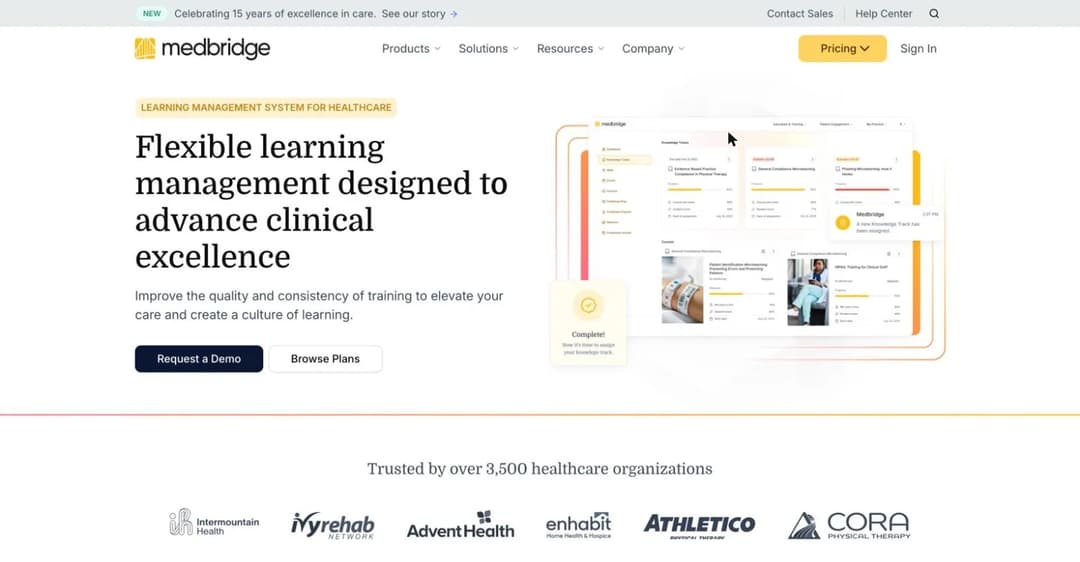
Medbridge is the answer to Question 3 in this whole category, and it is worth saying loudly: it is the only platform here a small clinic can buy without a sales call.
Business Essentials is $49 per seat per year with a two-seat minimum. The cart accepts up to 99 seats on a credit card. Above 50 seats Medbridge routes you to sales for enterprise terms, but the self-serve path is real and it is priced.
It is also an accredited provider. The nursing page states courses and live webinars are “accredited for RNs and LPNs by ANCC and are accepted in all U.S. states as continuing education,” and displays an ANCC Accredited Provider with Distinction badge. Its FAQ lists accredited disciplines explicitly: physical and occupational therapists and assistants, athletic trainers, strength and conditioning specialists, speech-language pathologists, nurses, case managers, long-term care administrators, respiratory therapists, and social workers.
The platform is HITRUST CSF Certified. Medbridge Skills covers self-assessments, customisable skills checklists with prebuilt job-specific templates, bulk preceptor sign-off, and evaluation notes logged to a permanent training record.
Where the scoping bites:
- The BAA rides with the Care plans, not the LMS plans. Medbridge’s FAQ states that plans including Care features permit PHI access and include a BAA in the service agreement. Educate-only plans, which is what you buy if you want the LMS on its own, are not covered by that statement. Confirm BAA availability for an Educate-only contract in writing.
- The accreditation claim carries an asterisk. “Accredited in every state and by all major licensing bodies” is footnoted, and the FAQ narrows it to twelve named disciplines.
- No ACCME accreditation. There is no physician CME here. Accreditation is US-only.
- Course counts conflict. The pricing chart says 2,500 or more on-demand CE courses; the CE landing page says over 3,100.
- No licensure expiry tracking. Competency assessment is real. Licence renewal monitoring is not described anywhere on the product pages.
- No real trial. Only the first chapter of each course is free. The LMS and admin tooling cannot be tried before purchase.
- Individual plan prices are currently promotional, not list. Student is $150 list, showing at $100; Education is $405 showing at $339; Premium is $455 showing at $389.
Best for: outpatient rehab and therapy groups, home health and hospice agencies, and skilled nursing operators who need ANCC nursing CE, and any small healthcare employer that wants to buy a platform this quarter rather than next.
Pricing: Business Essentials $49 per seat per year, In-Home Basics $75 per seat per year, two-seat minimum, annual prepay, no refunds on group subscriptions.
5. MedTrainer: Compliance and Credentialing on One Contract
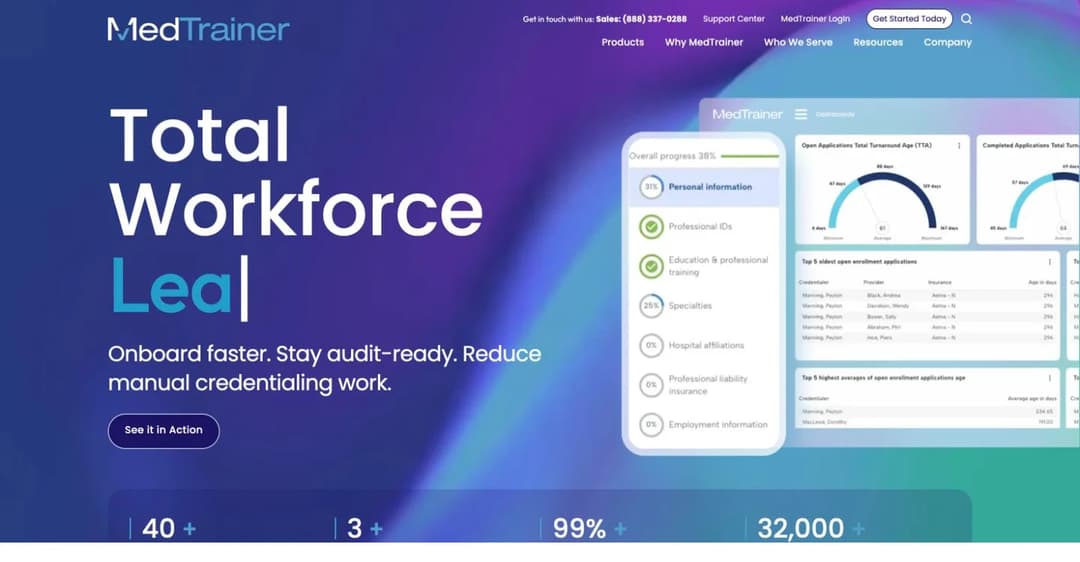
MedTrainer‘s proposition is consolidation. Learning, compliance document management, and provider credentialing on one login and one contract, aimed at ambulatory surgery centres, community health centres, urgent care chains, specialty groups, and dental groups.
The credentialing side is the strongest part and it is not a rebadge. DataSpring powered by CAQH gives permission-based API access to the CAQH Provider Data Portal. Propelus Data Solutions provides 50-state licence verification with source imagery pulled into the provider profile for primary source verification. NPDB queries run direct and unlimited, logged to the profile. OIG, SAM, and state exclusion screening runs continuously. Privileging and board approval shipped in June 2026.
Expiry tracking is concrete: if a BLS or other certification is set to expire, both the employee and the administrator get email notice ahead of time, and annual training auto-reassigns.
Then you read the contract.
MedTrainer’s Terms of Service, last updated 14 July 2026, section 10.1: “If no length is listed in the Order Form, the initial Term is sixty (60) months.” A five-year default commitment if nobody fills in the term. It auto-renews one day before term end unless cancelled at least 30 days prior, and early cancellation requires “payment of the aggregate, agreed upon contract amount.”
Section 4.14 adds an automatic 8% annual increase: “Annual support and maintenance fees shall increase by eight percent (8%) on each anniversary … The Annual Adjustment is a fixed rate and shall apply automatically at each renewal without further notice.” Over a five-year term that is four increases, so the final year runs roughly 36% above the starting rate.
The pricing page describes “Flexible Contract Terms.”
Other things to check:
- Fees are owed “regardless of actual usage” and are non-refundable. AutoPay authorisation is “irrevocable during the active contract term,” and the customer waives chargeback rights.
- HIPAA documentation is circular. The privacy policy points to the Terms of Service for PHI obligations. The Terms of Service never mention HIPAA and include no BAA.
- MedTrainer is not an accredited provider. Its courses are “recognized by” and “approved by” outside bodies. Named credit hours include ANCC 430+, ADA CERP 120+, CCMC 80+, ACPE 60+, ASWB 60+. ACCME is not among them, despite CME appearing in the marketing copy.
- The library is smaller than the marketing claims. The live catalogue lists 811 courses. Marketing says “nearly 1,000,” “1,000+,” and “1,200+” on different pages.
- CE entitlement is contradicted in the vendor’s own copy. The CE page says CE is provided “at no extra cost.” The Learning FAQ says CE courses are “available as add-ons.” Get it written into the order form.
- No formal competency assessment. No skills checklists, no observed sign-off, no preceptor module. Assessment is post-course quizzes.
- No EHR or practice-management integration is named anywhere. The API is described as HL7-compliant in architecture, which is not the same as a shipped connector.
- Its own FAQ steers small buyers away: “MedTrainer is the answer for healthcare organizations with more than 100 employees.”
Best for: multi-site US healthcare organisations above roughly 100 employees that want training, policy management, and credentialing on one contract, and whose legal team will read section 10.1 before signing.
Pricing: three tiers, Select, Premier, and Signature, none with a published price. Billing is per licence per month.
6. symplr Learning: Built for Survey Readiness
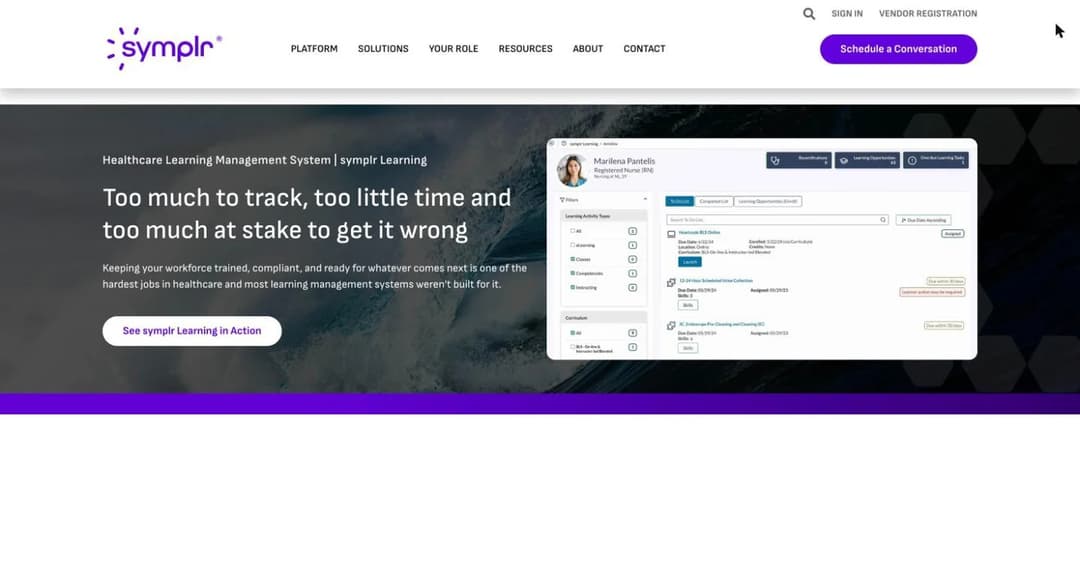
symplr Learning, formerly HealthcareSource NetLearning, is optimised for one moment: the survey. Its own framing is that most learning management systems were not built for healthcare, and its product is organised around producing clean Joint Commission, OSHA, CMS, and Magnet completion evidence on demand.
It does two things better than almost anything else here.
First, the BAA. symplr publishes a standing Business Associate Agreement you can read before you talk to anyone, incorporated by reference into the Master Services and License Agreement, that self-executes on the facts: if the customer is a covered entity and symplr may handle PHI in performing services, the BAA applies. It flows down to symplr’s own vendors. Its security page states plainly that “symplr products comply with HIPAA Security and Privacy regulations.” No vendor here comes close to that clarity.
Second, it separates two things every other vendor conflates. The product page lists competency assessment and licensure tracking as distinct capabilities in distinct bullets: “Evaluate staff competencies and clinical readiness with easy-to-use assessments and reporting” and “Track licenses, certifications, and mandatory training across teams.” That precision is rare and it is a good sign about the product.
The content library runs to 8,500 or more clinical and non-clinical courses carrying over 3,000 CE credits. Thirteen named partners supply it, among them the American Heart Association, Lippincott Solutions, AACN, RQI, Apex Innovations, and HCPro. The compliance libraries are enumerated course by course in the public solution terms, a 25-course Core library and a 55-course Premium library, with every title printed. That is unusual transparency.
The contract is where it gets expensive:
- A default 6% annual price increase. MSLA 7.1: recurring fees may increase annually by six percent unless the order form says otherwise. Roughly a third higher by year five.
- Two conflicting non-renewal deadlines in symplr’s own documents. The MSLA requires 90 days’ written notice. The Premium Compliance courseware terms require 60. Diarise the 60-day date and you auto-renew the platform.
- No termination for convenience anywhere in the MSLA, and no refunds on termination.
- Courseware carries a seat-parity floor: the number of content licences must equal the number of licensed LMS users, so you cannot pilot content with a subset.
- symplr is not an accredited provider. The product page makes no accreditation claim, and never mentions ACCME, ANCC, ACPE, or contact hours. The courseware terms define symplr’s role as a reseller of partner content.
- HITRUST does not cover Learning. symplr’s security page certifies five other products and pointedly does not include Learning or the Talent Suite.
- Its own credentialing products are not listed as integrations. symplr Provider does primary source verification. The Learning page does not name it. Neither page names the other. The one thing this vendor could uniquely offer, a single graph joining credentialing, licensure, and competency, is not claimed on either page.
Best for: mid-to-large hospitals and health systems already running other symplr modules, whose buying committee’s real question is whether they can produce clean survey evidence on demand.
Pricing: not published, and no rate card exists publicly.
7. MapleLMS: For Associations and CE Societies
MapleLMS is the odd one in this list, and it is here because it serves a buyer nobody else on the page serves well: the accredited body that runs its own CE programme and needs to report it.
Its continuing education handling is genuinely credible and, unusually, it keeps the two CE claims properly separate. On issuing, it supports CEU, CME, CNE, and ACCME PARS, with multiple credit types assignable per activity, auto-assignment to learners, credits shown on dashboards, certificates, and transcripts, and export to external systems. On accreditation, it is clear that it is an ACCME Premier Technology Partner, a designation covering “ACCME-aligned activity and learner data reporting through secure API integrations” and “simplified PARS and JA-PARS integrations.” Its own page frames the customer as the accredited body. That’s exactly right, and most vendors aren’t that careful.
Its named reference is the American Society of Hematology, covering ASH-SAP, CME, and Maintenance of Certification via PARS integration. That is the profile of buyer this fits.
The Salesforce connection is the other differentiator. MapleLMS runs a two-way Salesforce sync, which matters for membership organisations whose member records live in Salesforce.
Competency assessment is real: a competency matrix mapping required skill levels to job roles, with assessment against them and gap identification.
What to be careful about:
- The HIPAA claim is a statement of commitment, not an attestation. Its FAQ says MapleLMS is “fully committed to meeting the stringent requirements for HIPAA compliance.” It offers no business associate agreement and claims neither HITRUST nor 21 CFR Part 11 compliance. HIPAA comes up only on its healthcare page. The attestation it actually holds is SOC 2 Type 2.
- The “complete catalog of healthcare courses” names no course and no count. The only counted library is BizLibrary at 10,000-plus courses, and BizLibrary’s subject areas are business skills, HR compliance, leadership, IT, sales, and OSHA workplace safety. They are not clinical. The same page also states that BizLibrary access requires a separate BizLibrary subscription, which contradicts the word “bundled” used elsewhere.
- Quote only, and the smallest bracket is “Under 500” employees. The only price MapleLMS publishes anywhere is a $2,500 per company per year Salesforce Connector on AppExchange, which is a data-sync tool rather than the LMS.
- Case studies are national medical societies and multi-site enterprises. Small clinics are not the target.
Best for: medical societies, accredited CE providers, and membership organisations running Salesforce that need PARS and JA-PARS reporting.
Pricing: quote only, billed per active user, with a 15-day free trial.
8. Litmos: Fast to Deploy, and the Contract Bars Patient Data
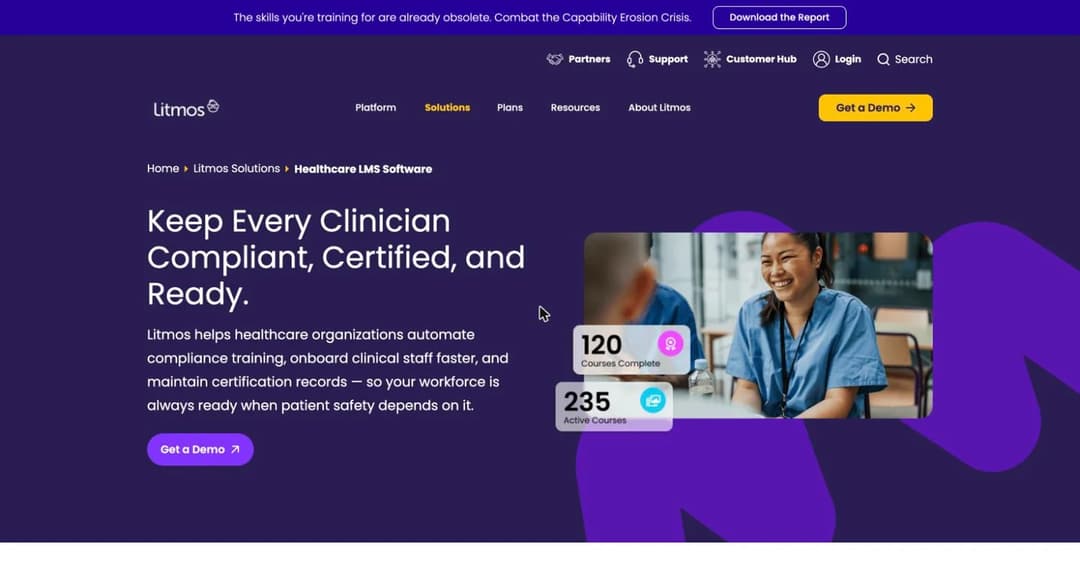
Litmos is a strong general-purpose corporate LMS with a healthcare page bolted on, and it is honest about the first half of that. Owned by Francisco Partners since December 2022, having passed through CallidusCloud and SAP, it sells speed: most healthcare customers are described as live within days of signing, without IT involvement.
The content story is real and the provenance is traceable, which we like. The live catalogue lists 17,778 courses. The healthcare depth comes from two named third-party collections: over 450 healthcare and dental compliance courses from American Medical Compliance, and 200-plus clinical simulations from SIMTICS. HRIS-triggered enrolment from Workday, ADP, and BambooHR is clean and well documented.
And then there is the contract.
Litmos’s Cloud Terms of Service, dated 6 December 2024, section 4(a)(2), states that the customer “shall not process or submit to the Cloud Services any Customer Data that includes any … patient, medical or other protected health information regulated by the Health Insurance Portability and Accountability Act (HIPAA).”
A healthcare LMS whose own contract prohibits patient data isn’t necessarily the wrong tool. Most workforce training genuinely does not touch PHI. But the healthcare page markets clinical readiness and never mentions it, and that gap is the buyer’s problem to discover.
The rest of the picture:
- No BAA anywhere. Neither the trust and security page, the Data Processing Agreement, nor the Technical and Organizational Measures document mentions a BAA, a business associate role, HITRUST, or PHI. Litmos holds SOC 2 Type II and ISO 27001:2022.
- Litmos is not an accredited provider. Every accreditation on the site belongs to American Medical Compliance, its content partner. AMC is accredited by ACCME, ADA, and AHIMA. Litmos is not.
- Continuing Education is a paid-tier feature. The plans grid shows the Continuing Education row blank for Foundation and checked for Platinum and above. So is Competencies and Skills. For a healthcare buyer, Platinum is the real floor, not Foundation.
- What it calls certification tracking is course-completion recurrence. Its documentation covers course expiration, due dates, and equivalencies. There is no credential object, no licence number model, and no primary source verification. The marketing says it “tracks certifications to the individual level.” The mechanism underneath is an LMS reassigning a course every N months.
- Excess seats cost 1.5x. Section 3(c): if no excess rate is in the order, the charge is the per-user fee multiplied by 1.5 times the number of excess licences.
- Subscriptions auto-renew for one year on 90 days’ notice, all payment obligations are non-cancellable, quantities cannot be decreased mid-term, and a multi-year subscription is an agreement to purchase every year of it.
- No EHR and no credentialing integration is named.
- The healthcare page’s own low end is 200 staff, not 50.
Best for: mid-market multi-site healthcare employers of roughly 300 to 5,000 staff whose problem is annual mandatory training and audit-ready reporting, with a one or two person learning team and no IT support, and no PHI in scope.
Pricing: three tiers, Foundation, Platinum, and Platinum AI, all reading “Contact for Pricing.” A 14-day trial exists behind a lead form.
9. Absorb: A General LMS for the Non-Clinical Side
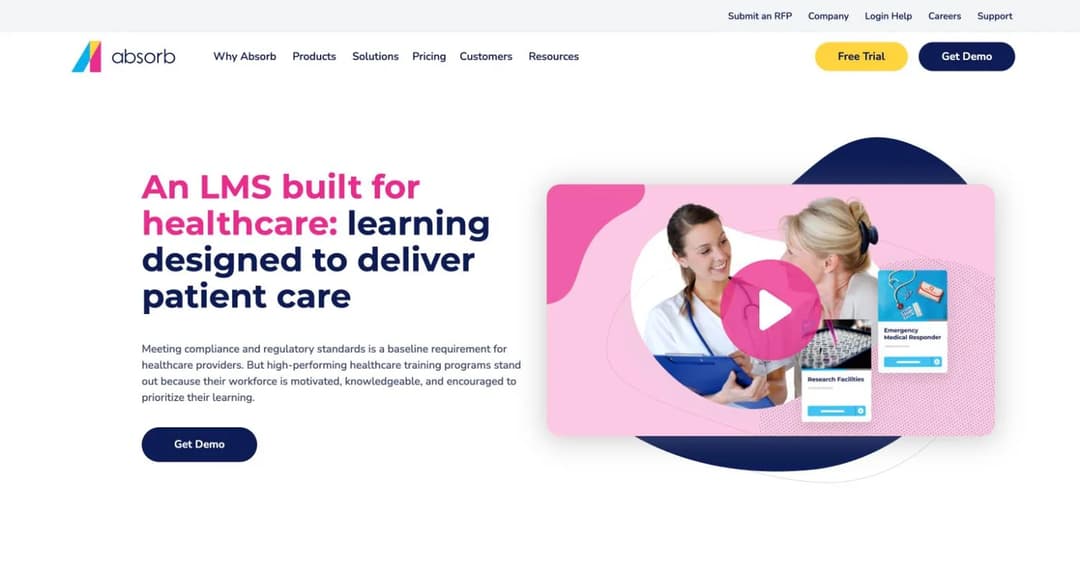
First, a naming note. **Absorb’s web address moved to absorbai.com, but the product is still Absorb LMS.** If you are comparing quotes or reading a guide written earlier this year, that is the same company.
Absorb is a genuinely good horizontal LMS. Clean administration, real reporting through Absorb Analyze, SCORM support, mobile, and e-commerce. Support runs 24/7. HCM connectors reach Workday, UKG, ADP, and SuccessFactors. It holds SOC 2 Type 2 and WCAG 2.1, and it ships an observation-checklist competency module that most general LMS platforms lack. For medtech and life sciences training, its 21 CFR Part 11 e-signature support is a real advantage.
For healthcare specifically, it fails both of the first two questions, and it does not pretend otherwise.
- No accredited CE, and no CE engine. Nothing on the site mentions ANCC, ACCME, ACPE, CEU, or continuing education. There is no CE Broker or PARS reporting. The nearest capabilities are certificate issuance and Credly digital badges.
- No HIPAA claim, no BAA, no HITRUST. Its compliance hub lists GDPR, WCAG 2.1, SOC 2, 21 CFR Part 11, and PCI. HIPAA is not among them. The privacy policy contains no mention of HIPAA, business associate, PHI, or protected health information.
- The terms actively disclaim it. Section 10.2 does not warrant compliance with specific data privacy regulations, and makes PHI notification the customer’s duty.
- The healthcare page mentions HIPAA only as advice to the buyer, telling you that your platform should meet HIPAA, rather than claiming that Absorb does.
- Auto-renews for twelve months on 30 days’ notice, payment obligations are non-cancellable, fees non-refundable, and user subscriptions cannot be decreased mid-term.
- No self-serve purchase. Both the pricing form and the free-trial form are lead capture. The trial page does not disclose its length or what is included.
Best for: healthcare employers buying a corporate LMS for the non-clinical side of the house, where PHI never enters the system: HR onboarding, leadership development, annual HIPAA-awareness training, partner and customer education for a medtech or payer organisation, and extended-enterprise training of external audiences.
Not for: anyone who needs accredited CE, anyone whose LMS could touch PHI, and any health system that needs licensure management as a system of record.
Pricing: not published. The smallest bracket on the pricing form is 1 to 50 learners, but every path is sales-gated.
10. Moodle: The Build-It-Yourself Route
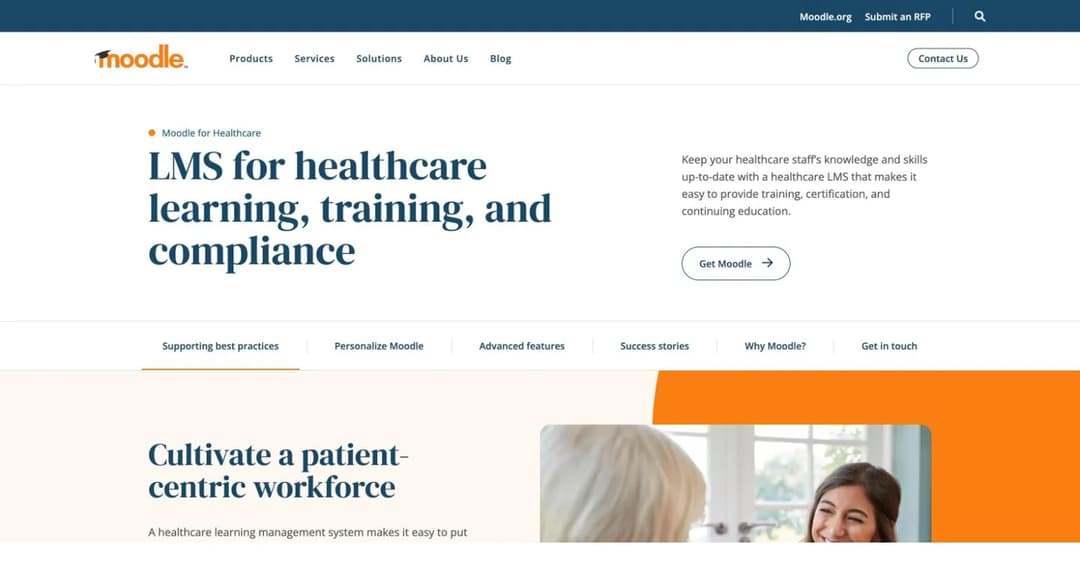
Moodle is the honest zero-licence option, and for a research institute, a teaching hospital, or a health NGO with real technical capacity, it is a serious answer.
Self-hosted Moodle LMS is licensed under GPLv3 with no seat cap, no course cap, and no licence fee. Moodle US holds SOC 2 Type 2. Moodle for Government reached FedRAMP Ready status in May 2026. Thousands of community plugins are available. SCORM and LTI import work, so you can bring licensed clinical content in. If you want to think through what building rather than buying actually involves, our build your own LMS guide covers the tradeoffs.
MoodleCloud gives you a hosted route with published prices, which almost nothing else here offers: Starter at $170 a year for 50 users, Mini at $280 for 100, Small at $510 for 200, Medium at $1,220 for 500, and Standard at $2,160 for 750, which is where hosted plans stop.
Then read the small print, because two things separate free Moodle from what the healthcare page advertises.
- The healthcare features are in Moodle Workplace, which is not open source and not free. Recertification, expiry reminders, dynamic rules, multi-tenancy, and organisational hierarchy all sit in Workplace. Moodle’s own FAQ: “Moodle Workplace is licensed software only available via our Moodle Premium Certified Partners and Service Providers.” In the US it can only be implemented by Moodle’s own certified services team, and the enquiry form’s smallest user band is “Less than 500.”
- MoodleCloud cannot be extended. Moodle states you cannot install plugins or integrations on it, so it will not connect to your HRIS or any credentialing system, and it caps at 750 users.
- No HIPAA claim and no BAA anywhere. Neither the healthcare page, the security and privacy page, nor the compliance training page offers a BAA or asserts HIPAA compliance. HIPAA appears once, as a training topic. Because Workplace is delivered by a partner who also supplies hosting, any BAA would come from that partner, not from Moodle.
- No clinical content at all. No library, no course count, no content partner. The “2,000+ plugins” figure counts software extensions, not courses. Do not let a buyer read it as content.
- No accreditation. Moodle issues certificates and badges. It confers no CE credit.
- Free software is not a free deployment. You supply the Linux server, the database, and PHP with the right extensions. You also supply TLS, an off-server backup routine, and security patching on a roughly six-month release cadence. And you supply a cron job, without which forum email and scheduled backups simply don’t run. Every upgrade then needs plugin compatibility testing.
Best for: teaching hospitals, research institutes, health ministries, and NGOs with in-house sysadmin capacity that need unlimited seats, data residency, or deep customisation, and can treat a multi-week implementation as normal.
Pricing: $0 self-hosted under GPLv3, MoodleCloud from $170 a year for 50 users, Moodle Workplace quote only through a partner.
How to Choose a Healthcare LMS
What is the best LMS for healthcare?
There’s no single answer. The right platform depends on which of the three questions binds hardest for you.
- If you must award accredited CE in-house across mixed disciplines, Relias is the shortest path, because Joint Accreditation across ACCME, ACPE, and ANCC removes several separate CE contracts.
- If your decision is survey readiness and clinical competency, HealthStream and symplr Learning are the two built for it, and symplr is the one with a published BAA.
- If you are small and need to buy this quarter, Medbridge is the only platform here you can purchase today at $49 per seat per year.
- If you need credentialing and training on one contract, MedTrainer, with your lawyer reading section 10.1 first.
- If you already have a compliance LMS and cannot get your own content into it fast enough, that is the gap Mini Course Generator fills, and it exports SCORM into whatever you already run.
Is Relias an LMS?
Yes, and more than one. Relias sells a learning management system, but it is more accurately described as a platform family assembled from roughly fifteen acquisitions under Bertelsmann ownership, including Nurse.com, the Wound Care Education Institute, and Relias Academy. When someone says “we run Relias,” ask which modules, because the answer varies a lot.
What does LMS stand for in medical contexts?
Two different things, and they get mixed up constantly. In workforce training, LMS means learning management system. In obstetrics and gynaecology, LMS is also shorthand for last menstrual period, which is why asking what LMS means in a medical context gets you clinical answers alongside software answers. This guide is about the first one.
Does a healthcare LMS need to be HIPAA compliant?
Usually not, and that’s the more useful answer.
A learning management system holds employee records, not patient records. Course completions, licence numbers, competency sign-offs, and quiz scores are employment data. If your LMS never touches PHI, the HIPAA question mostly falls away, and vendors like HealthStream and MedTrainer say plainly that their systems are not designed to hold it.
The question becomes live in three situations: if you build training around real patient cases, if you integrate the LMS with a system that holds PHI, or if your learners upload anything as evidence in a competency workflow. In those cases you need a BAA, and you need to know which vendors will sign one before you shortlist. Of the ten here, symplr publishes one, Medbridge scopes one to specific plans, and Litmos’s contract rules out the use case entirely.
How many courses do you actually need?
Fewer than the marketing suggests, and the numbers aren’t as solid as they look.
Vendor course counts in this category are too unreliable to compare on. Relias publishes four different totals across its own pages. Medbridge publishes two. MedTrainer’s live catalogue lists 811 courses while its marketing claims 1,000-plus and 1,200-plus.
More usefully, ask three questions about provenance instead of size. Who wrote it? Relias and Medbridge author their own accredited clinical content. HealthStream aggregates 60-plus publishers, symplr aggregates thirteen partners, and Litmos licenses AMC and SIMTICS. Is it clinical? MapleLMS’s counted 10,000-course library is BizLibrary, which is business and HR content. Who maintains it? A regulatory library is only worth something if somebody updates it when the rule changes, and only Relias and MedTrainer describe an explicit maintenance process.
What integrations should you insist on?
The gap in this category is bigger than most buyers expect: not one of the ten platforms names a single EHR integration. No Epic, no Oracle Health, no MEDITECH, no athenahealth. Some describe HL7-compliant API architecture, which is a description of the API’s design, not a shipped connector.
Credentialing is nearly as thin. MedTrainer is the only platform here that integrates credentialing and learning as one product. symplr owns a credentialing suite and does not list it as an integration of its own LMS.
So insist on two things concretely. Make the vendor name your specific HRIS and its connector before you sign, because “integrates with your HR system” appears on nearly every page here and names nothing. And if you need learning data to reach another system, ask about standards support directly. Our LMS integration guide covers what to ask for, and what a headless LMS does differently is worth reading if you want training delivered inside tools your staff already use.
Should you buy a healthcare LMS or a general one?
The honest split runs along Question 1.
If your obligation is to award or report accredited CE, buy healthcare-native. General platforms do not have the accreditation, the registry reporting, or the clinical library, and bolting them on costs more than the price difference.
If your obligation is annual mandatory training, onboarding, and policy compliance for a workforce that happens to be in healthcare, a general LMS is often the better product. It is usually easier to administer, more likely to name your HRIS, and more likely to publish a price. Our guides to the best LMS for small business and the best LMS for sales training cover that side of the market. For a high-turnover frontline team, the call centre training software guide is closer to the mark.
Plenty of organisations end up running both, and that isn’t a failure. It’s the normal shape of this market.
What a Healthcare LMS Costs, and Why Nobody Will Tell You
You cannot compare these platforms on price before a sales cycle, and that is itself the finding.
Nine of the ten platforms publish no usable price. Medbridge is the sole exception, at $49 per seat per year with a two-seat minimum. Moodle is a partial exception: the free licence and the MoodleCloud tiers are published, but the healthcare product isn’t. If a genuinely free tier is where you need to start, our best free LMS roundup covers every permanent free plan on the market and where each one stops.
What the published contracts do to the price after you sign:
| Platform | Default term | Annual increase | Exit |
|---|---|---|---|
| MedTrainer | 60 months if the order form is silent | 8%, automatic, no notice | Pay the full remaining contract value |
| symplr | Set by order form | 6% default | No termination for convenience |
| Relias | Auto-renews for a term equal to the ending term | Permitted after month 12, 60 days’ notice | No termination for convenience, no refunds |
| Litmos | Auto-renews 12 months, 90 days’ notice | Not in the public terms | Non-cancellable, no mid-term seat reduction |
| Absorb | Auto-renews 12 months, 30 days’ notice | Not in the public terms | Non-cancellable, non-refundable |
| Medbridge | 12 months, prepaid | Not stated | No refunds on group subscriptions |
Three practical consequences follow.
Budget for the escalator, not the quote. A 6% or 8% automatic annual increase compounds. At 8% a year, a five-year term ends roughly 36% above where it started. If nobody negotiates that clause, it is the single largest hidden cost in the deal.
Diarise every notice date, separately. These agreements renew unless you give notice, the windows range from 30 to 90 days, and at least one vendor has two different windows in two of its own documents.
Get the seat mechanics in writing. Ask what happens when someone leaves, whether the seat frees up, and whether reassigning it counts as a breach. One vendor here explicitly says cycling users to stay under a licence count is a material breach, which matters enormously for an employer with normal clinical turnover.
The Bottom Line
The healthcare LMS market is not short of good software. It’s short of vendors willing to answer three plain questions before you’re in a sales cycle.
Two of the ten can award accredited CE credit in their own name. One publishes a Business Associate Agreement you can read before you talk to anyone. One publishes a price a clinic can act on. No two of those are the same platform.
So work the questions in the order that binds for you. Accredited CE narrows the field to two. A genuine PHI requirement narrows it differently. A budget you have to defend this quarter narrows it to one.
And whichever platform you land on, you’ll still have training that no library covers and no vendor will write for you: the new protocol, the changed policy, the finding from the last survey. That is the part that has to be fast, and it is the part Mini Course Generator exists for. You can start free for 14 days, no credit card required, and have the first course out to your team the same day.
Sources
All vendor information comes from vendor-owned pages and was checked in August 2026. Nothing here comes from a third-party review site or another guide.
- Accreditation claims: quoted verbatim from Relias, Medbridge, HealthStream, MapleLMS, MedTrainer, and symplr accreditation and continuing education pages.
- Security and PHI posture: read from published trust, security, and privacy pages, plus the symplr Online BAA (public PDF), the Relias 2025 Master Service Agreement, the Litmos Cloud Terms of Service dated 6 December 2024, the MedTrainer Terms of Service last updated 14 July 2026, and the Absorb terms and conditions.
- Prices: quoted verbatim from vendor pricing pages, or reported as absent where no price is published.
- Course counts: taken from live vendor catalogue pagination where available (MedTrainer 811, Litmos 17,778), and otherwise reported as the vendor states them, with contradictions between a vendor’s own pages noted in the entry.
- Contract terms: quoted with section numbers from the published agreements listed above.
Where a vendor makes a claim we could not verify independently, we have labelled it as a vendor claim rather than repeating it as fact. Where a term was absent, we have reported the absence rather than assuming the capability exists.
Prices, contract terms, and accreditation status change. Everything above was accurate on 27 August 2026, and anything that matters to your decision should be confirmed in writing before you sign.