
Thinking about building your own LMS? Here’s the honest version up front. You have three real paths, not two: build everything, buy everything, or buy the learning back end and build only the experience on top. Every cost estimate you’ll find online is an agency’s guess. And the single first-hand number in public is bigger than most of those guesses.
This guide walks through what an LMS build actually contains and what the published numbers are worth. Then it gets to the useful part: when building is genuinely the right call, and how to decide in an afternoon instead of a quarter.
Key Takeaways
– No independent study of LMS development costs exists. Published ranges come from the agencies that sell the work.
– The one public first-hand number: a team that logged 4,450 hours of building, and kept going.
– The visible features are the small half of the project. SCORM playback, certificates with audit trails, SSO, and data deletion are where the hours go.
– The build cost is the down payment. Maintenance is the loan, and it never fully amortizes.
– There’s a third path between build and buy: keep the learning back end bought, and build only your front end. Most “we need custom” cases land there.
Why Teams Decide to Build
The urge to build your own LMS usually starts somewhere legitimate. The off-the-shelf portal looks nothing like your product. Learners bounce off a second login. The vendor’s roadmap ignores the one workflow you need. Or training is your product, and renting the core of your own business feels wrong.
It looks like a manageable project; developer forums call it a rabbit hole. The arc is always the same. The team looks at an LMS, sees “courses, users, quizzes,” and concludes it’s a few months of work, because the visible surface genuinely is. The decision that follows is rarely reckless. It’s optimistic, and it’s optimistic about scope, not skill. So before any cost talk, it’s worth being precise about what the project actually contains.
What You’re Actually Building
An LMS has a small visible layer and a large invisible one. The visible layer is what the demo shows: course pages, a player, quizzes, a dashboard. Competent teams ship that in months, which is exactly why the estimate feels safe.
The invisible layer is where builds go to grow:
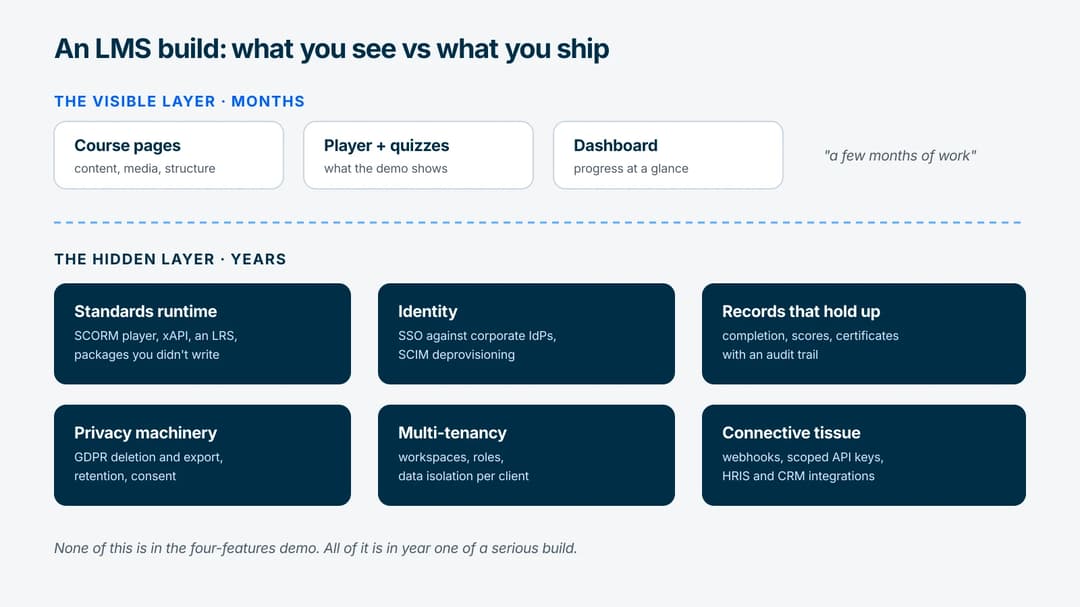
- Standards runtime. The moment a client says “we’ll run it in our LMS” or hands you a SCORM file, you need packaging, playback, and reporting for standards you didn’t write. Add an LRS if xAPI enters the picture.
- Identity. SSO against corporate identity providers, and SCIM so departed employees actually lose access. Enterprise buyers ask for this in the first call.
- Records that hold up. Completion states, scores, and certificates with an audit trail. The difference between “a green checkmark” and “evidence” is a data model, versioning, and time stamps that survive edits.
- Privacy machinery. GDPR-grade deletion and export, retention rules, consent records. Deleting a learner without breaking historical reporting is a genuinely hard problem.
- Multi-tenancy. The day you sell training to a second client, “one database, one theme” becomes workspaces, roles, and data isolation.
- The connective tissue. Webhooks, API keys with scopes, and the integrations your buyers assume: HRIS sync, CRM write-back, calendar invites.
None of this appears in the four-features demo, and all of it appears in year one of a serious build.
The Published Numbers, and What They’re Worth
Published LMS development cost tables look confident. Read them carefully and a pattern appears: every one is published by a company that builds LMSs for money, and none cites an external source.
The most granular public table comes from the development agency EnactOn (2026): roughly $8,000-15,000 for a basic system, $20,000-45,000 mid-range, and $50,000-100,000+ for enterprise scope (EnactOn, 2026). The same table puts hourly rates at $25-50 in South Asia and $100-200 in North America, plus running infrastructure like video hosting at $50-500 a month. Treat it as what it is: a vendor’s estimate of work the vendor sells. Useful for shape, not for planning.
The honest summary of the public data: there is no independent study of what building an LMS costs. Ranges vary five-fold between agencies, scopes are undefined, and the incentive points one direction. Which makes the one first-hand number that exists worth more than all the tables combined.
The Number Nobody Publishes
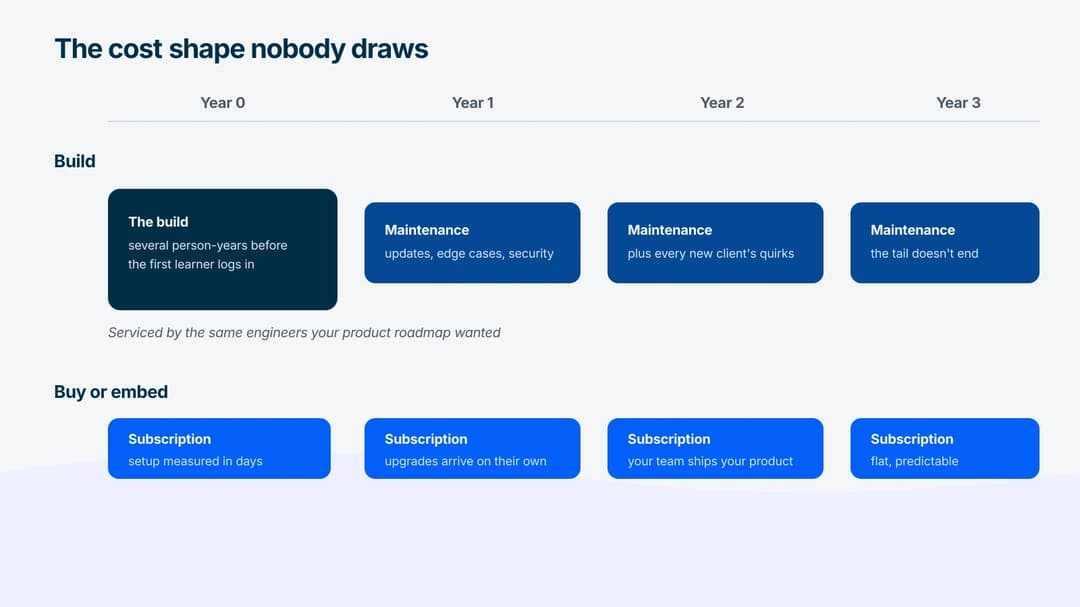
In April 2024, a developer posted a running tally of their team’s headless LMS build on r/elearning: 4,450 hours in. By that August, the counter was near 5,000. That’s a practitioner’s log, not a study, and that’s exactly why it matters: it’s the only public number measured by someone with no estimate to sell. At standard working hours, it’s several person-years, for a team that knew what it was building.
And the counter stops at launch only in spreadsheets. Real systems accrue a maintenance tail: browser and dependency updates, the SCORM edge cases a new client’s package exposes, and security reviews. Integration upkeep alone already consumes 36% of IT teams’ time by their own account (MuleSoft Connectivity Benchmark Report, 2026). The build cost is the down payment. The loan is serviced by the same engineers your product roadmap wanted.
When Building Is the Right Call
Building your own LMS makes sense when at least one of these is true:
- Learning is the product. If the learning experience itself is what customers pay for and your differentiation lives in its mechanics, owning the engine can be strategy rather than overhead.
- Proprietary pedagogy. Your method genuinely cannot be expressed in anyone’s course model, and that method is the moat.
- Isolation requirements. Regulatory or security constraints that rule out multi-tenant SaaS entirely, and a compliance team that has already written them down.
Notice what’s not on the list: “the portal is ugly,” “we want our branding,” “we need it inside our product.” Those are real problems. They also have a cheaper solution, which brings us to the third path.
The Third Path Everyone Skips
The choice looks binary: custom-build or an off-the-shelf portal. There’s a middle: buy the learning back end, build only your front end. A headless LMS keeps enrollment, progress, certificates, and standards bought and maintained by someone else, and delivers them through an API to an experience you fully control. You get the “it looks and behaves exactly like our product” outcome that motivated the build, without re-implementing the record-keeping that made it expensive.
One warning: building “an LMS” on top of a headless CMS is not this path. A content API will happily store lessons, but enrollment, completion semantics, scoring, and certificates aren’t in it. Teams that start there end up hand-modeling progress as custom fields with custom controllers. That’s the full build wearing a lighter costume.
If You Do Build, Scope Like a Practitioner
If the yes column applies and the question becomes how to build an LMS without drowning, the build logs and post-mortems across developer forums converge on the same discipline:
- Ship one course model first. One content type, one enrollment rule, one report. Every “flexible from day one” ambition multiplies the data model.
- Buy the ugly parts. Video infrastructure, authentication, email delivery, and payments are solved industries. Building them alongside an LMS is how 4,450 hours happen.
- Defer standards until a boundary forces them. SCORM and xAPI exist for crossing system borders. If all delivery is inside your own walls at MVP, they can wait, deliberately rather than accidentally.
- Write the deletion story early. Privacy machinery retrofits badly.
How to Decide in One Afternoon
| Your situation | The honest answer |
|---|---|
| Internal or customer training, standard delivery needs | Buy; the build cannot pay back |
| Training must live inside your product, on your brand | Embed or headless, not a build |
| Learning is the product and its mechanics are the moat | Build, with the practitioner scope above |
| One workflow the vendor roadmap ignores | Buy plus automation glue; revisit in a year |
| Regulated isolation, written down by compliance | Build or self-host, budgeted honestly |
| No developers on staff | Buy; there’s a launch path without engineering |
If one line replaces the table: build when owning the engine is the strategy, not when renting the portal is annoying.
Where Mini Course Generator Fits
Mini Course Generator exists for the middle rows of that table. Courses are built in minutes with AI assistance, then delivered where the build itch usually starts. They embed in your site or app with widgets, connect to your stack through Zapier, Make, and webhooks, and run as customer academy infrastructure when training has to feel native to your product.
For teams that want the third path fully: the Custom plan carries the REST API, Headless LMS delivery, and learner SSO, scoped in a demo. Everything below that line is self-serve on the plans listed on the pricing page, with a 14-day free trial. A fair test costs an afternoon: build one course, embed it, and compare that afternoon against the first sprint estimate of a build.
The Short Version
The visible half of an LMS is months. The invisible half (standards, identity, auditable records, privacy, tenancy) is years, and the only first-hand build log in public passed 4,450 hours. Published cost tables are agency estimates without independent sources. Build when learning is your product, your pedagogy can’t be expressed in anyone’s model, or compliance rules out shared infrastructure. Otherwise, buy the back end, and if the portal is the problem, embed or go headless instead of rebuilding record-keeping the world already solved.
Frequently Asked Questions
How much does it cost to build an LMS?
No independent study exists; published ranges are agency estimates. The most granular vendor table (EnactOn, 2026) runs from roughly $8,000 for a basic build to $100,000+ for enterprise scope, before infrastructure and maintenance. The one public first-hand log recorded 4,450+ hours of development. Treat any confident number without a scope attached as marketing.
How long does it take to build an LMS?
Agency guides describe several months to a year to build an LMS from scratch. The public build log passed two calendar years with the counter still running. The visible features arrive early; standards support, identity, and compliance machinery consume the rest.
Is there a free LMS?
Open-source platforms are free to license, not free to run: hosting, updates, security, and integration work all land on your team. For small, stable needs that trade can be fine. Budget it as an operations cost, not zero.
Should you build or buy an LMS?
Buy when your training needs are standard. Embed or go headless when the real requirement is “inside our product, on our brand.” Build only when learning is the product itself, your pedagogy can’t live in anyone’s model, or compliance rules out shared platforms.
Can you build an LMS without developers?
Not a real one; the hidden scope is engineering. What you can do without developers is launch a branded academy on an existing platform, embed courses in your site, and connect events with no-code automation. That covers the majority of cases that trigger the build question.
Sources
- 4,450 hours into building a headless LMS – r/elearning, April 2024 (first-hand practitioner log)
- LMS Development Cost: The Ultimate 2026 Breakdown – EnactOn, 2026 (development agency estimate; no external attribution)
- MuleSoft Connectivity Benchmark Report insights, 2026 – MuleSoft/Salesforce, 1,050 IT leaders