

Ask about the employee onboarding process and you will hear the same four frameworks and the same six statistics, repeated everywhere, almost never with a source attached.
Most of those sources do not exist.
The single most-quoted onboarding statistic in the industry, the one that says employees are 69% more likely to stay three years after great onboarding, is not SHRM research. It is a sentence a software vendor supplied to a SHRM article in 2017, with no study, no sample and no method behind it. The vendor itself no longer makes the claim.
The famous “5 C’s of onboarding” are actually four. The fifth was added twelve years later, on the blog of an onboarding software company.
So this guide does two things at once. It explains the onboarding process properly, stage by stage, and it tells you which of the things you have read are supported by evidence and which are marketing that got repeated until it sounded like research.
Build onboarding training with Mini Course Generator – turn your policies and process docs into courses new hires actually finish.
What Is the Employee Onboarding Process?
The employee onboarding process is the structured sequence a new hire goes through from the moment they accept an offer to the point they are working independently: paperwork and access, introductions, role training, and the checkpoints that confirm it worked.
It is broader than orientation, which is a single event, and narrower than the first year of employment. Three things distinguish onboarding done as a process from onboarding done as a folder of documents:
- It starts before day one. The gap between accepting an offer and starting is the most-neglected window in the whole process.
- It has a defined end. Usually 90 days, and the end is a decision point rather than a date that passes.
- It assigns owners. HR, IT, the manager and whoever owns training all have items, and unowned items are the ones that get missed.
Software is usually involved, and it is worth being precise about what kind. An onboarding LMS delivers the training portion: courses, completion tracking, assessment. An HR system handles the paperwork and provisioning portion. Those are different products, and we compare them in the employee onboarding software guide.
If you are here for the customer-facing version of this problem, that is a different process with different mechanics, covered in our customer onboarding process guide.
The Frameworks People Ask About, Attributed Properly
Four framework questions come up whenever this topic is discussed. All four have real answers, and three of them are usually given wrongly.
What are the 4 C’s of onboarding (and why do you see 5 or 6)?
The framework comes from Talya N. Bauer, Ph.D., Cameron Professor of Management at Portland State University. In her 2010 SHRM Foundation report Onboarding New Employees: Maximizing Success, Bauer set out four C’s:
- Compliance, the lowest level. Rules, policies, paperwork, legal requirements.
- Clarification, where the new hire understands the job and what is expected.
- Culture, the formal and informal organisational norms.
- Connection, meaning relationships and information networks. Bauer describes this as the most advanced level.
So why do you constantly see five? Bauer herself added a fifth C, Confidence, in March 2022, and then a sixth, Checkback, one month later. Both additions were published on the blog of Preppio, an onboarding software company that names Bauer as its scientific advisor, rather than in a peer-reviewed paper or an updated SHRM report.
That is why the fifth C changes from one source to the next: Confidence, Check back, Competence or Continuity, depending on who is listing it, and sometimes only four items appear under a heading that promises five.
One more thing worth knowing, since it is almost never mentioned: the framework itself has no study behind it. The 2010 report cites no study for the four C’s: the only note attached to them is Bauer’s own copyright line, “Copyright Talya N. Bauer (2010).” The four C’s are a conceptual synthesis of the socialisation literature and consulting experience, and Bauer describes them that way. That does not make the framework useless. It makes it a useful organising idea rather than a research finding, and those are different things.
The report was also sponsored by Right Management, a career-transition consultancy, and the SHRM Foundation discloses the sponsorship openly.
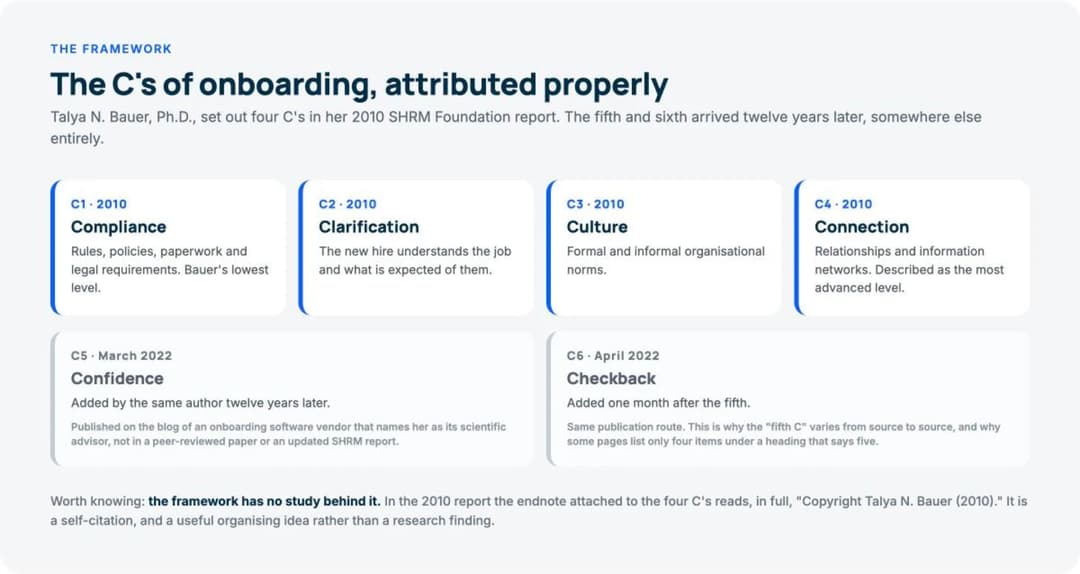
The four C’s and their 2010 source, with the two later additions and where each was published.
What are the stages of employee onboarding?
You will see four stages, five stages, or six, depending on who is counting. There is no standard, and no authority defines one.
The version that maps to how work actually happens is four:
- Preboarding, from offer accepted to first day.
- Orientation, the first day or two. Introductions, setup, essentials.
- Role training, weeks one to four. The largest block, and the one most often left to improvisation.
- Transition to independence, days 30 to 90. Checkpoints, feedback, goal setting.
Treat any claim that a specific number of stages is canonical with suspicion. The number is an editorial choice.
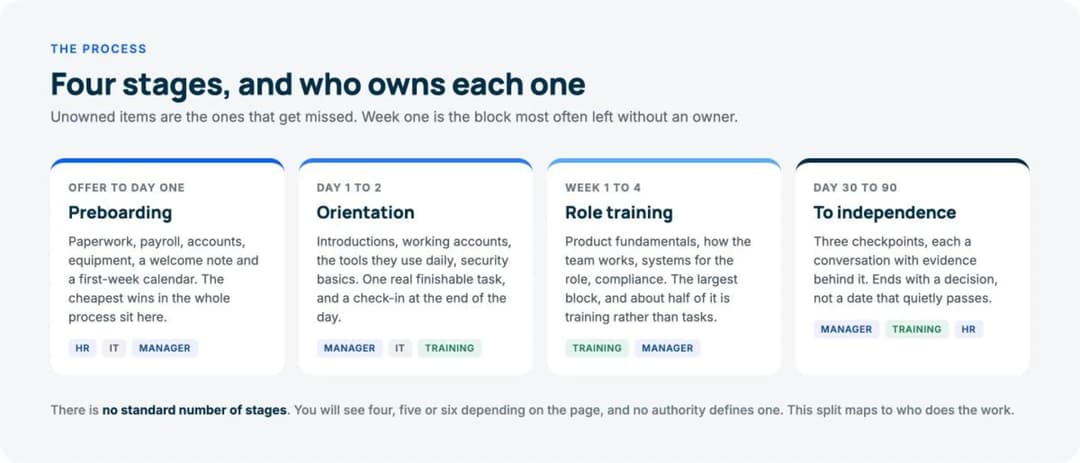
The four stages, with the team that owns each one. Week one is the block most often left without an owner.
What is the 30-60-90 rule?
A 30-60-90 plan sets what a new hire should be able to do at each of three checkpoints:
- Day 30: trained on the role, working on core tasks with support, compliance training complete.
- Day 60: owning a piece of work end to end, advanced or specialist training done, cross-team relationships forming.
- Day 90: performing at the agreed standard, gaps identified, next quarter’s goals set.
It is a planning convention rather than a rule, and it works because the intervals are short enough that a problem surfaces while there is still time to fix it. The detail belongs in a new hire training plan.
What are the 5 C’s of employee onboarding?
This is the same question as the first one, and it is the version most people ask. The short answer: there were four, published by Talya Bauer in 2010, and the fifth arrived in 2022 on a vendor’s blog. If a source gives you five C’s without saying which is the added one and where it came from, it is repeating someone else’s list.
The Process, Stage by Stage
Stage 1: Preboarding
Everything between offer acceptance and day one. This is the stage most companies skip, and the one where the cheapest wins are.
What belongs here: signed offer and background check, tax and eligibility forms, payroll record, laptop ordered and shipped, email and single sign-on account created, core app access, a welcome note from the manager, a first-week calendar, a buddy assigned, and the team told who is starting.
Two items in that list are training rather than admin: a short pre-start welcome course, and the role expectations written down. Both are worth doing, and neither is a task a checklist can verify.
Stage 2: Day one
The most common day-one mistake is volume. A first day filled with policy documents and system tours produces a person who has read a great deal and can do nothing.
Keep it to: welcome and workspace, verified working accounts, introductions with names and roles, the buddy, a tour of the tools they will use daily, security basics, benefits, and where to ask for help written down somewhere they can find it again.
Then two things that matter more than the rest of the list combined. Give them one real, small, finishable task. And hold a fifteen-minute check-in at the end of the day. A new hire who finished something real and was asked how it went starts week two differently from one who spent eight hours reading.
Stage 3: The first week
This is where the training load actually sits, and where most onboarding checklists stop being useful.
The week needs: product or service fundamentals, how the team works, a customer or user overview, required compliance training, systems training for the role, shadowing a colleague on a real task, meeting three people outside the immediate team, first 30-day goals agreed in writing, and a proper end-of-week conversation.
Roughly half of those are training, not tasks. That distinction is the practical reason onboarding tools and onboarding training tools are different purchases.
Stage 4: Days 30, 60 and 90
Three checkpoints, each a conversation with evidence behind it rather than a form.
The evidence is the part that gets skipped. “Is the training done” is answerable. “Are they performing at the agreed standard” needs a standard agreed in writing during week one, which is why the writing-it-down item appears so early.
At day 90, ask the new hire what was missing, and fix the checklist before the next person starts. That single loop is the difference between an onboarding process and an onboarding document.
Every item in all four stages, tagged by owner, is in our onboarding checklist template, which is on the page and copyable rather than gated behind a download.
What the Evidence Actually Says
The statistics that circulate about onboarding are unusually badly sourced. We traced the six statistics that appear most often. Four of them do not survive the trace. Here is what is left, and what to stop repeating.
Usable: Gallup on how rare good onboarding is
In its 2017 State of the American Workplace report, Gallup found that only 12% of employees strongly agreed their organization does a great job of onboarding new employees.
That figure comes from a Gallup Panel survey of 13,510 US adults conducted in May and June 2015, and Gallup has not published an updated number since. Read it as a historical US benchmark rather than a measure of where onboarding stands today. Gallup is a research firm rather than an onboarding software vendor, which is why this one survives when the others do not.
Usable with care: how long it takes to become productive
Time to full productivity is not well measured, and the popular figures are opinion rather than measurement.
The “eight months” number comes from the 2012 Allied Workforce Mobility Survey, an online survey of 500 US HR professionals funded by a corporate relocation company. The same survey reports that 58% of respondents do not measure new-hire productivity at all, so the eight-month figure is an estimate rather than a measurement. The “one to two years” variant comes from a 2012 trade-magazine article with no study behind it.
The better-documented estimate comes from Oxford Economics, commissioned by the insurer Unum in 2014, which surveyed more than 500 UK firms across five sectors. Those employers estimated that a new hire joining from another firm in the same sector reached full productivity in around 15 weeks. It is still employer estimation rather than measured output, and it is commissioned research, so treat it as an anchor rather than a fact.
Do not use: “69% more likely to stay three years”
This is the most-repeated onboarding statistic in existence and it is not research.
It appears in a 2017 SHRM article by Arlene S. Hirsch, where it is explicitly credited to Click Boarding, an onboarding software company in Eden Prairie, Minnesota. SHRM published it; SHRM did not conduct it, and gives no study name, no sample and no method. Click Boarding itself no longer makes the claim.
The sentence is not even well formed. “More likely to stay three years” names no comparison group and no baseline retention rate, so more likely than what is never specified. And the popular “69% more likely” phrasing does not appear in the SHRM source at all.
Two sibling statistics come from the same unsourced vendor block in the same article: “58% more likely to be with the organization after three years” and “50% greater new-hire productivity”. Treat all three the same way.
Do not use: “82% better retention and 70% better productivity”
This one is quoted accurately, which makes it more convincing and no better sourced.
It comes from The True Cost of a Bad Hire, a 2015 Brandon Hall Group research brief licensed for distribution by Glassdoor. On page 12 the brief gives the claim no source line, while it attributes its other statistics explicitly, for example “Source: 2015 Brandon Hall Group Talent Acquisition Study (n=153)”. The only sample size anywhere in the brief belongs to those other claims.
Neither figure has a baseline, a denominator, a comparison group, or a definition of “a strong onboarding process”. “Improve retention by 82%” is not a retention rate and cannot be turned into one. It is also eleven years old, and Brandon Hall Group no longer publishes it.
Do not use: “20% of turnover happens in the first 45 days”
The original figure is 22%, not 20%, and it traces to an unpublished April 2007 conference presentation by The Wynhurst Group, a boutique consulting firm. There is no paper, no dataset, no sample and no methodology. The document that cites it gives methodology for its other statistics and none for this one. It is nineteen years old.
If you need to make the point that early departures are common enough to design for, use real data instead. The US Bureau of Labor Statistics’ National Longitudinal Survey of Youth 1979, which has followed 9,964 people born between 1957 and 1964 with interviews from 1979 to the present, documents how short a large share of jobs actually are.
Why this matters more than it sounds
Every one of these numbers exists to justify a purchase. Three of the four failures trace directly to a company selling onboarding software or consulting.
If you are building a business case for onboarding investment, build it on your own numbers: your 90-day attrition, your time to first independent contribution, your manager satisfaction with new-hire readiness. Those are measurable in any company and no one can accuse you of quoting a vendor deck.
Where Onboarding Actually Fails
Four failure modes, in the order we see them most often.
Nothing happens before day one. The offer is signed, and then silence for three weeks. The candidate keeps interviewing.
Day one is all administration. Volume gets mistaken for thoroughness, and the new hire ends the day having accomplished nothing.
Week one has no owner. Preboarding and day one have obvious owners in HR and IT. Week one is training, and if nobody owns training, week one becomes whoever happens to be free.
There is no day-90 loop. The process runs, the person either works out or does not, and nothing is learned either way. The single highest-return change most companies can make is asking every new hire at day 90 what was missing, and editing the process before the next person starts.
How to Measure Onboarding
Four numbers, in increasing order of usefulness:
- Completion. Did they finish the assigned training? Easy, and the least informative.
- Time to first independent contribution. The first piece of real work delivered without supervision. Harder, and much more useful.
- 90-day and 12-month retention. This is the outcome most onboarding claims are about, and the one you can actually measure yourself.
- Manager-rated readiness at day 30 and day 90. One question, asked the same way every time, tracked over cohorts.
The fourth is the one almost nobody does and the one that surfaces problems earliest. It costs a single survey question. Where the training is mandatory and has to be renewed, track the current state separately in a training matrix rather than trying to read it off a completion report.
If your training is delivered through a platform, completion and assessment data come free, and connecting that to your HR system is a straightforward integration question rather than a reporting project. None of it replaces the manager doing the teaching, which is a separate craft covered in how to train new employees.
Frequently Asked Questions
How long should employee onboarding last?
Ninety days is the working convention, and the reason is practical rather than theoretical: 30, 60 and 90 day checkpoints are close enough together that a problem surfaces while there is still time to act on it. Some roles need longer, particularly technical and regulated ones. What matters more than the length is that it ends with a decision rather than fading out.
What is the difference between onboarding and orientation?
Orientation is an event, usually one or two days, covering introductions, paperwork and essentials. Onboarding is the process that contains it and runs for weeks or months after it. A company that has orientation and calls it onboarding typically has no plan for weeks two through twelve, which is where the training load actually sits.
Who owns the onboarding process?
In practice it is split, and that split is the usual failure point. HR owns compliance and paperwork. IT owns accounts and equipment. The manager owns integration, expectations and feedback. Training is the piece most often unowned, and it is the largest block of week one.
Name an owner for each item before you need one. Our checklist tags every item with its owner for exactly this reason.
What should be in a new hire’s first week?
Product or service fundamentals, how the team works, a customer overview, required compliance training, systems training for the role, shadowing a real task, three introductions outside the team, written 30-day goals, and an end-of-week conversation. About half of that is training. Our new hire training plan guide, linked earlier, covers how to design that half.
Does onboarding software fix a bad onboarding process?
No, and it is worth being blunt about it. Software makes an existing process faster, more consistent and easier to evidence. It does not decide what a new hire should learn in week one, and no product will write your role expectations for you.
Buy the software after you have written the process down, not instead of writing it. And check which kind you are buying: paperwork and provisioning tools and training delivery tools are different products, compared in our employee onboarding software guide linked above.
How much does onboarding software cost?
It depends entirely on which category you buy. HR platforms typically price per employee per month with a base platform fee. Learning platforms price on seats or active users, and the seat floors decide more of the bill than the rate does. Our LMS pricing guide has the full picture across twenty platforms, and the small business LMS guide covers the low end.
The Bottom Line
The onboarding process itself is not complicated: prepare before day one, keep day one short and finish something real, put the training in week one with an owner attached, and check at 30, 60 and 90 with evidence rather than a form.
What is complicated is the information around it. The frameworks are useful organising ideas rather than research findings, and should be attributed as such. The statistics that dominate this topic mostly trace to companies selling onboarding products, and three of the four most-repeated ones have no study behind them at all.
Build your case on your own 90-day attrition and your own time-to-contribution. They are more persuasive than a vendor’s number, and they cannot be fact-checked out from under you.
The training half of onboarding is the half that changes constantly, because your product, policies and processes change. Mini Course Generator turns those documents into short interactive courses new hires can finish on a phone, with completion tracked and no separate login to learn. You can see the interactive formats or start free for 14 days with no credit card.
Sources
- The four C’s: Bauer, Talya N. (2010), Onboarding New Employees: Maximizing Success, SHRM Foundation Effective Practice Guidelines Series, sponsored by Right Management. The framework’s endnote is a self-citation; it is a conceptual synthesis, not an empirical result. The fifth C (Confidence) and sixth C (Checkback) were published by the same author in March and April 2022 on the blog of Preppio, an onboarding software vendor that names her as its scientific advisor.
- Gallup: State of the American Workplace (2017), p.36. Gallup Panel survey of 13,510 US adults, fieldwork May to June 2015. Not updated since.
- Time to productivity: Oxford Economics for Unum (2014), survey of more than 500 UK firms across five sectors, employer-estimated. The competing “eight months” figure comes from the 2012 Allied Workforce Mobility Survey, an online survey of 500 US HR professionals funded by a relocation company, in which 58% of respondents said they do not measure new-hire productivity at all.
- Early attrition: US Bureau of Labor Statistics, National Longitudinal Survey of Youth 1979, following 9,964 people born 1957 to 1964.
- Traced and rejected: the “69% more likely to stay three years” claim (SHRM 2017 article, attributed to vendor Click Boarding, no study); the “82% retention / 70% productivity” claim (Brandon Hall Group 2015 brief licensed by Glassdoor, published with no source line); the “20% of turnover in the first 45 days” claim (unpublished 2007 Wynhurst Group presentation, no paper or dataset).
All tracing was done on 29 August 2026. Where a claim could not be traced to a primary source, it is named here rather than quietly omitted, so you can check our work.