

Most advice on training new employees is written for someone who is not you. It says be patient, set clear expectations, and encourage questions. All true, and all useless on a Monday morning when somebody’s sitting there waiting.
This is the version for the manager who has one person starting, no training team, and a job to do at the same time.
Try Mini Course Generator free – turn what you know into short courses so you are not the training programme.
First, Decide What “Trained” Means
Before you teach anything, write down three sentences that describe what this person can do without you at day 30. Not topics. Things they can do.
- “Can resolve a standard support ticket end to end and knows when to escalate.”
- “Can run the weekly report and explain what moved.”
- “Can take a first call with a new customer, on their own.”
Ten minutes of work, and it changes everything downstream. It tells you what to teach first, it gives you something to check against, and it prevents the single most common outcome, which is a new hire who has been shown a great deal and can do very little.
If you can’t write those sentences, you’re not ready to train anyone yet. That’s not a criticism of you. It usually means the role was defined by what the last person did rather than by what the job needs, and it’s worth fixing before somebody’s first week rather than during it.
The Sequence
Week 1: One task, done for real
Don’t cover the job. Cover one task, the one they will do most often, properly, and have them do it for real by Friday.
Everything else in week one is orientation rather than training: who people are, where things live, how to ask for help. Keep it to a couple of hours a day and let them work in between. The administrative side runs in parallel and isn’t your job to remember, which is what the onboarding checklist template is for.
The Friday test: they produced something real, and it was good enough to keep.
Week 2: Widen, and hand over the compliance
Add the next three or four common tasks in frequency order. Teach each tool next to the task that needs it, not as a tour of the software.
This is also where compliance training goes. It has a deadline attached, which is exactly why it gets dumped on day one. Day one is the worst possible day for anything anybody has to retain.
Week 3: What happens when it goes wrong
Normal work is the easy half. Week three is the escalations, the exceptions, the awkward customer, the request that does not fit the process. This is the part most managers skip, and it’s the part that decides whether the person can be left alone.
Give them a full day of real work with you available but not involved. Resist helping.
Week 4: Check properly, then set the next 60 days
Not “how are you feeling”. People always say fine.
Review one piece of their real work in detail and in writing. If you’ve got any scored material, use it. Then have the day 30 conversation against the three sentences you wrote at the start, and agree what day 60 and day 90 look like.
The detailed version of this, with the content split week by week, is in our new hire training plan guide.
How to Teach One Task, in Five Moves
This is the part that actually works. For any individual task:
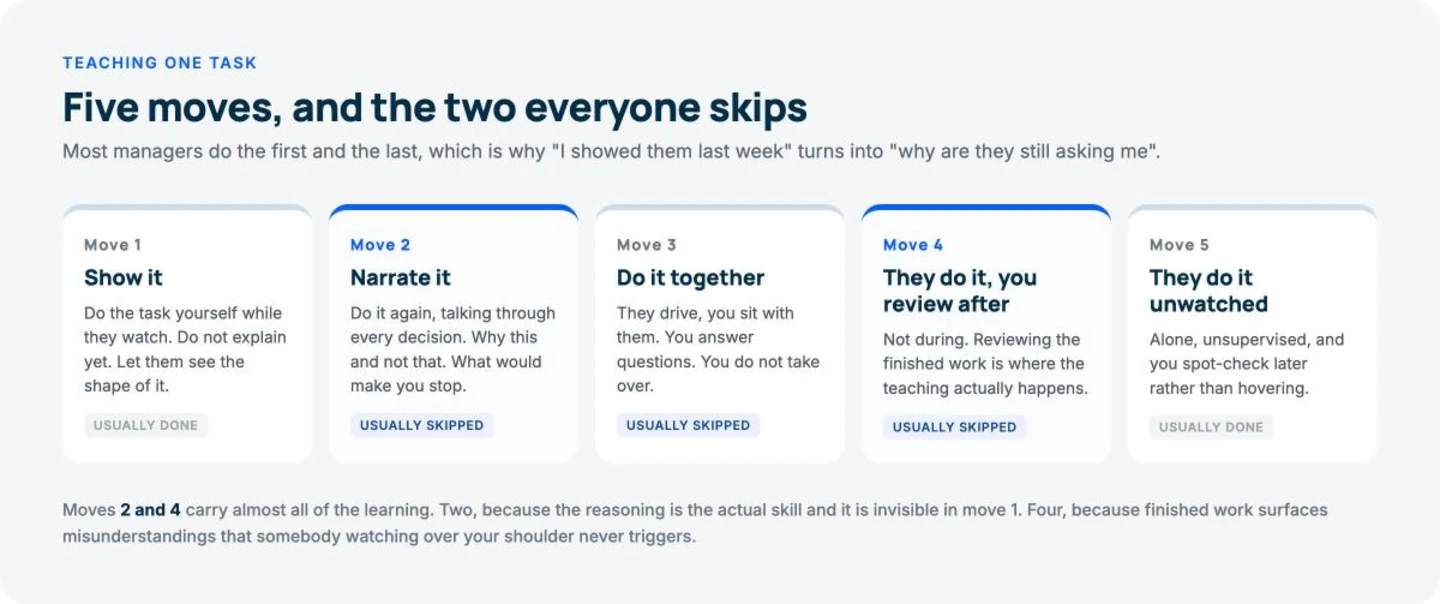
- Show it. Do the task yourself while they watch. Don’t explain yet. Let them see the shape of it.
- Narrate it. Do it again, talking through every decision. Why this and not that. What you are checking. What would make you stop.
- Do it together. They drive, you sit with them. You answer, you don’t take over.
- They do it alone, you review after. Not during. The review is the teaching.
- They do it alone, unwatched, and you spot-check later.
Most managers do step 1 and step 5 and skip the middle three, which is why “I showed them last week” so often ends in “why are they still asking me”.
Steps 2 and 4 carry almost all of the learning. Step 2 because the reasoning is the actual skill and it is invisible in step 1. Step 4 because reviewing finished work surfaces misunderstandings that a person watching over your shoulder never triggers.
The Four Places This Breaks
1. Shadowing instead of teaching
“Sit with Dave for a week” is not training. It’s a scheduling decision presented as a plan.
Shadowing works only in step 1 and step 3 above, and only when the person being shadowed knows what they are supposed to be demonstrating. Left undirected, the new hire watches somebody do a job fluently, understands almost none of the reasoning, and comes away confident and unable.
If you use shadowing, tell the person being shadowed what to narrate, and cap it at two days.
2. The week-one firehose
The instinct to be thorough produces five days of sessions and a person who has retained a tenth of it. Nobody remembers a systems walkthrough they had no reason to use yet.
The rule that fixes this: teach a thing immediately before it’s needed, not in a block at the start. Anything they won’t touch for a month doesn’t belong in week one. Anything they won’t touch for a quarter doesn’t belong in onboarding at all.
3. Training that only exists in one person’s head
“Ask Sarah about billing” works until Sarah is on holiday, and stops working permanently when Sarah leaves.
It also guarantees that two people hired into the same role get trained differently, because Sarah’s explanation depends on how her week is going. That variation compounds quietly across a growing team, and it usually becomes visible as a performance problem in one person rather than a training problem in the system.
Write it down, record it, or build it as a short course. Any of the three beats the alternative, and the reusable version belongs in an employee training plan template rather than in a thread somewhere.
4. No check, so nobody knows
If the only assessment is your impression, you’ll find out what didn’t land at the moment it costs something.
A ten-minute scored check at day 30 tells you which specific things are missing. It isn’t about grading the person. It’s about knowing where to spend the next conversation, and it’s the difference between “they seem to be doing fine” and actually knowing.
What Are the 5 Steps to Effective Training?
The five steps people usually mean are ADDIE: Analysis, Design, Development, Implementation, Evaluation. It’s the standard instructional design model, and it’s genuinely useful.
It’s also the wrong scale for your situation.
ADDIE describes how to build a training programme. You are trying to train one person who starts on Monday. Running a formal analysis and design phase for a single hire is a week you don’t have, and the output would be a document nobody reads.
Use ADDIE when you’re building the material once for everyone who will ever hold this role, which is worth doing the second or third time you hire into it. At that point you’re buying employee training software rather than managing a person. For the individual, use the five moves above instead. They’re the delivery method rather than the design method, and they’re what a manager actually needs on the day.
The Best Training for New Employees Is the Cheapest One You Repeat
There’s no single best method, but there is a reliable pattern: the training that works is the training that happens the same way twice.
Ranked roughly by how well they hold up under a busy week:
| Method | Works well for | Falls over when |
|---|---|---|
| Short course, self-paced | Anything factual and repeatable: product, policy, process | Content goes stale and nobody owns it |
| Guided walkthrough, live | Tools and systems, first time | The person doing it is unavailable |
| The five moves, on a real task | The craft of the job | The manager skips steps 2 and 4 |
| Directed shadowing, capped | Seeing the shape of the work | It runs a week and nobody narrates |
| Written documentation | Reference, later | Used as the primary teaching method |
| Undirected shadowing | Almost nothing | Always |
The first row is the one that scales, and it’s the one most small teams skip because building a course sounds like a project.
It’s worth revisiting. If you’ve already got documents describing the process, most of the work is done. Our onboarding LMS page covers that route, and we compared what the tools actually deliver in best employee onboarding software.
If You Are Training Someone for the First Time
Three things that are not obvious.
You’ll underestimate what they don’t know. Everything obvious to you was learned once. Watch for the moment they nod without asking a question; that is usually the moment they stopped following.
Your job is to become unnecessary, on a schedule. If they still need you at the same rate in week four as in week one, something in the sequence is wrong. It’s usually step 4, the reviewing.
Protect their first two weeks in your own calendar. Training somebody badly costs more time later than training them properly costs now, and the bill always arrives at the worst moment. Block the time before they start, because you won’t find it afterwards.
Frequently Asked Questions
How long should new employee training take?
Time it against how often the work happens, not against the calendar:
- A daily task belongs in week one.
- A weekly task in week two, practised once with you.
- A monthly task at its first real occurrence, with you present.
- A quarterly task doesn’t belong in onboarding at all.
What is the 30-60-90 rule for a new job?
It is a planning convention: you define what the person should be able to do at day 30, day 60 and day 90, and hold a real conversation at each point. Day 30 is usually working on core tasks with support, day 60 owning something end to end, day 90 performing at the agreed standard.
What are the 5 C’s of new hire onboarding?
The original framework has four, published by Talya N. Bauer in 2010: Compliance, Clarification, Culture and Connection. A fifth and a sixth were added by the same author in 2022, which is why lists of the ‘five C’s’ don’t all name the same fifth one. The full attribution is in our employee onboarding process guide.
Who should train a new employee, the manager or HR?
The manager owns the craft training, because they’re the only person who knows what the job actually requires. HR owns compliance and the paperwork. Where a training function exists, it owns the format and the reuse. The failure mode is HR owning content it cannot write.
How do I train someone when I am too busy?
Build the repeatable half once. The parts of the job that are identical for every hire, which is most of it, can exist as material rather than as your time. What genuinely needs you is step 2 and step 4: narrating the reasoning, and reviewing real work. Protect those two and delegate the rest to the material.
Should new hires be tested?
Lightly, yes. A short scored check at day 30 takes ten minutes and tells you what a conversation will not: which specific things did not land. Frame it as finding gaps in the training rather than gaps in the person, because that’s what it’s measuring.
What if the new hire is not picking it up?
Check the sequence before you conclude anything about the person, in this order:
- Were the three day-30 sentences written down and shared with them?
- Was anything taught in a block a month before it was needed?
- Did anyone actually narrate the reasoning, or only demonstrate?
- Has any of their real work been reviewed in writing?
Most of what looks like a slow learner is a fast trainer.
The Bottom Line
Write three sentences about what “trained” means. Teach one task properly in week one rather than covering everything badly. Use the five moves, especially the two in the middle that everyone skips. Then check at day 30 with something more reliable than your impression.
And build the repeatable half once, so the next hire gets the same thing this one did.
Build your training material free and stop being the only copy of it.