

A new hire training plan answers one question: what should this person be able to do, by when, and how will you know.
Most plans fail on the third part. They list topics, assign a week to each, and stop. Nobody defines what “trained on the product” means, so nobody can tell in week four whether it happened, and the manager ends up judging by vibe.
This guide covers how to build the plan for the first 30 days, what belongs in each week, and one popular model you should keep away from it.
Try Mini Course Generator free – build the training half of your plan from documents your team already has.
Start With the Outcome, Not the Topics
Write the last line of the plan first.
At day 30, this person can do X without help. That sentence is the plan’s specification, and everything else is derived from it. Write it in the language of the job rather than the language of training:
- Weak: “Trained on the CRM.”
- Strong: “Can log a call, update a deal stage, and run the weekly pipeline report without asking.”
The strong version tells you what to teach, in what order, and how to check. The weak version tells you nothing, which is why it survives so many review cycles unchallenged.
Three or four of those sentences is a complete day-30 target for most roles. If you find yourself writing eight, the ramp is longer than 30 days and the plan should say so out loud.
The Four Blocks Every Plan Contains
Whatever the role, the content sorts into four blocks. Getting the proportions right matters more than getting the content perfect, because the wrong proportions are what make week one feel like a firehose.
| Block | What it covers | Share of the first 30 days |
|---|---|---|
| Context | What the company does, who the customers are, how money is made | ~15% |
| Craft | The actual skills of the role | ~50% |
| Systems | The tools and processes they’ll use daily | ~25% |
| Compliance | Whatever is legally or contractually required | ~10% |
Two things go wrong with these proportions in practice.
Context expands. It’s the easiest block to produce, because marketing already made most of it, so it grows to fill week one. A new hire who has watched six company videos and touched nothing is not onboarded.
Compliance goes first. It’s the block with a deadline attached, so it gets front-loaded onto day one, which is the single worst day for it. Nobody retains harassment training four hours into a job where they don’t yet know anyone’s name. Put it in week two, where the deadline still allows it.
Week by Week
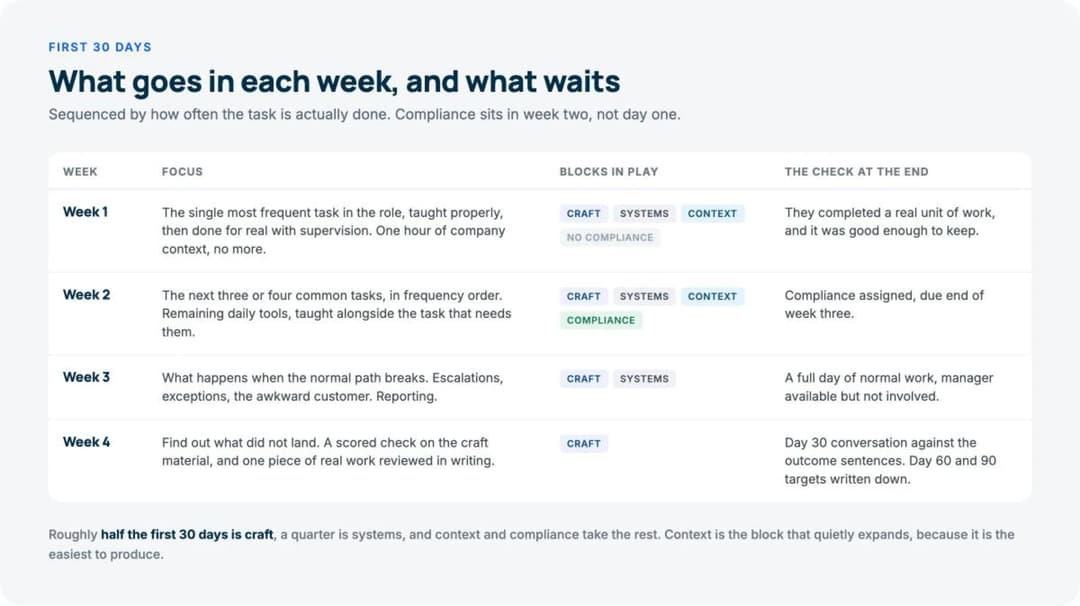
The first four weeks, with the blocks in play and what has to be true at the end of each one.
Week 1: One useful thing, plus the map
The goal for week one is not coverage. It’s that the person can do one small real piece of the job by Friday, and knows roughly where everything else lives.
- Context: one session, one hour, on what the company sells and to whom. Not the full brand deck.
- Craft: the single most frequent task in the role, taught properly, then done for real with supervision.
- Systems: only the tools needed for that one task. Everything else waits.
- Compliance: nothing yet.
The test at the end of week one: they completed a real unit of work, and it was good enough to keep.
Week 2: Widen the craft, add compliance
Week two is where most of the actual teaching happens, because the person now has a hook to hang it on.
- Craft: the next three or four common tasks, in frequency order.
- Systems: the remaining daily tools, taught alongside the task that needs them rather than as a tools tour.
- Compliance: assign it here, with a deadline at the end of week three.
- Context: the customer view. Recordings of real calls, real tickets, real sessions.
Week 3: Edge cases and independence
- Craft: what happens when the normal path breaks. Escalations, exceptions, the awkward customer.
- Systems: reporting and anything they’ll need to answer for.
- Check: they handle a full day of normal work with the manager available but not involved.
Week 4: Assess, then plan the next 60
Week four is for finding out what didn’t land, which requires actually checking rather than asking whether they feel ready. People always say they feel ready.
- A short assessment on the craft material, scored.
- One piece of real work reviewed in detail, in writing.
- The day 30 conversation, against the outcome sentences you wrote at the start.
- The 60 and 90 day targets agreed and written down.
That last step is what converts a training plan into an onboarding programme. Our guide to the employee onboarding process covers what the 60 and 90 day checkpoints should contain, and the onboarding checklist template covers the administrative half running alongside all of this.
Do Not Build This Plan on 70-20-10
If you research new hire training, you’ll be offered the 70-20-10 rule within about two clicks.
It is a real framework, it is well sourced, and it is the wrong tool for this job.
The rule comes from the Center for Creative Leadership, and CCL’s own page states what it is and where it came from. It emerged, in CCL’s words, “from over 30 years of our Lessons of Experience research, which explores how executives learn, grow, and change over the course of their careers”. The ratio it proposes:
- 70% challenging experiences and assignments
- 20% developmental relationships
- 10% coursework and training
Read the framing again, because it’s the whole issue. CCL describes this as “a research-based, time-tested, classic guideline for developing managers“, built from how executives learn over the course of their careers. The research it rests on is, again in CCL’s words, “rooted in U.S.-based corporations”, later extended to China, India and Singapore.
None of that describes a new hire in week one.
The 70% assumes challenging assignments a person can learn from. A new hire cannot learn from a challenging assignment, because they cannot yet tell which parts of it are hard, which parts are normal, and which parts they’ve got wrong. Learning from experience requires enough baseline to interpret the experience. Building that baseline is exactly what the first 30 days are for, and it lands almost entirely in the 10%.
Two more things are worth knowing before anyone quotes the ratio at you.
CCL publishes no sample size, no method and no date on its own explainer page. The page calls the rule “research-based” and points at a body of work, which is more than most frameworks in this space manage, but the number itself arrives without a study attached to it.
CCL itself says not to use it literally. On the same explainer, under the heading “Go Beyond the 70-20-10 Rule With Experience-Driven Development”, CCL writes: “The 70-20-10 framework seems simple, but you need to take it a step further. All experiences aren’t created equal.”
Use 70-20-10 for a two-year development plan for a manager you’re growing. For the first 30 days of a new job, invert it and stop apologising. What you’re actually designing there is a mix of taught material and supervised practice, which is blended learning with the proportions set by how little the person yet knows.
The 30-60-90 Framing Is the Right One
The model that fits new hire training is 30-60-90, because its unit is a checkpoint rather than a ratio.
- Day 30: trained on the role, doing core tasks with support.
- Day 60: owning something end to end, specialist training done.
- Day 90: performing at the agreed standard.
It works because the intervals are short enough that a problem surfaces while there’s still time to fix it, and because each checkpoint is a conversation about evidence rather than a number to hit. It’s a planning convention rather than a rule, and nothing stops you using 30-90-180 if your ramp is genuinely six months.
How Long Should New Hire Training Be?
Long enough that the day 30 outcome sentences are true, and no longer.
That sounds evasive, so here’s the practical version. Time the plan against the frequency of the work, not against the calendar:
- A task done daily should be trained in week one.
- A task done weekly should be trained by week two, and practised once with supervision.
- A task done monthly should be scheduled for its first real occurrence, with the manager present, whenever that falls.
- A task done quarterly does not belong in onboarding at all. Put it in the 90-day plan and train it when it happens.
That fourth line saves more time than the other three combined. Most bloated training plans are bloated because somebody tried to cover the annual reporting cycle in week three, to a person who will not touch it for five months and will have forgotten all of it by then.
Make It Reusable, or It Dies After One Hire
A training plan that exists as a manager’s document for one specific person gets rebuilt from scratch for the next hire, badly, by a different manager. That’s how two people in the same role end up trained differently, and how a team’s performance starts depending on who happened to onboard whom.
Three things make a plan survive:
1. Separate the role-generic from the person-specific. Roughly 80% of a training plan is the same for anyone in that role. Write that part once and keep it somewhere shared. The remaining 20%, the specific goals and the specific gaps, belongs to the individual. The employee training plan template is the reusable half.
2. Put the actual content somewhere that isn’t a person’s head. “Ask Sarah about the billing process” is a plan that stops working when Sarah is on holiday, and stops working permanently when Sarah leaves. Recorded, written or built as a short course, it works either way.
3. Track completion at the material, not at the plan. Knowing that the plan was “followed” tells you nothing. Knowing that this person opened the billing module, answered the questions, and got two of them wrong tells you where to spend the next conversation. That’s what employee training software is for, and what a shared document cannot do.
Points two and three are where a checklist stops being enough and a delivery tool starts earning its cost. That can be a full LMS, or it can be a handful of short courses built from documentation you already have. Our onboarding LMS page covers how that fits together, and we compared the options in the best employee onboarding software guide. The delivery half, the part that stays a manager’s job whatever you buy, is in how to train new employees.
A Worked Example
A support role at a 40-person software company. Day 30 outcome sentences:
- Can resolve a tier-one ticket end to end without escalation.
- Can explain what the product does to a customer, in the customer’s terms.
- Knows when to escalate, and escalates with the right information attached.
That yields a plan almost automatically.
| Week | Craft | Systems | Other |
|---|---|---|---|
| 1 | The five most common ticket types | Helpdesk only | One hour of context, no compliance |
| 2 | Next ten ticket types; product walkthrough | Helpdesk macros, knowledge base | Compliance assigned, due end of week 3 |
| 3 | Escalation paths, edge cases, angry customers | Reporting, internal tooling | Full day of live tickets, supervised |
| 4 | Assessment on ticket handling | – | Day 30 review, 60 and 90 targets set |
Note what isn’t in there. No billing system, because support doesn’t touch it until month three. No full tour of the product’s admin settings, because tier one doesn’t use them. Both were in the previous version of this plan, and both were cut after the second new hire said week two was overwhelming and week four was empty.
Frequently Asked Questions
What should a new hire training plan include?
Four things: the outcome you’re aiming at, written as what the person can do without help; the content split into context, craft, systems and compliance; a week-by-week sequence with the most frequent task first; and a way of checking at day 30 that isn’t the manager’s impression.
How do I write a 30-60-90 day plan for a new employee?
Write the day 30 outcomes first, in the language of the job. Then decide what day 60 looks like if day 30 goes well, usually owning a piece of work end to end. Day 90 is performing at the standard the role is paid for. Work backwards from each to the training that gets them there, and agree all three in writing with the person.
Who should own the training plan?
The hiring manager owns the content, because they’re the only person who knows what the job actually requires. Whoever owns training or L&D owns the format, the delivery and the reuse. When HR owns the content, the plan describes the company rather than the job.
What is the 70-20-10 rule for employee development?
It’s the Center for Creative Leadership’s framework holding that development comes 70% from challenging experiences, 20% from developmental relationships and 10% from formal coursework. It came out of CCL’s Lessons of Experience research into how executives learned across their careers, and CCL positions it as a guideline for developing managers. It’s a poor fit for new hire onboarding, for the reasons above.
How much does it cost to run this properly?
Less than most people assume, if the plan is the expensive part rather than the platform. Published LMS pricing starts free and runs to a few hundred dollars a month at 100 users, which we broke down in what an LMS actually costs. The larger cost is a manager’s time writing the day 30 outcome sentences, and that cost is unavoidable.
How is a training plan different from an onboarding checklist?
A checklist coordinates. It says who does what by when, across HR, IT, the manager and training. A training plan teaches. It says what the person will be able to do, and what content gets them there. Most companies have the first and think they have the second.
Should new hires be assessed?
Yes, and lightly. A short scored check at day 30 on the craft material takes ten minutes and tells you something a conversation won’t: which specific things did not land. It also gives you evidence when a role goes wrong later, which matters more than anybody wants it to.
The Bottom Line
A new hire training plan is three sentences about what the person can do at day 30, a sequence that gets them there in frequency order, and a check that isn’t a feeling.
Keep the ratios sane, put compliance in week two, cut anything they won’t touch for five months, and write the reusable 80% down somewhere that isn’t one manager’s inbox.
And when somebody offers you 70-20-10 for this, thank them and use it for the two-year plan instead.
Build your new hire courses free and turn the craft block into something the next hire gets identically.
Sources
- Center for Creative Leadership, “The 70-20-10 Rule for Leadership Development”, ccl.org, read 29 August 2026
- Talya N. Bauer, Onboarding New Employees: Maximizing Success, SHRM Foundation, 2010