Most training programs fail for one reason: they pick one format and use it for everything.
A full-day classroom session does not work for distributed teams. A library of self-paced videos loses people who need live interaction. Blended learning solves both problems by design.
Blended learning is now the default approach in corporate training. The blended learning market was valued at approximately USD 23.14 billion to USD 23.5 billion in 2024 and is projected to reach over USD 48 billion to USD 51.82 billion by 2030–2032 according to a Research and Markets report. That growth reflects a shift in how organizations think about learning: not as a single event, but as a multi-format experience.
This guide covers what blended learning is, the five main models, real examples from companies like Deloitte, and a step-by-step process to build your own blended training program using Mini Course Generator.
Blended Learning vs. Online Learning vs. Classroom Training
Organizations often compare blended learning against purely online or traditional classroom formats. The main difference lies in how learning formats are combined and what each format is asked to do.
| Training Approach | Delivery Method | Strengths | Limitations |
|---|---|---|---|
| Classroom Training | In-person, instructor-led | Real-time interaction and feedback | Expensive and difficult to scale |
| Online Learning | Fully digital, self-paced | Accessible anywhere, highly scalable | Limited interaction and engagement |
| Blended Learning | Digital + live instruction combined | Flexible, engaging, measurable | Requires intentional program design |
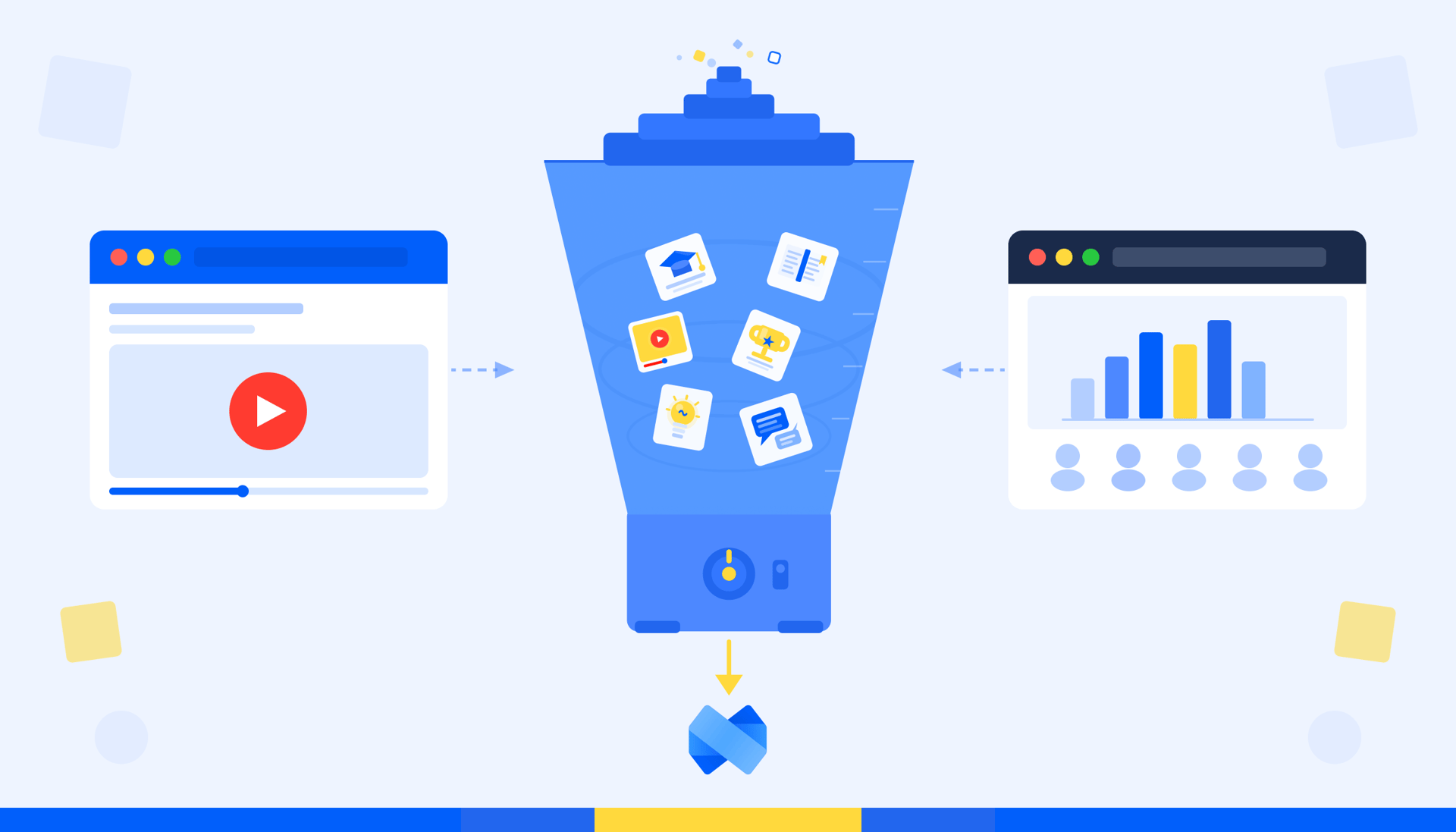
Blended learning captures the scalability of online learning and the engagement of live instruction. The digital component delivers knowledge consistently at scale. The live component creates the interaction and application that digital-only programs cannot replicate.
Why Are Organizations Adopting Blended Learning?
Traditional classroom training is hard to scale across distributed and remote teams. Fully online programs often struggle with completion rates and engagement. Blended learning addresses both challenges at once.
Research from the U.S. Department of Education found that students in blended learning environments performed better than those receiving purely face-to-face instruction.
For organizations managing remote teams, global workforces, or rapid growth, blended learning is not a nice-to-have. It is the most practical way to deliver consistent, scalable, and measurable training.
What Does a Blended Learning Environment Look Like?
A blended learning environment combines multiple training formats into a structured learning journey. Most blended programs include self-paced digital learning modules, instructor-led workshops or virtual sessions, peer collaboration and discussion, and coaching or applied practice.
- Self-paced digital learning modules
- Instructor-led workshops or virtual sessions
- Peer collaboration and discussion
- Coaching or applied practice
This structure separates knowledge acquisition from skill application. Learners first understand concepts independently, then practice them with guidance. The result is a program that is more efficient with live time and more effective overall.
What Are the Main Blended Learning Models?
There is no single way to do blended learning. The right model depends on your goals, your audience, and your content. Here are the five most widely used models in corporate training.
Flipped Classroom
Rotation Model
Flex Model
Face-to-Face Driver
Enriched Virtual
1. The Flipped Classroom Model
Learners complete online content before the live session, not during it. They might finish a mini-course, watch a short video, or work through pre-reading on their own time. When the live session happens, all the time goes to discussion, questions, and practice.
This removes the passive listen-and-watch experience from in-person sessions. The live time becomes a coaching and application environment. It is widely used in onboarding programs, leadership development, and product training.
2. The Rotation Model
Learners move through different formats on a structured schedule. A program might rotate between online self-paced modules, group workshops, job shadowing, and coaching sessions. Each format serves a specific learning purpose.
This model works well for new hire onboarding, where employees need exposure to knowledge, skills, and team culture over several weeks. Every learner moves through the same sequence but engages with each format at their own level.
3. The Flex Model
Online learning is the primary format. In-person or live support is available on demand rather than on a fixed schedule. Learners move through digital content at their own pace, with coaches or instructors available for check-ins when needed.
This model works well for distributed and remote teams. It scales easily because the online content reaches any number of learners without depending on facilitator availability.
4. The Face-to-Face Driver Model
Most instruction happens in person. Online content supplements, reinforces, or extends the classroom experience. Pre-work, post-session assignments, and knowledge checks may be digital, but the core format remains face-to-face.
Organizations with an established in-person training culture often start here and gradually shift more content online over time.
5. The Enriched Virtual Model
Online learning is the core format. Occasional in-person or live sessions enrich the experience. Learners complete most training digitally but meet periodically with a facilitator or cohort to discuss, practice, and go deeper.
This model is common in organizations with global teams where regular in-person sessions are not practical.
What Are the Benefits of a Blended Learning Approach?
Blended learning outperforms single-format training across every dimension that matters in a corporate context.
Improved Knowledge Retention
Learners retain more when they encounter information across multiple formats and sessions. According to Shift Learning data, micro-learning, a core component of most blended programs, improves knowledge retention by 50 percent compared to traditional formats. The online layer creates a knowledge base. The live session deepens it. Reinforcement locks it in.
Greater Flexibility for Learners
Remote and hybrid work makes fixed-schedule classroom training difficult to mandate. Blended learning works around that. Self-paced online content can be completed between meetings or at whatever time fits each learner. Live sessions still create structure and accountability without requiring everyone to be in the same place at the same time.
Higher Engagement
Long-form elearning courses have completion rates of around 20 to 30 percent. Blended programs, which break content into shorter modules and pair them with live application sessions, consistently achieve higher engagement and completion. Learners stay enrolled when they can see what they are building toward.
Measurable Learning Outcomes
The digital component of a blended program generates data that traditional classroom training never could: completion rates, quiz scores, time on task, and knowledge gaps by individual or team. This makes it possible to see what is working, identify who needs support, and connect training to business outcomes.
Knowledge retention improvement with micro-learning
Micro-learning completion rate vs. 20–30% for long-form
Projected blended learning market by 2030–2032
Where Is Blended Learning Used in Corporate Training?
Blended learning supports every major type of workplace training program. The digital layer handles scale and consistency. The live layer handles application and connection.
New Hire Onboarding
A blended new hire onboarding program might combine digital modules covering company processes, policies, and product knowledge with live sessions where new hires practice workflows and meet their teams. The online layer ensures every hire receives the same foundational content. The live layer makes it human.
Sales Training
Blended learning is widely used in sales training, where teams need both product knowledge and practical selling skills. Online modules introduce product features and competitive positioning at scale. Live workshops focus on demos, objection handling, and role-plays, the skills that can only be built through practice with feedback.
Partner and Customer Training
Companies use blended programs for partner training, allowing partners to complete product knowledge modules on their own schedule before joining live sessions for implementation guidance. The same approach works for customer training programs, especially when users need both self-paced product tutorials and hands-on support.
Real-World Examples of Blended Learning in Corporate Training
The best evidence for blended learning is not theoretical. It comes from organizations that have built and measured real programs.
📊 Deloitte
🏋️ Freeletics
IBM: The Tiered Blended Model for Manager Onboarding
In 1999, IBM launched Basic Blue, a blended management training program for new managers. The program delivered 75% of content online across three tiers: articles and simulations, scenario-based learning, and virtual collaboration exercises. The fourth tier was a one-week in-person Learning Lab where managers applied everything they had already mastered. IBM trained around 5,000 new managers per year through this model and reported saving approximately $166 million in its first year of full implementation. (Source: MBA Knowledge Base)
Deloitte: Multimodal L&D at Scale
Deloitte does not use a single training format. Their L&D program combines 12-week in-person boot camps, one-day courses, one-hour eLearning modules, 15-minute podcasts, in-app prompts for on-the-job tasks, and peer learning communities called guilds. The mix is intentional. Different roles, schedules, and learning preferences get different blends. Deloitte also uses individual knowledge assessments to recommend the most appropriate starting point for each learner. (Source: Training Industry)
Freeletics: Microlearning and Social Learning Combined
Freeletics built its leadership development program around a blended approach that combines microlearning with social and immersive learning. Short, self-paced modules provide the knowledge layer. Social learning principles, including peer interaction and community-based application, provide the reinforcement layer. The program was designed to increase learner engagement and promote a culture of continuous learning across the organization. (Source: Deel)
How Do You Design a Blended Learning Program?
Most blended programs fail not because the concept is wrong, but because teams start with formats and tools instead of outcomes. Here is a process that starts in the right place.
-
1
Step 1: Define the Learning Outcome
“Train our sales team” is not an outcome. “New sales reps will be able to deliver a product demo independently within 30 days” is an outcome. Start with one clear, measurable goal. Every decision that follows, what goes online, what stays live, how long the program runs, comes from that outcome.
-
2
Step 2: Decide What Belongs Online vs. Live
Online works best for foundational knowledge, product documentation, repeatable explanations, compliance content, and anything people need to revisit. Live works best for coaching, simulations, collaborative problem-solving, and feedback. Map your content to these two categories before you build anything.
-
3
Step 3: Choose the Right Blended Model
A remote team with self-directed learners often suits the flex or enriched virtual model. A new hire cohort benefits more from the rotation model. A classroom-heavy program with an existing live infrastructure might start with the face-to-face driver model. Match the model to your audience, not to what is easiest to build.
-
4
Step 4: Build Short Digital Learning Modules
Many organizations rely on microlearning for the digital component of blended programs. Short, focused lessons, typically 3 to 7 minutes, covering a single concept outperform long-form courses on every engagement metric. You can build them in minutes using an AI course creator. Upload a PDF, a playbook, or a set of notes. MCG generates a structured, interactive mini-course with lessons, quizzes, and knowledge checks automatically. No instructional design experience needed.
-
5
Step 5: Design Live Sessions for Application
Once learners have completed the online pre-work, live sessions can skip the basics entirely. Use the time for role-plays, case discussions, group problem-solving, and coaching. Focus on what digital learning cannot create on its own: practice with real-time feedback and human connection.
The Role of Micro-Learning in a Blended Approach
Micro-learning is not a replacement for blended learning. It is the most effective format for the online layer of any blended program.
According to Shift Learning data, micro-learning improves knowledge retention by 25 to 60 percent compared to traditional formats, and completion rates reach around 83 percent, versus 20 to 30 percent for long-form courses. The reason is structural: long courses ask learners to hold too much in mind at once. Micro-learning solves one problem at a time. Each lesson delivers a clear outcome and something the learner can apply immediately.
In a blended program, micro-learning handles everything that needs to be understood before the live session. It is also the reinforcement layer that keeps knowledge current as products, processes, and teams change over time.
“Each micro-learning lesson delivers a clear outcome and something the learner can apply immediately.”
Common Challenges in Blended Learning (and How to Fix Them)
Challenge 1: Low Completion Rates on the Online Component
Long eLearning courses have low completion rates because they ask too much of learners at once. The fix is format, not motivation. Break each online component into a single focused lesson under 10 minutes. Remove anything a learner does not need before the live session. Short mini-courses built around one outcome consistently outperform long-form alternatives.
Challenge 2: Keeping Content Up to Date
Products change. Processes evolve. Compliance rules shift. Traditional course content gets outdated fast, and rebuilding it is expensive. Tools that allow rapid editing, like MCG’s AI-powered course editor, let teams update content in minutes, not weeks. The online layer of a blended program always reflects current reality.
Challenge 3: Measuring the Impact of Live Sessions
The digital component generates data automatically. Live sessions are harder to measure. Build measurement in from the start. Pre-session knowledge checks establish a baseline. Post-session assessments or follow-up micro-courses show what was retained. This creates a before-and-after picture that proves the value of the whole program.
How Mini Course Generator Supports Blended Learning
The most common bottleneck in blended learning is not the live component. Most organizations already know how to run workshops. The bottleneck is the online layer: building it, keeping it current, and making it easy for learners to access.
Mini Course Generator is built to remove that bottleneck. Using AI, training teams can turn existing documents, playbooks, slide decks, or product notes into structured, interactive mini-courses in minutes.
Share via link, embed into intranets, or export as SCORM for LMS integration
Learner access requires no mandatory login — reduces friction and improves completion rates
Built-in analytics to track completion, knowledge gaps, and team progress
Role-specific learning paths aligned with real-world use cases
Whether you are building a flipped classroom program for new hire onboarding, a continuous enablement system for your sales team, or a micro-learning reinforcement layer for employee training, MCG gives you the online content layer that makes the blend work.
Blended Learning Is No Longer Optional
The organizations building strong teams in 2026 and beyond are the ones that stopped treating training as a one-time event. They design it as a multi-touchpoint experience.
The online layer handles knowledge transfer at any scale, consistently. The live layer handles application, judgment, and human connection. Together, they create learning that is more flexible, more measurable, and more effective than either format alone.
The question is not whether to blend anymore. It is how to build the online component fast enough to keep pace with how quickly your business moves.
- Knowledge transfer at any scale, consistently
- Application, judgment, and human connection preserved
- More flexible, measurable, and effective than either format alone
- Built to keep pace with how quickly your business moves
Mini Course Generator makes the online layer of your blended training program fast to build, easy to update, and simple for learners to access. Start building your first blended learning mini-course today. No setup fees, no implementation timeline, no instructional design experience needed.