
America’s franchised light-vehicle dealers sold 16.2 million vehicles in 2025 and wrote more than 276 million repair orders, across just 16,990 rooftops. Service and parts sales topped $164 billion (NADA Data, 2025 full-year report). Behind those numbers is a workforce that has to know more every year: 805,600 automotive service technicians (BLS, 2024), plus the service advisors, salespeople, F&I managers, and BDC agents around them.
Keeping that workforce trained is getting harder, not easier. The BLS projects about 70,000 technician openings every year over the coming decade, most of them replacing people who leave the trade. At the same time, EV and ADAS procedures change faster than any annual training cycle. OSHA and EPA compliance has to be provable per location, and multi-rooftop groups need every store teaching the same material the same way.
That’s the job of an automotive LMS: deliver the training, keep it current, and prove who completed it. This guide covers what an automotive LMS is, the benefits and features that matter in this industry specifically, and the 10 tools worth a serious look. That includes the dealership sales networks, technician simulators, and safety systems generic software lists never mention. Every vendor number is labeled as their claim. Disclosure up front: Mini Course Generator is our product, listed first and judged by the same standard.
Want to see the fast path first? Start building automotive micro-training free with Mini Course Generator, no card required.
What Is an Automotive LMS?
An automotive LMS is a learning management system used by dealerships, service centers, collision shops, and manufacturers to deliver training and prove who completed it. The records span technician certifications, safety modules, sales onboarding, and product updates. One system holds the courses, assigns them by role, tracks completions, and produces the audit trail.
What makes the industry different from generic corporate training is cadence and floor shape. EV and ADAS procedures change faster than annual training cycles, so authoring speed matters more than a big content library. Technicians learn between jobs, standing up, on phones, not at desks. Multi-rooftop groups need per-location reporting, because OSHA doesn’t audit your company average; it audits a shop.
One acronym trap before we go further: in dealership CRM stacks, “LMS” often means lead management system, the software that routes internet leads to salespeople. Same letters, different aisle, and the collision is common enough that vendors on both sides rarely flag it. If a demo keeps talking about follow-up cadences instead of course completions, you’re shopping in the wrong category. The same goes for the broader software boundary: a learning system tracks who knows what; a content system merely publishes pages. Our LMS vs. CMS comparison draws that line properly if your team is debating whether the intranet can carry training. (It can host documents. It cannot prove anyone read them.)
One more boundary: everything here is for training a team you employ. If you’re an individual looking to become a technician or F&I manager, you want trade schools and certification programs, and this guide will disappoint you on purpose.
Benefits of Using an LMS for Automotive Teams
The case for an LMS in this industry isn’t abstract. Every benefit below maps to a number a dealer principal or shop owner already tracks: training spend, fixed-ops throughput, technician turnover, audit exposure, and per-store performance.
Training cost savings
Traditional automotive training means travel, hotel nights, and people off the floor. A two-day offsite for six technicians is not only the course fee; it’s two days of lost repair orders in a service department that sells time. At average effective labor rates, pulling one productive technician for two days costs more than most annual software subscriptions on this list, before you count the hotel.
An LMS moves most of that learning into the building. Modules run on phones between jobs, product updates go out without gathering anyone in a room, and the trainer’s day rate gets spent on the coaching only a human can do. Offsites still have a place, for the skills that need a live coach and a role-play partner, but they stop being the delivery mechanism for information that could have been a ten-minute module.
The savings compound at scale: when a process changes, updating one course once beats re-briefing twenty stores separately. That’s also why micro-format content matters so much here; a microlearning platform built around minutes-long modules fits shop rhythm in a way hour-long courses never will.
Standardized training across every rooftop
Walk into two stores of the same group and you’ll often find two different walkarounds, two different multi-point inspection routines, and two versions of the warranty process. Every variation is margin leaking somewhere: a skipped inspection line is an unsold repair, and a mishandled warranty claim is a chargeback. An LMS makes the standard teachable and provable: one curriculum, assigned by role, completed on record, in every location.
The acquisition case is even stronger. Dealer groups grow by buying stores, and every acquired store arrives with its own habits. Onboarding a new rooftop onto the group’s curriculum in the first month, with completion reports to show it happened, is how “our way of working” becomes real instead of aspirational. This is the same logic that drives employee training software in any multi-site business, but automotive raises the stakes, because the factory audits process compliance and ties it to incentive money.
Faster EV and ADAS rollout
The technical half-life of automotive knowledge is collapsing. High-voltage battery procedures, ADAS calibration steps after a windshield replacement, new diagnostic trees for software-defined vehicles: these change monthly, not annually. A shop where that knowledge travels by word of mouth is a shop doing comebacks, and a comeback on a misdiagnosed ADAS system is not only lost time; it’s a liability question.
With an LMS, the update ships the day the procedure changes, reaches every affected role, and shows you who hasn’t read it yet. That last part matters more than it sounds. “We sent an email about that” proves nothing; a completion list with quiz scores does.
In practice the rollout is a repeatable loop: bulletin arrives, a module gets drafted from it and assigned to the affected roles, and the exception report shows who still hasn’t completed it by Friday. How fast a platform lets you run that loop is the deciding capability, and it’s the first thing we test in the features section below.
Technician engagement and retention
With roughly 70,000 technician openings projected per year (BLS), keeping the people you have is cheaper than replacing them. Every departure costs recruiting, ramp-up months, and the repair orders the empty bay didn’t produce. Training is retention infrastructure: technicians consistently rank development and a path to certifications among the reasons they stay or go. A shop that visibly invests in skills gives people a concrete reason to stay when a recruiter calls.
An LMS makes the path visible, from structured onboarding in week one to a recorded ladder of completed certifications a tech can take into a pay-plan conversation. Daily-practice tools like Today’s Class (reviewed below) push this further by making learning a habit with points and team competition rather than an annual event. The pattern shows up on the sales floor too, where training visibly tied to income is one of the few levers that outlasts a pay-plan tweak. It shows up in the BDC as well, where turnover runs highest of all.
Compliance you can prove in an audit
OSHA and EPA compliance in a shop isn’t a policy binder; it’s evidence. Who took lift-safety training, when, and what did they score? Who is current on right-to-know and pollution prevention? Which of last quarter’s new hires completed EV high-voltage safety before touching an orange cable? When an inspector or an insurer asks, “we cover that in orientation” is not an answer; a completion report is.
An LMS produces that report per person and per location, automatically, and the same records feed insurance conversations, OEM audits, and the uncomfortable meeting after a near-miss. Recertification machinery matters as much as first delivery. Certificates expire quietly, and the platforms that monitor validity and reassign training (iSpring LMS is the standout below) close the gap before an audit finds it. Purpose-built [compliance training software](https://minicoursegenerator.com/use-cases/compliance-training-software/) thinking applies to automotive with extra teeth, because the fines and the injuries are both real.
Reporting that turns training into coaching
Completion data is only the start. The useful layer is what the scores say: which store struggles with the new F&I menu, which technician aces electrical but avoids driveability modules, which advisor never finishes anything after lunch. Managers coach from that, in one-on-ones and team huddles, instead of discovering gaps in a CSI report three months later.
The comparison gets sharper when training scores sit next to the numbers the store already lives by: hours per repair order, effective labor rate, CSI, F&I product index. A store that completed the menu training but didn’t move its product index has a coaching problem, not a training problem, and the combined view is what tells you so. The one warning: reporting only earns its keep if someone owns it. Decide before launch who reviews the dashboard, on what cadence, and what happens when a red flag shows up.
Key LMS Features for the Automotive Industry
Feature lists all look alike until you test them against a shop floor. These are the eight capabilities that separate an LMS that works in automotive from one that merely demos well.
Mobile-first delivery
Technicians don’t have desks; they have bays. Salespeople have a lot, a showroom, and a phone. If training only works on a desktop in the break room, completion rates will tell you so within a month. Mobile-first means more than a responsive website: modules sized for minutes, resumable mid-lesson when a customer walks in, readable standing up in shop light.
Check the ugly details in the demo: does video buffer on shop Wi-Fi, does a module survive switching from Wi-Fi to cellular, can a tech in gloves scroll it? Ask whether the mobile experience is an app, a browser, or both, and what offline behavior looks like in a metal building where signal dies. The vendors on this list that lead with mobile (iTacit for frontline apps, Today’s Class for daily phone-first practice) built for this reality; for the others, make the demo prove it.
Fast authoring and micro-format content
Automotive training content has a short shelf life, so the platform’s authoring speed is a feature, not a convenience. The test: can your service manager turn a two-page process bulletin into an assigned, trackable module today, without a designer? If the honest answer involves a content team, a template library, and next Tuesday, the platform will always lag your floor.
AI-assisted authoring has changed what’s reasonable to expect here; drafting a quiz-backed micro-course from an existing document is now a minutes-long job on the right platform. Interactive elements matter too, because reading is not rehearsing. Look for built-in quizzes, flashcards, and branching scenarios rather than plain document hosting. And check the update path, not just the creation path: fixing one step in a published module should be an edit, not a re-publish-and-reassign cycle that resets everyone’s completion status.
Certification and compliance management
The compliance layer needs three things: expiry-aware certifications that reassign themselves, per-location completion reporting, and content that maps to actual OSHA and EPA requirements rather than generic safety themes. If you run collision, add refinish and pollution-prevention specifics; if you’re taking on EV work, high-voltage safety belongs in the required set before the first battery job, not after.
Some of this you’ll author; some you’ll buy from a specialist like S/P2 and track alongside your own content. Either way, the LMS is your system of record, so its certificate and reporting machinery has to be strong enough to hand to an auditor as-is: named person, named course, date, score, expiry. Test it by generating that exact report in the trial. If producing it takes an export and a spreadsheet, you’ve found next year’s audit-week problem early.
Multi-rooftop reporting and analytics
A dealer group’s training question is never “how are we doing?”; it’s “how is store 7 doing against store 12?” Per-location dashboards, role filters, and exportable completion reports are table stakes. The subtler requirement is assignment logic. A new-hire advisor in one store should automatically inherit that store’s curriculum, not a group-wide blob, and moving a manager between stores should move their requirements with them.
If you operate service and sales under different brands or OEMs, check that reporting can slice by both location and franchise. Factory training requirements differ by brand, and the incentive money attached to them is real. And ask the boring operational question early: who at the group level gets which view? A platform where every store manager can see every store’s numbers creates a different politics than one with scoped dashboards. Neither is wrong; pick deliberately.
DMS, CRM, and HRIS integrations
Training data becomes powerful when it meets your operational systems. New hires flow in from HR so enrollment is automatic, completions flow out to compliance dashboards, and coaching gets triggered by CRM outcomes. In a dealership, the DMS is the system of record for almost everything else. Training that lives in a silo next to it gets forgotten at exactly the moments (new hire, role change, termination) when it matters most.
Most platforms promise “integrations”; the practical questions are which connectors are native, what the API covers, and whether no-code bridges like Zapier or Make can close the gaps. None of the vendors on this list advertises a native connector for the major DMS platforms, so plan on HRIS-driven enrollment or a light API bridge rather than waiting for one. Before you sign, decide which systems to connect first and why; connecting everything on day one is how implementations stall.
SCORM and xAPI portability
Content you build should outlive the platform you build it on. SCORM remains the compatibility standard; xAPI tracks richer activity beyond the course window. If you buy off-the-shelf automotive content, it will most likely arrive as SCORM packages, so your LMS has to import them cleanly. “Cleanly” is worth testing with a real package during the trial rather than taking from a compatibility logo.
If you author in-house, prefer platforms that can export your courses to SCORM so a future migration is a file transfer, not a rebuild. This is cheap insurance: platforms get acquired, pricing models change, and the group that owns its content as portable packages negotiates renewals from a stronger seat. Our xAPI vs SCORM comparison covers which standard you need; the short version is that SCORM is the safe default and xAPI earns its complexity when you care about tracking real-world activity like ride-alongs, observation sign-offs, and repair outcomes.
Assessments, role-play, and observation checklists
A completed course proves exposure, not competence. Automotive needs the verification layer. That means quizzes for knowledge, AI-graded role-play for customer conversations (walkarounds, service write-ups, objection handling), and observation checklists so a supervisor can sign off that a skill was performed on the floor, not merely clicked through.
Sales and service both live on conversations. A service advisor’s ability to present a $1,400 estimate without apologizing for it is worth more than any completion certificate. And it’s trainable: practicing against an AI counterpart lets people get the awkward repetitions done in private, before a customer is watching. Observation checklists close the loop on the hands-on side; iSpring LMS ships them natively. They’re the difference between “took the lift-safety course” and “was watched setting the arms correctly, twice, by someone qualified to judge.”
Multi-portal structure for dealers and partners
Manufacturers, importers, and large groups train audiences beyond their own payroll: dealer networks, independent installers, fleet customers. That calls for separate branded academies per audience, with distinct content and reporting, run from one system. Your dealer network shouldn’t see your internal onboarding, and your fleet customers shouldn’t see either; the portal structure enforces that without running three platforms. It’s the same architecture as partner training anywhere in B2B, and AcademyOcean below makes it the core of the product.
If your training needs to live inside an existing dealer portal rather than as a separate site, look at embedded delivery options too; the difference between “another login” and “training inside the tools they already use” shows up directly in completion rates. With an audience you don’t employ, completion rates are the whole game.
The 10 Best LMSs for the Automotive Industry
The best LMS for the automotive industry depends on who you’re training. Dealership sales floors, service technicians, and multi-rooftop groups buy three different kinds of tools. The families: LMS platforms that deliver and track any training, dealership sales and management programs, and technician, safety, and retention systems. The list below covers all three families, in that order. Generic platforms like Litmos or Docebo can serve automotive teams well; this list stays with the tools that earn a specific automotive job. If a general platform is where you’re heading, the Docebo alternatives comparison covers that shelf on price, seat floors and contract terms.
How we picked: no paid placements, no affiliate links, and no vendor saw the list early. The bar was automotive relevance (not an industry landing page bolted onto a generic product), verifiable claims, and honest pricing labels. Prices and plan details were checked in August 2026 and are quoted only where a vendor publishes them. Pros and cons draw on third-party review platforms (Capterra, G2, iATN) where the product has a real review base, and we say so when it doesn’t.
How they compare at a glance, before the detailed reviews:
| Platform | Best for | Automotive-specific content | Authoring | Compliance tracking | Pricing |
|---|---|---|---|---|---|
| Mini Course Generator | Rapid micro-training across roles | No; you author it, AI-assisted | AI-assisted, minutes per module | Completion + audit records | Public, free start |
| TalentLMS | Structured programs at scale | No; generic platform | Course builder + TalentLibrary add-on | Paths, reports, certificates | Public, free plan |
| iSpring LMS | Certification renewal | No; generic platform | iSpring AI + ready libraries | Auto-reenrollment + observation checklists | Quote (per active user) |
| AcademyOcean | Dealer and partner academies | Partial; portal architecture | AI course creation | Limited, per reviewers | Quote |
| iTacit | Frontline comms + training | Partial; frontline focus | Drag-and-drop, SCORM import | Strong tracking | Quote |
| Joe Verde (JVTN) | Dealership sales skills | Yes; prebuilt curriculum | — | — | Quote |
| AMI | Management credentials | Yes; accredited designations | — | Credit-hour records | Per designation |
| Electude | Technician skills and simulation | Yes; 3,000+ modules | — | — | Quote |
| Today’s Class | Daily knowledge retention | Yes; adaptive content | — | — | Quote |
| S/P2 | OSHA/EPA safety compliance | Yes; prebuilt courses | — | Credential records | Public, $485/roof (collision) |
1. Mini Course Generator
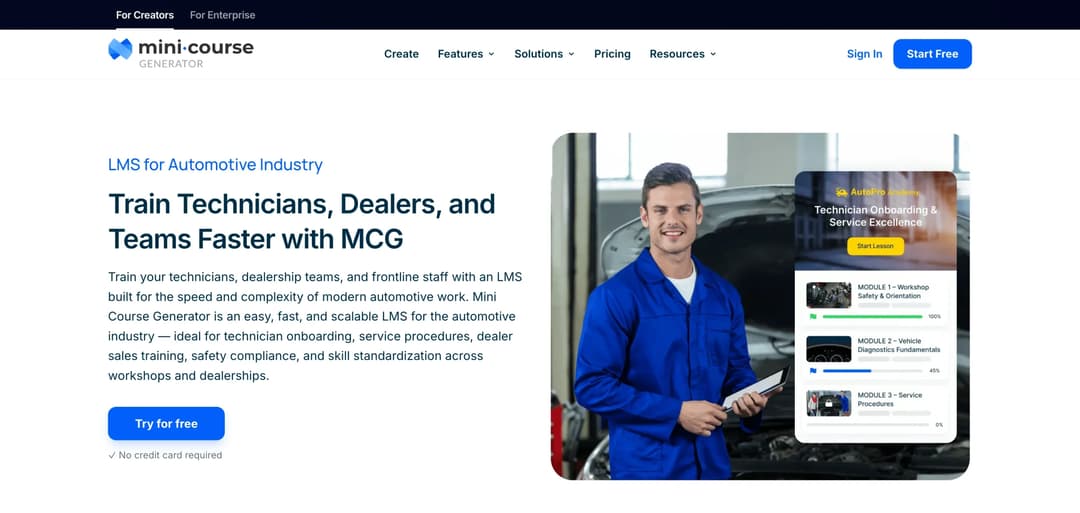
Disclosure: Mini Course Generator is our product. Judge this entry hardest.
Top Features
- AI-assisted authoring that turns a procedure document into an interactive micro-course in minutes.
- Interactive modules with quizzes, flashcards, and AI-graded role-play scenarios.
- Mobile-first delivery sized for minutes between jobs, not hours at a desk.
- Completion tracking with audit-ready records for every required course.
- Same-day updates when an EV or ADAS procedure changes.
Mini Course Generator’s automotive story is speed and shape: create and deliver structured training in minutes, as short interactive modules rather than hour-long courses. Repair steps, warranty procedures, and product updates become bite-size lessons that technicians open during repairs, diagnostics, or customer walk-arounds. It’s built for the whole roster: technicians, service advisors, sales staff, lot attendants, and managers.
The industry fit shows up in the update cadence. When a procedure changes, a working module ships the same day, and completion tracking keeps audit-ready records behind it. Quizzes and role-play scenarios handle sales certification and customer-service practice, and courses export to SCORM or embed into an existing portal when your training needs to live where people already work. The trade-off is deliberate: this is an authoring-and-delivery platform for your own material, not a library of prebuilt automotive content, which is why it pairs naturally with the industry specialists later in this list.
Try it on a real training need: the free plan needs no card, and public plans are on the pricing page when you outgrow it. A service bulletin you received this week is the honest pilot.
Pros
- Built for a rapid authoring loop: document in, assigned interactive module out, same day.
- Micro-format and mobile delivery match how shop floors learn.
- Rated 4.3/5 on G2 and 4.76/5 across 210 reviewers on AppSumo.
Cons
- No simulation engine for hands-on diagnostics; that’s Electude’s territory below.
- No built-in dealership sales curriculum; you author the content, AI-assisted, or pair it with a program like JVTN.
2. TalentLMS
Top Features
- Learning paths by role and department across dispersed teams.
- Free plan covering 5 users and 10 courses.
- Native mobile apps with offline access.
- TalentLibrary ready-made course collection as a paid add-on.
- Automated assignments, notifications, and reporting.
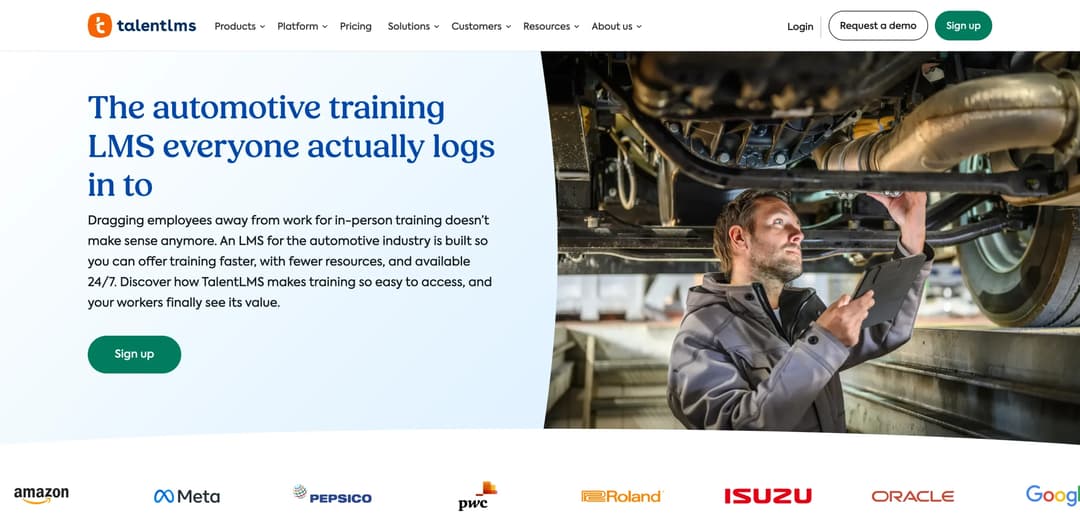
TalentLMS pitches itself as “the automotive training LMS everyone actually logs in to,” and the strength is exactly that: a clean, proven platform for structured programs at scale. Learning paths run by role and department, automation handles assignments and reminders, and the mobile apps keep dispersed teams inside one system. For a group that wants a mature LMS backbone with a real free tier to test on, this is the safest generic pick on the list.
Its pricing is refreshingly public: the free plan covers 5 users, then Core at $119/month, Grow at $229, and Pro at $449 plus $6 per extra user, with 20% off annually. The honest caveat is that the automotive page is a landing variant on a general product. There’s no technician certification content, no dealer compliance modules, no OEM material. You’re buying an excellent generic LMS and supplying the automotive substance yourself, either authored in-house or through the TalentLibrary add-on’s general workplace courses.
Pros
- Setup is fast and intuitive, requiring minimal technical expertise, per Capterra’s reviewer consensus.
- Content creation is straightforward across formats, with reviewers calling the feature set strong for the price.
- Support responds quickly and works around missing functionality, per the same review base.
Cons
- Some Capterra reviewers report persistent bugs and unreliable integrations.
- Editor and formatting options are restrictive, making layout customization harder than expected.
- Reviewers note missing pieces like automated grading and exam scheduling.
### 3. iSpring LMS
Top Features
- Intelligent reenrollment that monitors certificate validity and reassigns expiring training.
- Observation checklists for verifying skills applied on the floor.
- iSpring AI authoring plus ready-made course libraries.
- 360-degree feedback and a built-in knowledge base.
- Salesforce and BambooHR connectors.
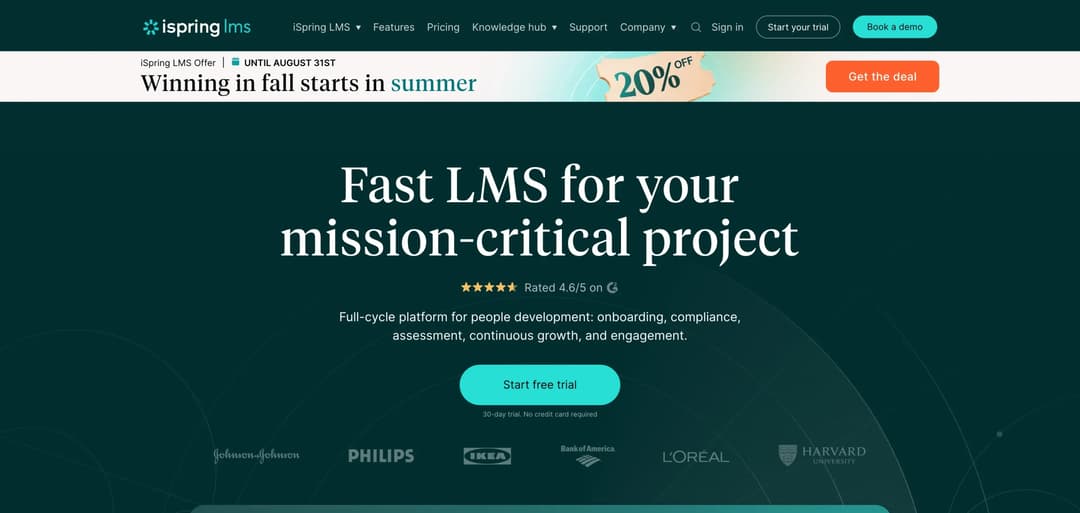
[iSpring LMS](https://www.ispring.com/)’s automotive case is its compliance machinery. The “intelligent reenrollment system monitors all certificate validities,” so annual safety or policy training reassigns itself before it lapses. For a service organization where certificates expiring quietly is the biggest training risk, that’s the headline feature. Observation checklists let a supervisor verify skills in practice, which maps naturally onto shop-floor competencies. The surrounding toolkit runs deeper than most mid-market LMSs: 360-degree feedback for manager development, a built-in knowledge base for the procedures that don’t need to be courses, and iSpring’s AI authoring on top.
Nothing in the product is automotive-specific. Pricing is per active user, with actual figures behind a demo (“a user is considered active if s/he has logged in at least once during a month”). That definition is worth reading twice before you model costs for seasonal staff.
Pros
- Clean, intuitive interface with fast onboarding and no nested menus, per Capterra reviewers.
- Scales from a handful of users to tens of thousands in one deployment.
- Support quality scores 9.5 on G2, with reviewers citing fast response times.
Cons
- Reviewers flag missing integrations (Slack, broader HRIS like Personio) and no easy Google/LinkedIn SSO.
- Customization is limited in places: custom certificates need Acrobat Pro, and profile fields are constrained.
- Some users wanted more robust reporting.
4. AcademyOcean
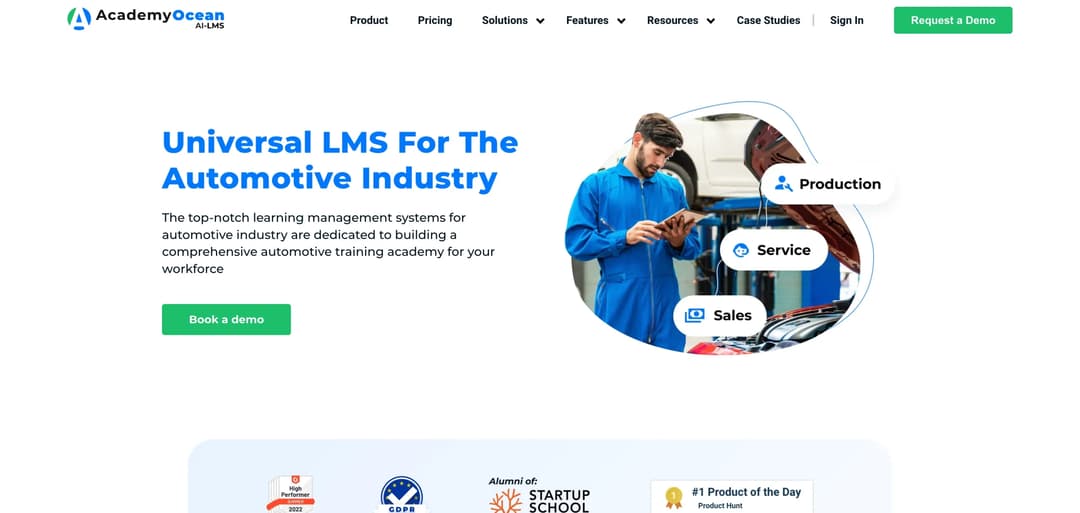
Top Features
- Separate branded portals for partners, dealerships, and employees from one system.
- Role-based content: safety for production, sales for the showroom.
- Service manuals with clickable images.
- Video assessments for sales conversation practice.
- Zapier, API, and webhook integrations, with 30+ interface languages.
AcademyOcean‘s automotive angle is structural: a manufacturer or importer runs distinct branded academies per audience from one system. That’s the multi-portal architecture from the features section above, delivered as the core of the product rather than an add-on tier. Content is role-based (safety for production, sales for the showroom), service manuals become interactive with clickable images, and video assessments let managers review recorded sales conversations instead of imagining them. Their claim: clients report “60% less time on onboarding.”
Integration runs through Zapier, APIs, and webhooks. The interface ships in 30+ languages, which matters more than it sounds for importers running academies across markets. Pricing is demo-gated, and mobile delivery is worth asking about in the demo, since the vendor doesn’t showcase it.
Pros
- Averages 4.9/5 across Capterra, G2, GetApp, and Software Advice, with G2’s ease-of-use score at 9.9.
- Reviewers praise flexible customization, responsive support, and AI-powered course creation.
- Unlimited course creation on all plans.
Cons
- Compliance features are limited compared to dedicated compliance platforms, per reviewer feedback.
- Reviewers managing large learner bases want more automation in team creation and updates.
- The third-party review base is thin (about a dozen Capterra reviews), so ratings rest on few voices.
5. iTacit
Top Features
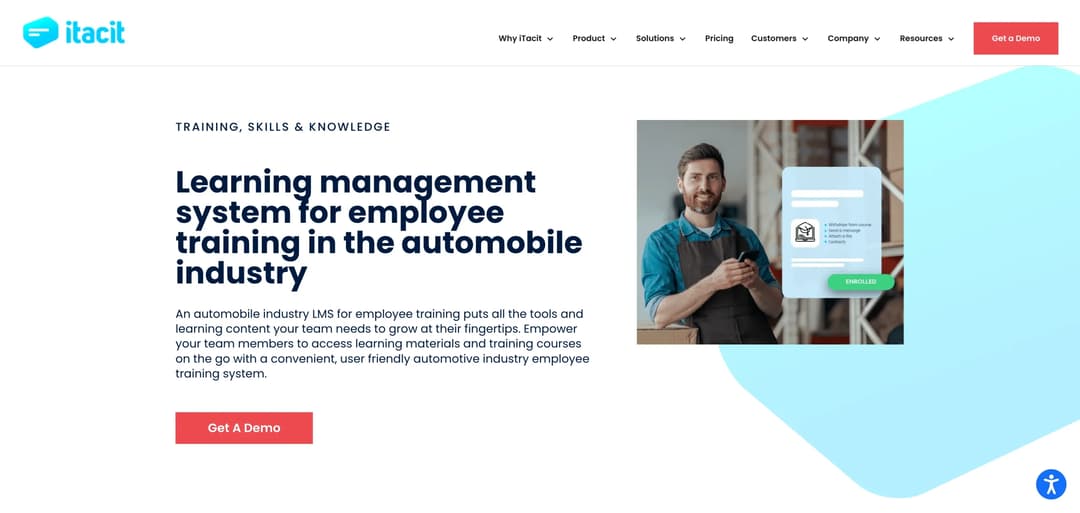
- LMS and employee communication in one mobile-first frontline app.
- Drag-and-drop course authoring.
- SCORM support with Storyline and Captivate compatibility.
- Microlearning and automated learning paths.
- Compliance tracking built for non-desk workforces.
iTacit bundles the LMS with an employee-communication layer in one app for non-desk workers, which fits how automotive floors operate: announcements, tasks, and training land in the same place a technician already checks. That single-app logic is the pitch. A recall notice, the module explaining the new procedure, and the sign-off that everyone read it can travel together instead of across three systems and a bulletin board.
Authoring is drag-and-drop, it “handles SCORM really well” per a customer quote on their site, and Storyline and Captivate compatibility means existing courseware imports rather than dying with your old platform. If you don’t need the comms layer, it’s extra surface; if internal communication at your group currently means printouts by the time clock, it’s the point. Pricing is demo-gated.
Pros
- Front end is easy to use and visually pleasing, per Capterra reviewers (4.6/5 from 35 reviews).
- The training-plus-communication combination reaches frontline staff that email never did.
- Extensive compliance tracking and customization draw larger organizations.
Cons
- Reviewers describe a steeper learning curve than competitors, with some features needing support’s help to master.
- The admin side can feel complex for non-specialist users.
- Small G2 footprint (4.3/5 from 2 ratings), so most evidence sits on one review platform.
6. Joe Verde (JVTN)
Top Features
- Complete dealership sales curriculum, from the greeting to delivery.
- Desking, negotiation, and objection-handling courses.
- Management and coaching tracks for sales managers and desk managers.
- Pairs with live two-day workshops.
- 24/7 online access for the whole store.
Here’s where sales training stops being a feature checkbox and becomes a curriculum. Joe Verde Group pioneered online dealership sales training in 2005 and has trained salespeople for decades; JVTN, its online training network, claims “29,000,000+ chapters” completed by 180,000+ paid users (their figures). Content is pure dealership: the sales process from the greeting to delivery, objection handling, desking and negotiation, and coaching tracks for the managers who are supposed to hold the training.
That last part is the real design choice. JVTN is built to be run by a manager in a store, as scheduled team training with follow-up on the floor, not assigned as solo homework. Its testimonials cite salespeople going from 8-9 units a month to 20+ and stores up 26.5% year over year. Those are their claims, from their own testimonial pages; no third-party review base exists to check them against. This is a content-and-coaching program, not a general LMS; you won’t run technician compliance on it, and pricing is quote-led through their store.
Pros
- The deepest dealership-specific sales curriculum in this list, refined over decades.
- Designed for managers to run in-store training, not just for individual self-study.
- Combined online-plus-workshop model reinforces the material on the floor.
Cons
- No meaningful third-party review base; results evidence comes from Joe Verde’s own testimonials, so treat the numbers as marketing.
- Sales and management only; it will not carry service, safety, or compliance training.
- Quote-led pricing makes budgeting a conversation, not a lookup.
7. AMI (Automotive Management Institute)
Top Features
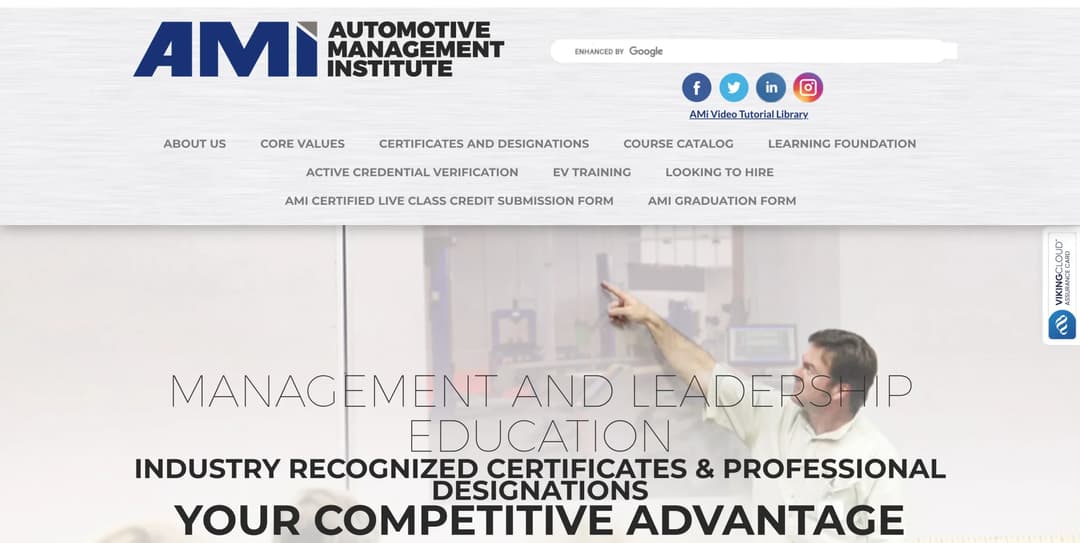
- Industry-recognized accredited designations for service and collision management.
- A ladder from Accredited Automotive Manager (AAM, 40 credit hours) to Accredited Master EV Manager (AMEV, 102 credit hours).
- Credit hours earned across partner training providers.
- Online, virtual, and live delivery.
- 501(c)(3) nonprofit governance.
The Automotive Management Institute is not a platform; it’s the credential path. Its designations cover service and collision management, with credit hours awarded across partner training providers, so training your managers already take can roll up into an accreditation the industry recognizes. The ladder runs from the Accredited Automotive Manager at 40 credit hours through specialized tracks up to the Accredited Master EV Manager at 102. Learning is delivered “online, virtual and live” across AMI’s provider network.
That’s a different product category from everything else here, and it earns its place because “what does this training add up to?” is the retention question your best people are quietly asking. A service manager three courses from an industry-recognized designation has a concrete reason to finish, and to stay. Pricing is per designation and course.
Pros
- The designations are recognized across the service and collision industry, which platform certificates are not.
- Nonprofit governance and a decades-long history give the credential weight.
- Complements any LMS on this list rather than competing with it.
Cons
- Not an LMS: no course delivery infrastructure, tracking, or authoring for your own content.
- No third-party review presence to cite; evaluation rests on the credential’s industry standing.
- Per-designation pricing across multiple providers takes work to total up.
8. Electude
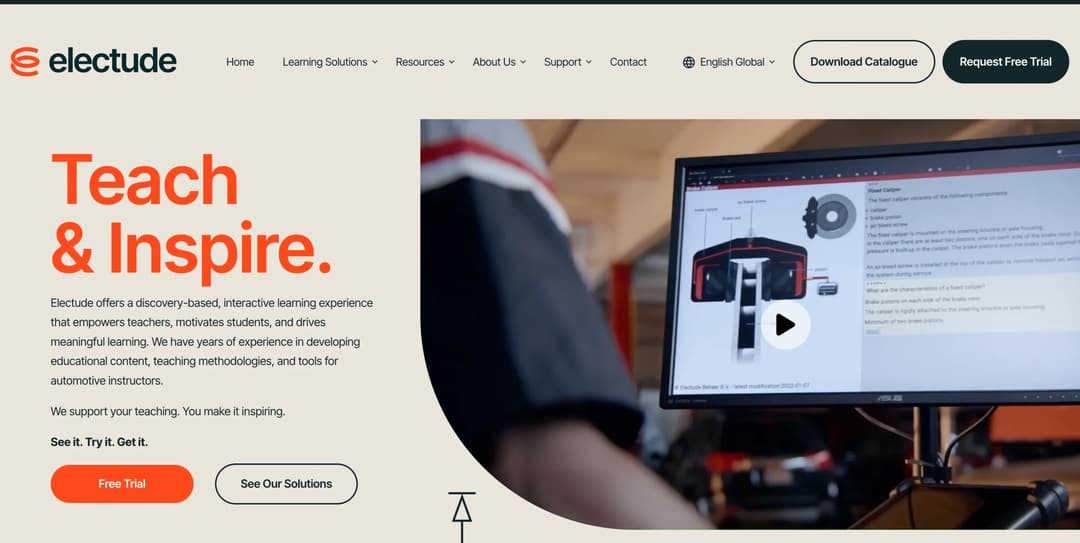
Top Features
- 3,000+ interactive modules across light, electric, and heavy vehicles (their figure).
- Virtual workshop simulator with complaint sheets, tools, and diagnostic equipment.
- Gamified, discovery-based lesson design.
- Runs standalone or integrates with an institutional LMS such as Canvas.
- Alignment with national qualification frameworks in six countries.
Electude is a dedicated automotive e-learning specialist. It’s used by 4,000+ schools and over a million students in 70+ countries (their figures). The core is a virtual workshop where “students feel they are doing a real job”: a customer complaint sheet, tools, and diagnostic equipment, without a vehicle on a lift. A learner can misdiagnose safely, see why, and run the job again, which is exactly the rep count a live shop can’t afford to provide.
The catalog spans light vehicles, EVs, and heavy equipment, with lessons built discovery-first rather than lecture-first. For shops and OEM programs investing in real diagnostic skill, simulation is the layer a standard LMS can’t fake. For groups feeding their bays from local trade programs, Electude is often what those students already trained on. It’s content and simulation rather than your compliance record system, and pricing is trial/contact-gated.
Pros
- Reviewers on iATN, the professional technician network, praise the interactive, discovery-based approach for keeping students engaged.
- ASE task alignment and Canvas integration fit both trade programs and structured shop training.
- Automotive-only focus runs deeper than any general library’s automotive shelf.
Cons
- Built for vocational education and structured development; it won’t serve as your day-to-day compliance LMS.
- Little critical third-party feedback is published, so pilot against your own bar.
- Pricing requires contact, and per-seat costs for small independent shops are unclear up front.
9. Today’s Class
Top Features
- Daily 3-5 minute adaptive question sessions for technicians and advisors.
- Spaced repetition that adjusts to each learner’s weak spots.
- Points and team competition to sustain engagement.
- Real-time feedback dashboards for managers.
- About 10 minutes a day of admin effort, per their own materials.
Today’s Class attacks a different problem: not delivering training but making it stick. The mechanism is spaced repetition. Instead of a course followed by forgetting, technicians and advisors answer a few adaptive questions a day, and the algorithm keeps circling back to each person’s weak spots until they stop being weak. Knowledge stays fresh in the flow of daily shop operations rather than evaporating between annual training events.
Owners describe adoption as a culture change, with learning becoming “a common topic of conversation” and the leaderboard becoming shop banter (their testimonials). It’s a retention layer rather than a full LMS: deep content authoring and audit-grade compliance records live elsewhere, and pricing is demo-gated.
Pros
- The adaptive daily format targets forgetting, which is the actual failure mode of most shop training.
- Light admin load by design, per their published materials.
- Team competition mechanics give managers a lever that doesn’t require nagging.
Cons
- No meaningful third-party review base to cite; the evidence is vendor-published.
- Success depends on daily team engagement; a store that won’t build the habit gets little.
- Not a system of record for compliance or certification tracking.
10. S/P2
Top Features
- Online OSHA and EPA-aligned safety and pollution-prevention training.
- Automotive service, collision repair, and heavy-duty/diesel tracks, plus EV safety.
- Industry-recognized entry credentials listed with O*NET.
- Fixed annual per-location pricing.
- Serves both career-tech schools and working shops.
S/P2 is the safety-and-compliance standard of the service and collision world, training “more than 225,000 students and employees every year” with over 4,000 schools, employers, and insurers relying on it (their figures). Two details stand out. Pricing is honestly structured: a fixed annual fee per location. The collision package is published at $485 to train all staff under one roof for a full year, covering safety, pollution prevention, a supervisor course, and EV safety (their collision page).
And it spans schools and shops. Career-tech programs run S/P2 with students, so new hires arrive carrying credentials your shop already recognizes, and the same system then keeps your existing staff current. The credentials are listed with O*NET, which is as close to a public standard as this layer of training gets. Scope is deliberately narrow: safety, compliance, and entry-level fundamentals, not sales or advanced diagnostics, and that narrowness is why it stacks cleanly under any platform in family one.
Pros
- The de facto safety credential in service and collision; instructors report using it since 2009 and valuing the portfolio-ready credentials it gives students.
- Published per-roof pricing is rare in this market and easy to budget.
- EV safety and supervisor courses keep the package current with how shops run today.
Cons
- Deliberately narrow: it handles the safety and compliance layer, and nothing else on this page.
- No general review-platform presence; its reputation lives in the trade rather than on G2.
- Per-roof pricing for multi-location groups still requires contact for a total.
How to Choose the Best LMS for Your Automotive Business
Ten tools, three families, and more demos than anyone has time for. The way through is to ask four questions in order, and to start from your failure mode rather than a feature list.
Is it suitable for your use case?
Name the problem first, in operational terms, then match the family:
- “New procedures reach the floor too slowly” → fast-authoring micro-training (Mini Course Generator), or the comms-plus-training combo (iTacit).
- “Sales numbers are the problem” → a dealership program (Joe Verde), with your LMS keeping the completion records around it.
- “Certificates expire quietly until an audit” → compliance machinery (iSpring LMS) plus safety credentials (S/P2).
- “Techs pass the course and forget it” → a retention layer (Today’s Class) on top of whatever delivers the content.
- “We’re building real diagnostic skills” → simulation (Electude), with structured programs around it.
- “We run academies for dealers and partners” → multi-portal platforms (AcademyOcean), or structured scale (TalentLMS).
Notice that most real answers pair one platform with one or two vertical tools. That’s normal here, not a failure of shopping; the families solve different problems, and pretending one tool covers all three is how groups end up with an expensive platform nobody opens. Budget for the pairing from the start and the demos get easier to judge, because each vendor only has to be excellent at its own family.
And if the honest answer is “our problem is the phones, not the floor,” your BDC belongs with the call center training stack we covered separately.
Do its features satisfy your needs?
Run the eight-feature checklist from earlier against your shortlist, and weight it by your use case. A single-store service operation cares most about mobile delivery, authoring speed, and compliance records. A group cares about rooftop reporting and integrations. An importer cares about portals.
Two feature questions deserve a hard answer before any contract. First, integration: does completion data flow into the systems you already run, your DMS, HRIS, and per-rooftop reporting? Second, portability: does your content move via SCORM or xAPI if you ever switch platforms? Vendors answer both questions vaguely by default; make them answer specifically.
Cost belongs in this question too, because pricing structure is a feature. TalentLMS publishes tiers from free to $449/month, Mini Course Generator lists public plans with a free start, and S/P2 publishes a fixed per-roof annual fee. Everyone else on this list (AcademyOcean, iTacit, Electude, Today’s Class, JVTN, AMI) is quote- or contact-gated. Ask every gated vendor the same question: total year-one cost at your headcount and rooftop count, in writing.
Is it a scalable solution?
In automotive, scale means rooftops as much as seats. Adding a store should mean cloning a curriculum and a reporting view, not a second implementation project. Check how per-location assignment works, whether reporting can compare stores, and what the pricing curve looks like at double your current size. Per-active-user models and per-roof models behave differently as you grow, and the wrong one turns success into a budget surprise.
Ask each vendor to model two futures with you in writing: your group at twice the rooftops, and your group after acquiring a store mid-year. How long until the acquired store’s people are enrolled, trained, and reporting? For importers and OEM programs, add the portal question: can you stand up a new dealer academy without a services engagement?
Scale also raises the build-question at OEM and importer level: some groups conclude they need something fully custom. Before anyone commits engineering budget to that, read what building your own LMS actually costs; the honest math usually points back to configuring a platform, with custom work reserved for the integration layer.
Does it offer good support?
In a shop, training software that breaks quietly stops being used; nobody files a ticket from a bay, they simply go back to word of mouth. So support quality is worth checking on evidence rather than promises. TalentLMS and iSpring LMS both carry strong support reputations in their review bases (iSpring’s support scores 9.5 on G2). iTacit reviewers note that mastering some features requires support’s help, which makes support responsiveness part of the product itself.
Look past the ticket queue too. What does implementation include, and who does the work, you or them? Is onboarding a documented program or a shared Google Doc? Does support cover your admins only, or can a store manager with a broken assignment get help directly? For the vendors without review bases (JVTN, Today’s Class, Electude, S/P2), test it during the pilot. Send a real question mid-trial and time the answer, because trial-period support is the best support you will ever get.
Then run the pilot that decides it: one store or one bay, one real training need, two weeks. Completion rates and manager effort will tell you more than any demo.
Now Over to You: Choosing the Right LMS for Your Automotive Team
The automotive training stack is three families. Platforms deliver and prove training: Mini Course Generator for speed and micro-format, TalentLMS for structured scale, iSpring LMS for recertification, AcademyOcean for multi-academy groups, iTacit for frontline comms plus LMS. Dealership programs fix the floor: JVTN for sales skills, AMI for accredited management credentials. And the hands-on layer teaches and protects: Electude for simulation, Today’s Class for retention, S/P2 for OSHA and EPA compliance.
Three of ten publish usable pricing, and every vendor stat above is labeled as theirs. The right first move is a two-week pilot against one real training need, in one store or one bay. Measure it on completion rates and manager effort, not demo impressions.
Whichever direction you take, decide the pairing before the platform: which family carries your biggest failure mode, and which one or two vertical tools stack under it. If that first need is “turn the procedures we already have into training people actually complete,” start a free Mini Course Generator account and build the first module today; it costs nothing to find out whether the fast path fits your floor.