Two of the leading AI roleplay vendors will tell you, on their own websites, that they are not a learning management system.
Hyperbound’s FAQ asks “Is Hyperbound an LMS?” and answers “No.” Quantified’s pricing page goes further: “An LMS confirms a rep finished the training. Quantified proves the rep can apply it in the field. Most teams run both.” That’s unusually honest positioning, and it points straight at the question every guide in this category skips.
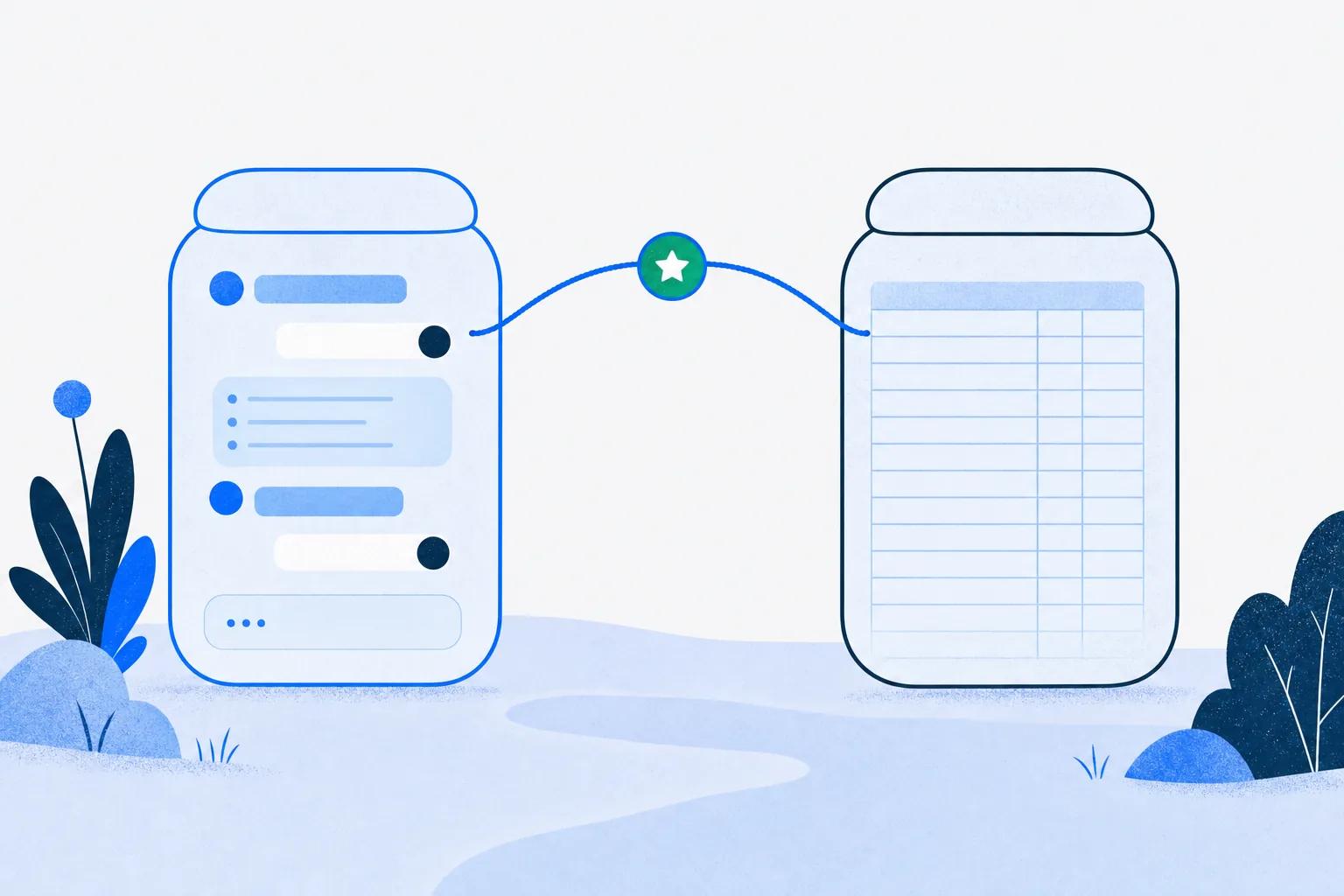
If you buy one of these tools, you are adding a second system next to the one that already holds your training records. The practice happens in one place and the completion record lives in another. How those two connect – or whether they connect at all – varies enormously between vendors, and it will matter more to you in year two than any feature on the comparison grid.
So that’s the axis this article is organised on, alongside the usual. Below is each tool, what it publishes about pricing, and where its completion record ends up.
Try Mini Course Generator free – build a rubric-graded roleplay and export it as SCORM.
Key Takeaways
- Most tools in this category are coaching platforms, not training systems. Two of them say so themselves. Plan for two systems and decide early how the score moves between them.
- Yoodli is the transparency outlier, publishing individual plans at $0, $8 and $20 a month. Every other vendor quotes on request, and two publish no pricing at all.
- Zenarate is the structural exception, shipping an integrated LXP with SCORM support rather than assuming you have an LMS elsewhere.
- Whatever you buy, the rubric matters more than the model. Without explicit scoring criteria, an AI roleplay rehearses whatever the rep already does.
What Are AI Roleplay Tools for Corporate Training?
AI roleplay tools let an employee practise a conversation against an AI counterpart that responds in character, then score that conversation against defined criteria. In corporate training the conversation is usually a sales call, a support escalation, a compliance-sensitive exchange or a difficult management discussion.
The category exists because the thing it replaces doesn’t scale. A manager running roleplay in a Tuesday meeting provides three things: a difficult counterpart, criteria for what good looks like, and a judgement. That works, and one manager can supply it to perhaps six people a week, unevenly, depending on how good that particular manager is at giving feedback.
AI supplies the first at unlimited volume and the third consistently. It supplies the second only if you write it down. That distinction runs through everything below, because a roleplay without a rubric is conversation practice, and conversation practice rehearses whatever the rep already does. We wrote the full method for that in building a rubric-graded roleplay.
One vocabulary note, since these terms get used interchangeably in vendor material. Roleplay is the practice conversation itself. Simulation usually implies a scored scenario with a defined outcome. Coaching typically means feedback on real recorded calls rather than simulated ones. Several tools here do all three, and it’s worth checking which one a demo is actually showing you.
Why Companies Are Buying AI Roleplay Tools
Six reasons, roughly in order of how often they turn out to be the real one.
Ramp time is the number on the business case
Almost every vendor in this category leads with ramp reduction, and it’s the metric buyers are actually measured on. Second Nature publishes a 34% ramp reduction as its own figure; Zenarate claims 40% faster speed to proficiency and 50% less training time; Quantified claims a 40% reduction in time to readiness.
Those are vendor claims rather than independent findings, and they’re consistent enough across independent vendors to suggest the direction is real even if the magnitude is marketing. Treat them as a hypothesis to test on your own cohort, not as a forecast.
Managers are the bottleneck and everyone knows it
Practice requires somebody to practise against. That somebody is a manager who has a pipeline of their own, which is why roleplay is the first thing cut in a busy quarter and the first thing reinstated after a bad one.
The value here isn’t that AI is better than a good manager. It’s that AI is available at 9pm on a Sunday, doesn’t get tired of the same pitch, and doesn’t make the rep feel watched. One enablement leader quoted on Second Nature’s site puts the psychological half plainly: practice one-on-one removes “that antsy feeling of doing it in front of your manager”.
Feedback consistency
Manager feedback quality varies enormously, and the variance is invisible until you compare two teams. A rubric applied by software is consistent by construction, which is worse than an excellent manager and considerably better than an average one applied unevenly across forty people.
Certification you can actually evidence
This is the compliance-adjacent driver, and it’s growing. “We trained everyone” is a completion report. “Every rep demonstrated they could handle the objection to a defined standard” is a different claim, and in regulated industries it’s the one that gets asked for. It’s also the distinction that separates a new hire training plan that ramps people from one that files them.
Quantified builds its whole pitch on this for life sciences, with MLR-aware governance and on-label messaging checks. That’s a real specialism rather than a repositioning.
Practice for things that are expensive to get wrong
The strongest use case and the least discussed. A rep mishandling a discovery call costs a deal. A support agent mishandling a data-deletion request costs something else entirely, and no amount of policy training predicts what somebody says when a customer is being persuasive on the phone. Where the requirement renews on a cycle, the state you need to track belongs in a training matrix rather than a completion report.
Simulation tests application under pressure, which is the only version of a compliance question that matters.
The board asked about AI
Worth naming honestly, because it’s frequently the real trigger and it produces bad purchases. A tool bought to demonstrate AI adoption gets deployed without a rubric, produces pleasant conversations and no measurable change, and gets quietly dropped at renewal.
If this is the actual driver, the way to survive it is to pick one team, one scenario and one rubric, and measure something narrow. That produces a defensible result. A broad rollout produces a broad shrug.
What to Look For in an AI Roleplay Tool
Eight criteria, in the order that eliminates candidates fastest.
Where the completion record ends up
The question this article is built around.
You almost certainly have a system of record – an LMS or an HRIS – that holds who completed what. A roleplay tool creates scores that live somewhere else. Three possible answers, and you need to know which one you’re buying:
It exports into your LMS. The mechanics of getting completion data across a system boundary are in our LMS integration guide. Second Nature states it “integrates with any LMS via SCORM or LTI”. Yoodli lists LMS, CMS and HRIS integrations on team plans. Quantified says it integrates with LMS platforms alongside Salesforce and Veeva.
It is the LMS. Zenarate ships an integrated LXP with digital lessons and SCORM inside its Learn module, so the record can stay in one place.
It’s a separate system and stays one. Hyperbound is explicit that it isn’t an LMS, and its integration story is oriented toward CRM and revenue tooling rather than learning records.
None of those is wrong. Buying the third while assuming the first is where the pain comes from, and it usually surfaces at the first audit rather than in the demo.
Whether the rubric is yours
Any tool can score. The question is whether it scores against your methodology or a generic sales framework.
Hyperbound supports “AI scorecards for any sales methodology or messaging frameworks”. Quantified tunes scoring “by role, market, and indication”. If a vendor can’t clearly explain how your criteria get in, the scores will measure a generic idea of good selling, and your best rep will score badly for doing the thing your playbook tells them to do.
Whether the AI counterpart resists
The most common quality failure, and it’s easy to test in a demo. Ask to run the roleplay yourself and deliberately do it badly – pitch immediately, ignore the objection, talk over them.
A good simulation disengages, pushes back, or raises the objection it was holding. A weak one stays agreeable and scores you 7 out of 10. If the vendor only shows you a scripted demo, that’s an answer too.
Per-criterion feedback with evidence
An overall score out of ten ranks reps and tells them nothing actionable. What you want is per-criterion results citing the transcript: which criterion was missed, and where in the conversation.
Ask to see the feedback screen, not the dashboard. Dashboards are built for the buyer; feedback screens are built for the person who has to improve.
Authoring effort per scenario
The hidden cost. A tool that needs professional services to build each scenario has a different total cost from one where an enablement manager builds one in an afternoon.
The published claims vary widely: Hyperbound says a first bot and scorecard take “less than 10 minutes” with full personas and modules averaging two weeks; one Second Nature customer is quoted saying “in 15 minutes we could create any scenario we want”. Quantified sells self-authoring from approved content as a distinct capability. Ask to build one during the evaluation rather than watching one being built.
Language coverage, if you’re global
Straightforward and easy to check. Hyperbound publishes support for 25+ languages and names them. Quantified’s pricing page cites 40+ languages. If you train outside English, get the list in writing rather than a number.
Security posture
Several vendors here publish serious certifications, which is unusual in a category this young. Hyperbound lists SOC 2 Type II, GDPR, HIPAA and ISO 27001. Quantified is SOC 2 Type II with a fine-tuned private model. Yoodli is SOC 2 Type 2 certified and GDPR compliant.
The specific question worth asking beyond the badge: does the vendor train on your data? Hyperbound states it does not and that its models are pre-trained on proprietary datasets. Yoodli excludes data from AI training on its Advanced plan and above. That’s a plan-dependent answer, which is worth noticing.
Whether you can evaluate it without a sales call
More important than it sounds, because it determines how honestly you can compare.
Yoodli and Hyperbound both have real free tiers – Yoodli’s Starter at $0 and Hyperbound’s Free plan with 45 prebuilt roleplays. In both cases the free tier runs their scenarios rather than yours; custom bots and custom scorecards sit on paid tiers. Everyone else in this roster requires a conversation before you see the product working on your material.
The Best AI Roleplay Tools for Corporate Training
**Methodology.** Prices and plan details were checked in August 2026. Pricing is quoted exactly as the vendor publishes it, and where a vendor publishes none we say so rather than estimating. Capability claims are attributed to the vendor, because in this category almost every number is a vendor number.
One disclosure: Mini Course Generator is our product. It’s listed first because it’s ours and we’d rather be obvious about that than bury it at number seven. Its limitations are listed alongside everything else.
Comparison table
| Tool | Category shape | Where the record lands | Published pricing | Published security |
|---|---|---|---|---|
| Mini Course Generator | Course platform with a roleplay Skill | Portable SCORM 1.2, or in-platform | Plans on the pricing page | Not published |
| Hyperbound | Sales coaching, explicitly not an LMS | Its own system; CMS/LMS integrations on paid tiers | Free tier + 2 enterprise tiers, no figures | SOC 2 Type II, GDPR, HIPAA, ISO 27001 |
| Second Nature | Roleplay and coaching | SCORM or LTI into any LMS | None published | Not published |
| Quantified | AI sales coaching, life sciences | Integrates with LMS, Salesforce, Veeva | Pricing page, no figures | SOC 2 Type II |
| Yoodli | Communication coaching, individual to enterprise | LMS, CMS and HRIS on team plans | $0 / $8 / $20 per month | SOC 2 Type 2, GDPR |
| Zenarate | Frontline performance with an integrated LXP | Its own LXP, with SCORM | None published | Not published |
1. Mini Course Generator
Top features
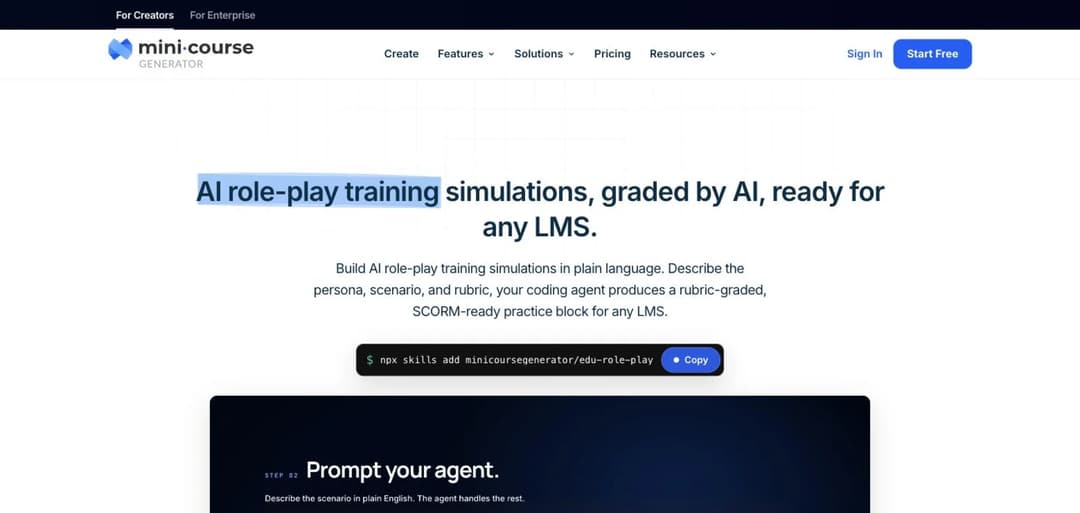
- AI Role-play Skill producing a rubric-graded conversation simulation
- Exports as a self-contained SCORM 1.2 package, reporting through
cmi.core.score.rawandcmi.core.lesson_status - Runs standalone in a browser or inside any LMS that imports SCORM
- Open-source Skill installed with
npx skills add minicoursegenerator/edu-role-play, and the packaging details are in our AI SCORM generator guide - Full course platform underneath, so the practice can sit inside a course rather than beside one
This is our product, so weigh the description accordingly. The structural difference from everything else in this list is that roleplay here is a component of a course platform rather than a standalone coaching product. Which means two deployment shapes: keep the practice inside a course you’re building, or export it as a SCORM package into an LMS you don’t control.
That second route is the one that solves the record problem in this category outright. The package has been tested against Cornerstone, Moodle, Canvas, TalentLMS, Docebo, Brightspace, Absorb, 360Learning, SAP SuccessFactors and Workday Learning, and it requires no account with us on the receiving side.
Pros
- The only entry here where the practice artefact can run with no vendor relationship at all, since the SCORM package is self-contained
- Open-source Skill, so the scenario and rubric definitions are inspectable rather than a black box
- Bring your own model – Claude, GPT, Gemini or self-hosted – rather than being tied to the vendor’s choice, and the Skills versus MCP trade-off is documented rather than assumed
Cons
- Not a dedicated sales-coaching platform: there’s no real-call analysis, no CRM-driven deal coaching, and no pipeline integration, which is the core of what Hyperbound and Quantified sell
- No published SOC 2, ISO or GDPR statement, which is a genuine gap against Hyperbound and Quantified for enterprise procurement
2. Hyperbound
Top features
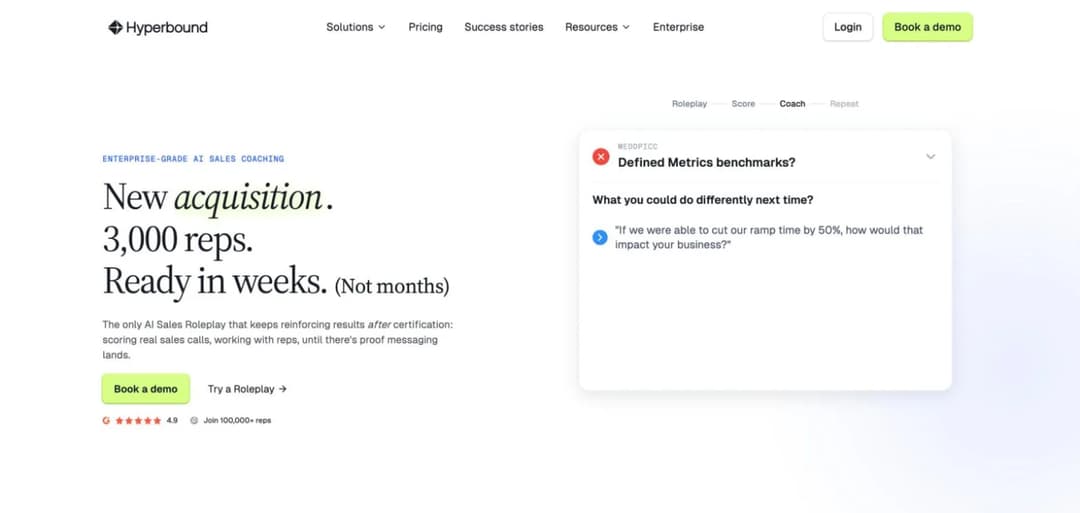
- AI sales roleplay built from your methodology, historical deals and top-performing reps
- Real call reinforcement analysing live conversations alongside simulations
- Agents that turn call, deal and roleplay signals into automated coaching
- Custom AI scorecards for any sales methodology or messaging framework
- 25+ published languages; used by reps in 40+ countries, with a published G2 rating of 4.9
Positioned as “the revenue activation system”, with the tagline “It doesn’t end at roleplay”. The three-part structure – practice, perform, activate – is the clearest articulation in this category of the idea that simulated practice alone doesn’t change behaviour.
Named customers on their site include Nivoda, JumpCloud, Klaviyo, Vanta and ALKU, each with a titled quote. On setup, they state a first bot and scorecard take under 10 minutes, full persona and module configuration averages two weeks, and most customers see value within 30 days.
Pros
- The strongest published security posture in this roster: SOC 2 Type II, GDPR, HIPAA and ISO 27001, with enterprise SSO and SIEM
- States plainly that it does not train on customer data, with models pre-trained on proprietary datasets
- A genuine Free plan – 45 prebuilt AI roleplays and example scorecards, no credit card and no sales call – which is rare in this category
- Unusually honest scope statement: their own FAQ answers “Is Hyperbound an LMS?” with “No”
Cons
- Publishes a tier structure (Free, Practice, Perform) and a full feature matrix but no dollar figures; it is priced per user with separate Practice and Perform licences, so budgeting still needs a conversation
- The honesty about not being an LMS is also the limitation: your completion record stays elsewhere. CMS and LMS integrations (Seismic, Highspot, WorkRamp) are listed from the Practice tier up, so the bridge exists – it is a paid-tier feature rather than a core one
- Sales-specific by design, so it’s a poor fit for support, compliance or management-conversation training
- The Free plan gives you their 45 prebuilt roleplays; building a custom buyer bot and custom scorecards starts at the Practice tier, so the free route tests the product rather than your scenario
3. Second Nature
Top features
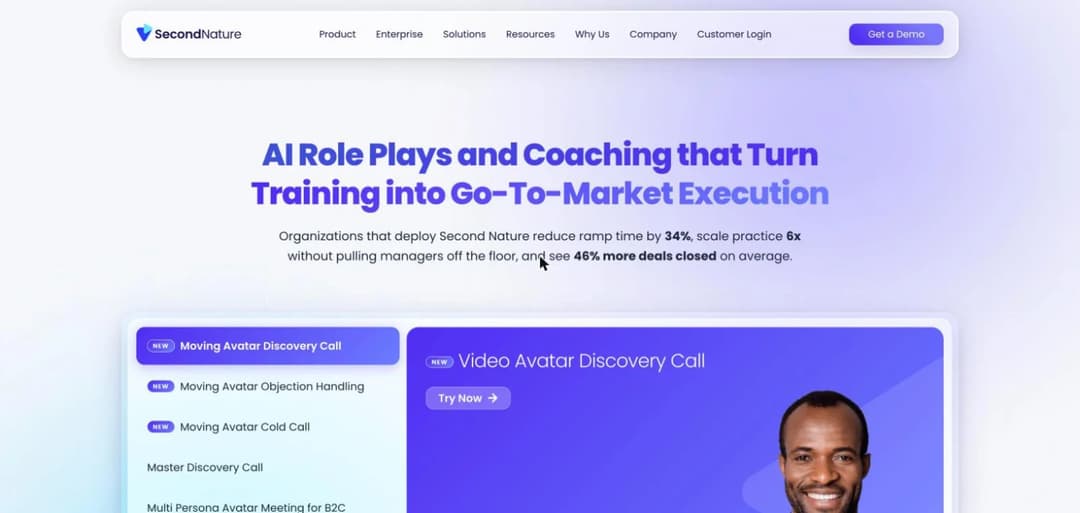
- AI roleplay with moving and video avatars, including multi-persona meetings for B2B and B2C
- Deal Coach for AI-driven coaching on live deals
- Integrates with any LMS via SCORM or LTI
- Certification programmes with gamification
- Available on any device, with multi-language support
The most explicitly training-oriented of the standalone coaching platforms, and the one that answers the record question best. SCORM or LTI into any LMS means the score can reach your system of record without a bespoke integration – the single most useful sentence on any vendor site in this roster.
Published outcome claims are theirs: a 34% reduction in ramp time, 6x more practice, 46% more deals closed on average. Case studies name Oracle NetSuite (32% more sales opportunities, 5,680 hours saved) and GoHealth (onboarding cut from 9 weeks to 5).
Pros
- SCORM and LTI support solves the two-systems problem more directly than anything else here except an integrated LXP
- The broadest use-case coverage in this list – sales, enablement, L&D, customer support, HR and call centre – rather than sales alone
- Deep testimonial evidence with named roles across Oracle, Zoom, iQor and others
- Video and moving avatars are further ahead than most of this category
Cons
- No published pricing and no self-serve entry point, so evaluation starts with a demo
- No security certifications published, which is a gap against Hyperbound and Quantified
- The headline outcome figures are vendor-published averages with no methodology attached; treat them as directional
- Avatar realism is prominent in the marketing, and realism is not the same as assessment quality
4. Quantified
Top features
- Six AI agents: roleplay, readiness coaching, self-authoring, field coaching, compliance and governance, insights and reporting
- Adaptive AI tuning scenarios and scoring by role, market and indication
- MLR-aware governance with OPDP-aware guardrails for on-label messaging
- Fine-tuned private model trained on regulated-industry datasets
- Integrations with Salesforce, Veeva, LMS platforms and approved-content systems
The specialist. Quantified describes itself as “the #1 Platform for Life Sciences and Regulated Industries”, and unlike most industry positioning this one has substance behind it: the compliance layer is built for pharmaceutical regulatory review rather than adapted from a general product.
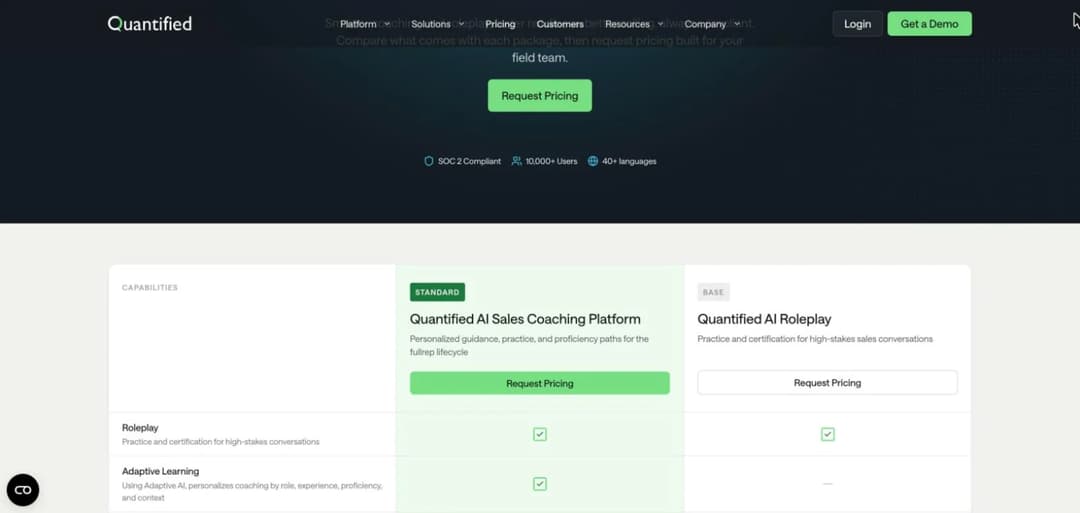
Their pricing page publishes a two-package structure – Base (AI Roleplay: practice, certification, self-authoring, reporting, compliance guardrails) and Standard (the full coaching platform) – with figures quoted per organisation. Named customers include Novartis, Sanofi and Bayer. Claims: 40% faster time to readiness, 6x more practice, +19% more good selling outcomes.
Pros
- The regulated-industry governance is genuinely differentiated, not a repositioning of a horizontal product
- Publishes a capability-by-capability package comparison, which is more transparency about scope than most of this roster offers
- SOC 2 Type II with a private fine-tuned model rather than a general-purpose API
- Their own FAQ states the LMS boundary clearly: an LMS confirms a rep finished the training, Quantified evidences they can apply it, and most teams run both
Cons
- No published figures despite having a pricing page; the answer is that pricing is quoted per organisation
- The life-sciences specialisation that makes it strong also makes it overweight for a general sales team
- Enterprise-shaped: with 10,000+ users cited and pharma-scale deployments, a 30-person team is not the target
5. Yoodli
Top features
- Live AI roleplays plus feedback on uploaded recordings
- Individual plans from free through to unlimited
- Team plans with custom roleplays, dashboards, roleplay assignment and advanced user management
- SSO, SCIM and data-retention controls
- LMS, CMS and HRIS integrations on team plans
The transparency outlier, and the easiest tool in this category to evaluate honestly because you can just use it.
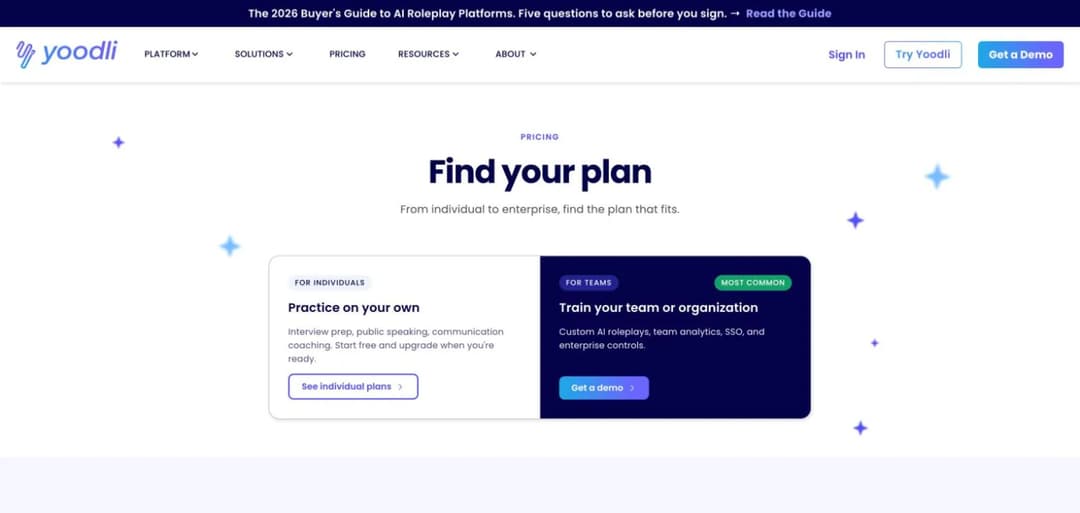
Published individual pricing: Starter at $0 (up to 5 roleplays total), Pro at $8 a month billed annually (up to 10 roleplays a week, which don’t roll over), and Advanced at $20 a month billed annually (unlimited roleplays, with data excluded from AI training). Team and Enterprise pricing requires a demo. Named enterprise customers include Snowflake, Google Cloud and Harness, with a claimed 95% enterprise retention.
Positioning is broader than sales – interview prep, public speaking and communication coaching sit alongside team training.
Pros
- The only tool here you can properly evaluate before talking to anyone, at $0 and then $8
- SOC 2 Type 2 certified and GDPR compliant, which is unusual at this price point
- LMS, CMS and HRIS integrations on team plans address the record question directly
- Reimbursable as a learning benefit, which matters for individual adoption inside larger organisations
Cons
- Data exclusion from AI training is a plan-dependent feature, listed under Advanced rather than as a blanket policy – worth confirming for team plans in writing
- Roleplay caps on the lower plans (5 total, then 10 a week without rollover) make the cheap tiers a trial rather than a deployment
- The communication-coaching breadth means less depth on complex B2B sales methodology than Hyperbound or Quantified
- Team pricing is undisclosed, so the transparency stops exactly where corporate buying starts
6. Zenarate
Top features
- Learn module combining AI conversation simulation, software simulation, digital lessons, SCORM and an integrated LXP
- Analyze module with conversation AutoQA, next-action coaching and automated development plans
- Coach module with an AI tutor and call review coach
- Evolve module for building AI voice and chat agents with a no-code studio
- 100+ system integrations; delivery into Slack, Teams, phone and text
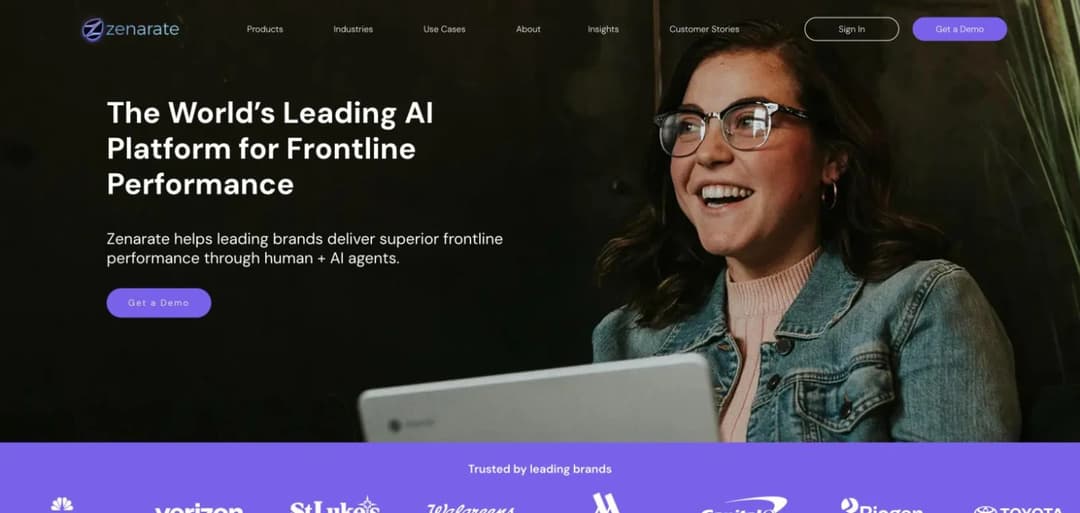
The structural exception in this roster. Zenarate doesn’t assume you have an LMS elsewhere – its Learn module is a learning experience platform, with digital lessons and SCORM support alongside the simulation engine.
Positioned for frontline performance: contact centres and customer-facing teams rather than complex B2B sales. Published claims are theirs: 50% less training time, 40% faster speed to proficiency, 25% lower attrition. It’s also the only entry that trains AI agents and humans in the same platform, which is a distinctive bet on where contact centres are going.
Pros
- The integrated LXP genuinely solves the two-systems problem, rather than integrating around it
- Software simulation alongside conversation simulation, which matters for contact centres where the failure is often the tooling rather than the words
- Delivery into Slack, Teams, phone and text meets frontline staff where they already are
- The AI-agent training capability is a real differentiator if you’re deploying voice agents alongside human ones
Cons
- No published pricing and no self-serve route
- Frontline and contact-centre focus makes it a heavier fit than needed for a small B2B sales team
- The four-module structure is a lot of platform; buying it for roleplay alone means paying for scope you won’t use
- “The World’s Leading AI Platform for Frontline Performance” and “more AI-powered simulations than any company in the world” are vendor claims with no methodology published
The Scenarios Worth Building First
Whichever tool you pick, the scenario list decides whether anyone uses it after month two. Six that consistently earn their place, and two that don’t.
Discovery, done badly on purpose
The highest-value scenario in sales, because the failure is systematic rather than individual: reps pitch before diagnosing, and they do it because pitching feels like progress.
Build the buyer to disengage visibly when it happens. The lesson lands in one run, in a way no amount of coaching does, because the rep watches the conversation deteriorate and knows exactly why.
The objection your team actually loses to
Not the objection list from the playbook. The one that shows up in lost-deal notes.
Most enablement teams already know what it is and haven’t built practice for it, because building practice used to cost a workshop. This is the scenario with the shortest path to a measurable result.
The escalation that becomes a complaint
For support teams. A customer who is angry for a legitimate reason, and gets angrier if the agent explains policy before acknowledging impact.
The criterion is sequence, not content – acknowledge, then establish, then propose. It’s coachable, it’s observable in a transcript, and it’s the single most common cause of a support interaction becoming a complaint.
Compliance under persuasion
The scenario that justifies the whole category in regulated environments, and it’s rarely built.
Standard compliance training tests whether somebody read the policy. This tests what they say when a customer is being reasonable, sympathetic and persistent about wanting something they shouldn’t get. Those are completely different questions, and only one of them predicts behaviour.
The manager conversation nobody rehearses
Performance feedback, a missed target, a behavioural issue. Managers get promoted for being good at their previous job and then have these conversations with no practice at all.
The AI counterpart needs a hidden grievance – something the employee believes is the real cause and won’t say unless asked. That’s what makes it worth running twice.
The renewal at risk
For customer success. A customer signalling dissatisfaction without stating it, where the failure mode is the CSM reassuring rather than diagnosing.
Structurally identical to discovery, which is why it works well as a second scenario once discovery is in place.
Two that don’t work
The generic elevator pitch. Everybody can do it after two attempts and it stops producing signal. It demos well and it teaches nothing after week one.
The impossible customer. Tempting to build, satisfying to watch, and useless. A counterpart who cannot be satisfied teaches reps that the scenario is unwinnable, and they stop trying rather than improving. Resistance should be difficult, not futile – which is exactly why an explicit resistance level matters more than an aggressive persona.
What Changed in This Category This Year
Three shifts worth knowing if you evaluated tools twelve months ago and are looking again.
Real-call analysis merged with simulation. Hyperbound’s “it doesn’t end at roleplay” positioning and Quantified’s field-coaching agents are the same bet: that practice alone doesn’t change behaviour, and the loop has to close against real conversations. Expect this to become table stakes.
Avatars got a lot better and it matters less than the marketing implies. Second Nature’s moving and video avatars are genuinely more convincing than last year’s. Realism improves engagement; it doesn’t improve assessment. A photoreal counterpart scoring against a weak rubric is a better demo and the same training.
Security posture became a differentiator. SOC 2 Type II, ISO 27001 and explicit no-training-on-your-data statements now appear on vendor homepages rather than buried in a trust centre. That’s a category maturing into enterprise procurement, and it’s a real gap for the vendors that don’t publish one.
How to Choose the Right AI Roleplay Tool
Four questions, in the order that resolves fastest.
Where does the completion record need to live?
Ask this first, because it eliminates faster than anything else and it’s the question that causes regret later.
If your system of record is fixed – a corporate LMS holding compliance evidence that isn’t moving – you need SCORM, LTI or a documented integration. Second Nature states SCORM and LTI support outright. Yoodli lists LMS integrations on team plans. A portable SCORM package sidesteps the question entirely by needing no integration at all.
If you’re willing to run two systems, the pure coaching platforms open up, and they’re the strongest products in the category for sales specifically. Just decide deliberately, and tell whoever owns compliance before they find out.
If you’d rather have one system, Zenarate’s integrated LXP is the only entry that offers it natively, and a course platform with a connected agent is the other route to the same place. Hyperbound sits between the two: not an LMS, but it does list CMS and LMS integrations from the Practice tier.
Is this sales, or is it broader?
The category is dominated by sales because sales has budget and measurable outcomes, which is also why sales-training LMS buying decisions so often start here. But a meaningful share of roleplay demand is support escalation, compliance-under-pressure and management conversations, and the sales-specialised tools fit those poorly.
Hyperbound and Quantified are sales-shaped by design. Second Nature and Yoodli span wider. Zenarate is frontline and contact-centre. A generic tool with a good rubric often beats a specialist aimed at the wrong conversation.
Can you evaluate it before committing?
This determines how honest your comparison can be, and the answers vary more than in most software categories.
Yoodli and Hyperbound you can simply sign up for. Custom scenarios sit behind paid tiers in both. Everyone else starts with a demo.
If you can only see curated demos, insist on two things: build one scenario yourself during the evaluation, and run the roleplay badly on purpose to see whether the AI counterpart resists. Both take ten minutes and both are more informative than the deck.
What is the rubric, and whose is it?
The question that determines whether any of this works, and it’s independent of vendor.
A tool scoring against a generic sales framework will mark down your best rep for following your playbook. Confirm how your criteria get in, who can change them, and what happens when your methodology changes – because a rubric encodes today’s definition of good, and every scenario built against an old one is now training the wrong behaviour confidently and at scale.
If you want to design the rubric before you shop, the method is in our rubric-design guide: four to six criteria, each observable in a transcript, each one a behaviour you’d stop a call recording to coach.
How to Run an Evaluation That Tells You Something
Most evaluations in this category compare demos, which compares sales teams rather than products. A better pilot takes about three weeks and produces an answer you can defend.
Pick one scenario, not a programme
One conversation type, chosen because it’s high-frequency and currently handled inconsistently. Discovery calls, the pricing objection, the escalation that goes wrong. Not “sales training”.
A narrow scenario makes every subsequent decision easier, because you can tell whether the output is good. Across a whole programme you can only tell whether it looks good.
Write the rubric before you see any product
This is the step that changes the outcome, and it’s the one everybody skips.
Write your four to six criteria first, on your own, in your own words. Then evaluate every vendor on how faithfully your criteria survive contact with their system. If you let the tool suggest the rubric, you’re evaluating their opinion of good selling and you’ll never notice.
Build one scenario yourself in each product
Not watch one being built. Build it. This surfaces the authoring cost, which is the number most likely to be wrong in the business case.
Time it. A vendor claiming ten minutes and taking two hours with a solutions engineer helping has answered a different question than the one you asked.
Run it badly on purpose
Deliberately pitch too early, ignore the objection, talk over the AI counterpart. Then read the feedback.
Three things to check: did the counterpart resist, did the score drop, and does the feedback name the specific moment it went wrong. A tool that scores a deliberately bad call at 7 out of 10 with encouraging commentary has failed the only test that matters.
Put ten real reps through it, including two sceptics
Volunteers produce flattering results. Include people who think this is a waste of time, because their objections are the ones you’ll hear at rollout, and they’re usually specific and fixable.
Measure one narrow thing
Not ROI. Pick something observable: the pass rate on the criterion your reps currently fail most, before and after. Or the ramp time of the next cohort against the last one, with the caveat that other things changed too.
A narrow, honest measurement survives scrutiny. A modelled ROI figure invites somebody to challenge the model, and they will.
The Two-Systems Problem, in Practice
Worth spending real time on, because it’s abstract until it bites.
What actually goes wrong
You buy a roleplay platform. Reps practise in it, scores accumulate, managers coach from its dashboard. Meanwhile your LMS holds the certification record that compliance, HR and any auditor will ask for.
Twelve months later somebody asks a question that requires both: which reps certified on the new product messaging and demonstrated they could deliver it. The answer lives in two systems with different user identifiers, different date semantics and no shared key. Somebody exports two spreadsheets and reconciles them by name, and discovers that “Dave Robinson” and “David Robinson” are the same person.
This is not a hypothetical failure mode. It’s the normal outcome of buying a coaching tool without deciding where the record lives.
The three workable answers
Push the score into the LMS. SCORM or LTI, so the roleplay result lands as a completion alongside everything else. Second Nature states support for both; a portable SCORM package does it without any vendor integration at all.
Make the roleplay platform the record for capability, deliberately. Quantified argues this explicitly: the LMS is the system of record for completion, theirs is the system of record for capability, and you run both on purpose. That works when somebody has decided it, written it down, and told the compliance owner.
Use one system. Zenarate’s integrated LXP, or a course platform where the roleplay is a component rather than a separate product.
What doesn’t work is the fourth option, which is the default: buy the coaching tool, assume the integration exists, and find out at the audit.
Ask these three questions in the demo
“Show me a completion record in our LMS that originated here.” Not a slide about integration. A record.
“What identifier links a user here to a user there?” Email is the common answer and it breaks when people change surname or the LMS uses employee ID.
“If we leave in two years, what happens to the scores?” Export format, and whether historical results come with you. Practice data becomes an evidence trail in regulated contexts, and evidence you can’t take with you isn’t evidence.
What None of These Tools Do
Four limits that apply across these tools, worth knowing before a business case is written.
They don’t replace listening to real calls. Simulation builds the reflex. Coaching against real recordings catches what the simulation didn’t anticipate, which is always something. Hyperbound and Quantified both build real-call analysis alongside simulation for exactly this reason.
They don’t measure composure. The AI counterpart is patient in a way a real prospect having a bad Thursday isn’t. Reps who score well and still struggle live are usually failing on nerve, not process, and no scorecard here detects that.
They don’t tell you whether the training mattered. Every vendor publishes ramp and win-rate figures. None of them can isolate their contribution from the comp plan change, the new product and the market, and neither can you. Measure something narrow you can observe instead of accepting a modelled ROI figure.
They don’t fix a rubric that encodes the wrong thing. Consistency is the product. Consistently scoring the wrong behaviour is worse than inconsistent human feedback, because it’s applied to everyone and nobody argues with it. Date the rubric, and review it whenever the playbook changes.
Now Over to You
The best AI roleplay tools for corporate training in 2026 are genuinely good at the thing they do: unlimited, consistent, judged practice against a difficult counterpart, which no manager can supply at scale.
The decision that will matter most in year two isn’t which one has the best avatar. It’s where the score ends up. Two of these vendors will tell you themselves that they’re not a learning management system and that you should expect to run both, which is honest and is also a description of a problem you’re inheriting. Second Nature answers it with SCORM and LTI, Yoodli with team-plan integrations, Zenarate by being the LXP, and a portable SCORM package answers it by needing nothing at all.
Ask about the record first, the rubric second, and the avatar last.
If your situation is that the practice needs to run inside an LMS you don’t control, and you don’t want a second platform to do it, that’s the case the AI Role-play Skill was built for – a self-contained SCORM package, no account required on the receiving side, and the rubric definitions open for you to read.
Frequently Asked Questions
What are the best AI roleplay tools for corporate training?
It depends on where the completion record has to live. For sales specifically, Hyperbound and Quantified are the deepest specialists. For LMS compatibility, Second Nature states SCORM and LTI support. For evaluating cheaply, Yoodli publishes plans from $0. For a single system, Zenarate includes its own LXP.
Is AI roleplay training worth it?
Yes, when it’s graded against explicit criteria. The advantage is unlimited repetition against a counterpart that resists, which managers can’t supply at scale. Without a rubric it becomes conversation practice, which rehearses existing habits rather than correcting them. The rubric matters more than the vendor.
How much do AI roleplay tools cost?
Only Yoodli publishes figures: $0, $8 and $20 a month billed annually for individuals, with team pricing behind a demo. Hyperbound and Quantified publish tier structures and feature matrices without dollar amounts. Second Nature and Zenarate publish no pricing at all.
Do AI roleplay tools integrate with our LMS?
It varies more than you’d expect, and it’s the question worth asking first. Second Nature states it integrates with any LMS via SCORM or LTI. Yoodli lists LMS, CMS and HRIS integrations on team plans. Quantified integrates with LMS platforms. Hyperbound is explicit that it isn’t an LMS.
Are AI roleplay tools only for sales?
Mostly, because sales carries the budget and the measurable outcome. But support escalation, compliance-under-pressure and management conversations all suit the format, and the sales-specialised tools fit those poorly. Second Nature and Yoodli span wider; Zenarate targets frontline and contact-centre teams.