
A course outline that sells carries three things in every row: the promise the buyer gets, the artefact the learner walks away holding, and an honest number of minutes. Most outline templates in circulation carry a different three, because they were built for a university and you are not running one. This page has three outlines filled in with real content, the blank grid underneath, and the two rules that settle how many modules you need.
Write the Promise column in the buyer’s words, then build a course landing page out of those same sentences.
What a Course Outline Is, and What It Isn’t
A course outline is the list of what your course promises, module by module, with what the person leaves each one holding. It’s not a syllabus and it’s not a script.
A university outline is built around obligations: office hours, a grading policy, a prerequisite list, an academic integrity statement. Those fields exist because an enrolled student is owed them, and because she’s already registered and can’t easily leave.
Your document gets read by someone who hasn’t paid yet. No grades, no office hours, no prerequisite you could enforce if you wanted to. She’s deciding, in the length of one scroll, whether your course gets her somewhere she wants to be.
Same document name, opposite job. Stop filling in the fields an institution needs. Start deciding what your course owes a buyer.
The Three Columns That Make an Outline Sellable
Every grid on this page uses the same three columns. They’re the row spec, and a row that can’t fill all three isn’t a module yet.
| Column | What goes in the cell | The test | Fails when |
|---|---|---|---|
| Promise | What the buyer can do after this module. One testable sentence, in her words. | Could the buyer tell whether it happened? | It starts with “understand”, “learn about”, “explore” |
| Artefact | The thing she physically has when the lesson ends: a filled worksheet, a written script, a calculated number, a drafted email, a recorded practice run. | Does something exist at the end? | The answer is “understanding”, “awareness” or “clarity” |
| Time | Honest minutes. Not the minutes you wish it took. | Would you bet on this number? | It’s rounded to the nearest hour |
“Understand pricing psychology” is not a promise, because nobody can tell whether it happened. “Set a price you can defend on a sales call” is, because she either can or she can’t. And a course that says “45 minutes” and takes three hours is where refund requests come from.
Run those three tests on every row of your current outline before you read on. The rows that pass are keepers. The rows that fail are the subject of most of this page.
One fork before the grids. If a corporate client has to sign your outline off, you need two more columns, method and evidence, and the employee training plan template carries both already.
Version 1: The Five-Module Paid Course
The default shape for something you charge for. Five modules, one promise each, and a run time a working person can picture.
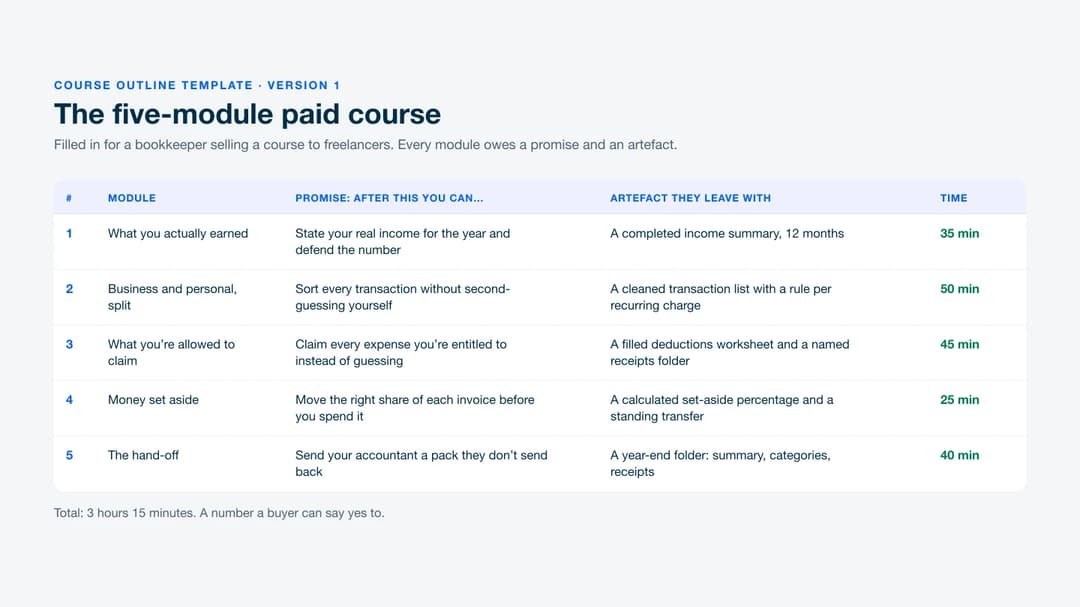
Filled in, for a bookkeeper selling a course to freelancers:
| # | Module | Promise: after this you can… | Artefact they leave with | Time |
|---|---|---|---|---|
| 1 | What you actually earned | State your real income for the year and defend the number | A completed income summary, 12 months | 35 min |
| 2 | Business and personal, split | Sort every transaction without second-guessing yourself | A cleaned transaction list with a rule per recurring charge | 50 min |
| 3 | What you’re allowed to claim | Claim every expense you’re entitled to instead of guessing | A filled deductions worksheet and a named receipts folder | 45 min |
| 4 | Money set aside | Move the right share of each invoice before you spend it | A calculated set-aside percentage and a standing transfer | 25 min |
| 5 | The hand-off | Send your accountant a pack they don’t send back | A year-end folder: summary, categories, receipts | 40 min |
Total: 3 hours 15 minutes. That’s a number a buyer can say yes to.
Now the grain inside a module. Module 1 breaks into four lessons, and every one of them still owes an artefact:
| Lesson | Promise | Artefact | Time |
|---|---|---|---|
| 1.1 | Get every statement into one place | 12 months of statements, one folder | 6 min |
| 1.2 | Find the income you forgot about | A list of every platform that paid you | 8 min |
| 1.3 | Build the income summary | The income tab, filled | 14 min |
| 1.4 | Sanity-check the total | One number you’d say out loud to an accountant | 7 min |
The lesson artefacts stack into the module artefact. That’s the test for whether you’ve split a module correctly: the small things add up to the big thing, nothing left over and nothing missing.
Once the five promises are written, what to charge for it gets much clearer, because you’re looking at outcomes rather than hours of video.
Version 2: The Coach’s Six-Week Program
Use this when you’re turning a 1:1 method into something a group goes through together. The extra column decides your calendar: every row is either the live call or the pre-work.
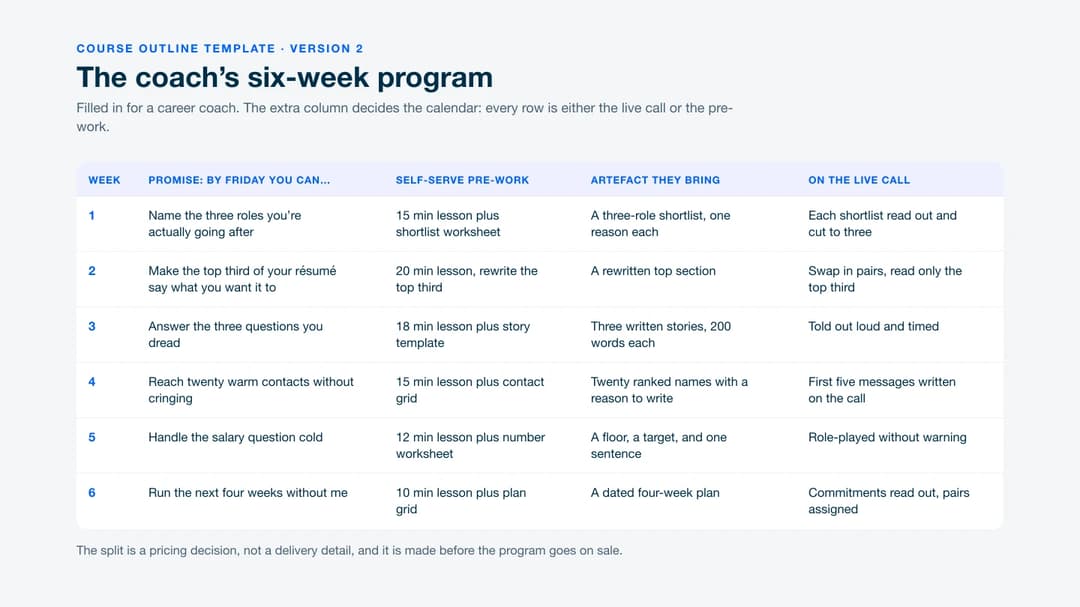
Filled in, for a career coach running a six-week group program:
| Week | Promise: by Friday you can… | Self-serve pre-work | Artefact they bring | On the live call |
|---|---|---|---|---|
| 1 | Name the three roles you’re actually going after | 15 min lesson plus shortlist worksheet | A three-role shortlist, one reason each | Each shortlist read out and cut to three |
| 2 | Make the top third of your résumé say what you want it to | 20 min lesson, rewrite the top third | A rewritten top section | Swap in pairs, read only the top third |
| 3 | Answer the three questions you dread | 18 min lesson plus story template | Three written stories, 200 words each | Told out loud and timed |
| 4 | Reach twenty warm contacts without cringing | 15 min lesson plus contact grid | Twenty ranked names with a reason to write | First five messages written on the call |
| 5 | Handle the salary question cold | 12 min lesson plus number worksheet | A floor, a target, and one sentence | Role-played without warning |
| 6 | Run the next four weeks without me | 10 min lesson plus plan grid | A dated four-week plan | Commitments read out, pairs assigned |
The split is a pricing decision, not a delivery detail, and it has to be made before the program goes on sale. “We’ll work out which weeks are live” turns into six weeks of live calls you never priced.
The pre-work artefact is what makes the live hour worth paying for. Everyone arrives with a written shortlist, and the call is about cutting it. They arrive with nothing, and the call is about writing it: a workshop sold at group-program prices.
Version 3: The One-Sitting Mini Course
The free course that sits in front of the paid one. Five to seven screens, one artefact, a single sitting, and a last row that’s an offer rather than a recap.
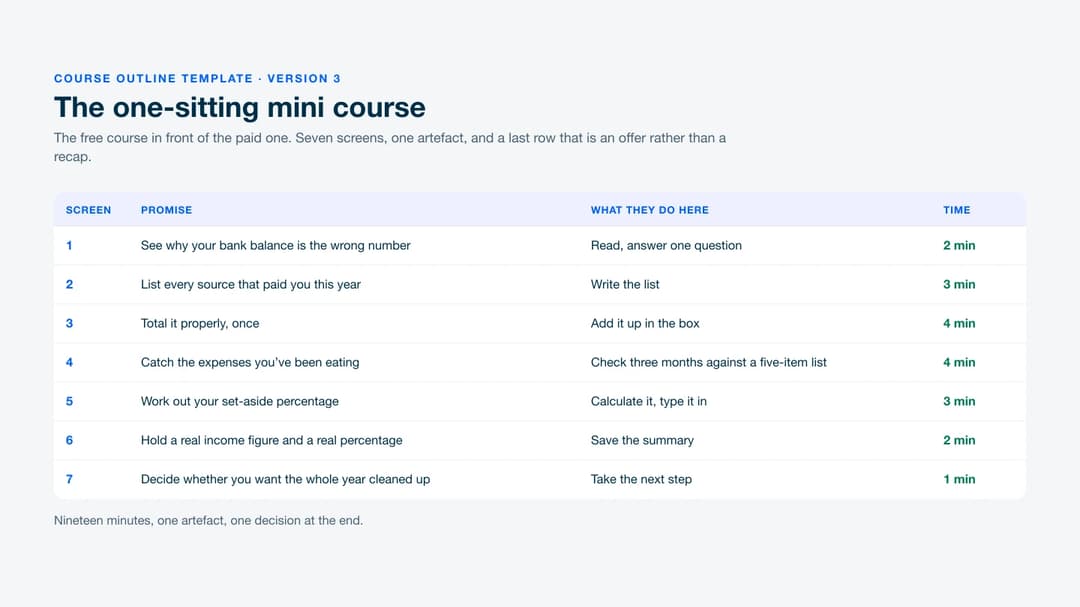
Filled in, for the same bookkeeper, as the front door to Version 1:
| Screen | Promise | What they do here | Time |
|---|---|---|---|
| 1 | See why your bank balance is the wrong number | Read, answer one question | 2 min |
| 2 | List every source that paid you this year | Write the list | 3 min |
| 3 | Total it properly, once | Add it up in the box | 4 min |
| 4 | Catch the expenses you’ve been eating | Check three months against a five-item list | 4 min |
| 5 | Work out your set-aside percentage | Calculate it, type it in | 3 min |
| 6 | Hold a real income figure and a real percentage | Save the summary | 2 min |
| 7 | Decide whether you want the whole year cleaned up | Take the next step | 1 min |
Nineteen minutes, one artefact, one decision at the end.
Screen 7 is the row people get wrong. A free course ending with “that’s a wrap, well done” ends the relationship too. One ending with a specific next step reads as generous rather than as a trailer, because she’s already holding something she didn’t have twenty minutes ago. That’s the mechanic behind a course that earns you the email address, and it only works if screens 1 to 6 delivered the artefact.
The Blank Grid
Copy this into a sheet or a doc. Nothing here is behind a form and there’s nothing to download.
Module level:
| # | Module | Promise: after this you can… | Artefact they leave with | Time |
|---|---|---|---|---|
| 1 | ||||
| 2 | ||||
| 3 | ||||
| 4 | ||||
| 5 |
Lesson level, one of these per module:
| Lesson | Promise | Artefact | Time |
|---|---|---|---|
| 1.1 | |||
| 1.2 | |||
| 1.3 | |||
| 1.4 |
Fill the Promise column first, across all five rows, before you write a single lesson. If two promises say nearly the same thing in different words, you’ve found your first merge.
How Many Modules, and How Long Each Lesson Should Be
Two questions people try to answer with a number. Both have rules instead.
One module, one promise. Two promises in one module means split it. A module carrying no promise a buyer would pay for means merge it into its neighbor. That rule sets your module count, which is why the answer usually lands between four and seven: few people can make more than seven distinct promises about one subject without repeating themselves in new words. Nine modules with seven near-identical promises is one module wearing nine hats.
A lesson ends when the artefact exists. That’s why “how long should a lesson be” has no honest number attached. A lesson producing a one-line pricing decision is four minutes. One producing a written sales script is twenty-five. Both are correct, and both would be wrong if you’d padded them to hit a house average.
The clock is a symptom. The artefact is the cause. If a lesson runs long, look at what it’s trying to produce, and you’ll usually find two things.
Five Things to Take Out of Your Outline
Every one is a field inherited from a document written for a different situation.
- Prerequisites you can’t enforce. You cannot stop anyone from buying. A prerequisite list on a paid course is either decoration or a reason not to buy, so replace it with a “this is for you if” line on the sales page.
- Required materials you should be supplying. If your course needs a worksheet, ship the worksheet. A list of things the buyer has to go and find is a list of places she’ll stop.
- A grading policy for a course with no grades. Quizzes can check understanding. They’re not marks, nobody’s transcript is affected, and a policy paragraph about them makes the course sound like school.
- Your bio. It belongs on the sales page, where it does its job. In the outline it sits between the buyer and the only thing she’s reading the outline to find out.
- Week numbers on a self-paced course. This is the worst one. Week numbers invent a deadline your buyer will miss by week two, and a buyer who feels behind is a buyer who asks for a refund. Number your modules. Date nothing.
If your program genuinely runs on a calendar, like Version 2 above, keep the weeks. Everywhere else, they’re a promise you’re making on the buyer’s behalf that she never agreed to.
The Lesson Where People Stop
Every course has one, and yours will surprise you.
First, the numbers you’ll be tempted to reach for. The completion figures quoted around online courses come from studies of free university courses with open enrollment and no purchase involved. Someone who paid for your course and chose the topic herself isn’t in that population. So there’s no trustworthy figure to give you here, and this page won’t invent one.
You get a structural rule and a column instead.
The rule: the fix is almost always the lesson before. People don’t quit on a hard lesson. They quit after a lesson that gave them nothing to hold.
So when you find the stop, look one row up and read that row’s Artefact cell. If it’s empty, or says something like “an understanding of the framework”, that’s the lesson to rebuild. The one they abandoned is usually fine.
The column: add Drop after launch. Before launch your grid has three columns; after launch it has four, filled from your own course rather than from guesswork. Analytics and Reporting is included on every Mini Course Generator plan, so the number comes out of a platform that runs the course and reports on it rather than a spreadsheet you keep by hand.
Your own grid, after launch, gains a cell like this:
| # | Module | Promise | Artefact | Time | Drop |
|---|---|---|---|---|---|
| 3 | What you’re allowed to claim | Claim every expense you’re entitled to | Filled deductions worksheet | 45 min | 31% |
One row like that points at a lesson. The rule above points at the fix, one row up.
The Outline Is Half of Your Sales Page
Here’s the payoff for writing the Promise column in the buyer’s words rather than yours.
The “what’s inside” block on a sales page is a list of module titles and a sentence each. You’ve already written those sentences. They go across unchanged, because they were written for the person deciding rather than the person building. That’s worth the extra ten minutes the Promise column costs.
Landing Pages are included on every Mini Course Generator plan, so the grid has somewhere to go the day it’s finished, and you can sell it directly from the same place the course lives.
Test it before you publish. Read the Promise column out loud, top to bottom, with nothing else around it. If that alone doesn’t make someone want the course, the problem was never your sales copy.
When the Document Becomes a Course
An outline becomes a course when every row has a screen behind it. That’s the whole definition, and it’s where the typing starts.
The typing is the part that’s been automated. The AI Course Creator drafts a course from a source document, and PDF to Course Creator turns a PDF you already have into a structured course.
Neither decides what your buyer is paying for. The Promise and Artefact columns are still yours, and they’re the two that determine whether anybody finishes. A tool drafting twelve lessons from a document you wrote in 2023 will happily draft twelve lessons that promise nothing. Write those two columns by hand first, then let the drafting happen against them.
Frequently Asked Questions
What should a course outline include?
Module titles, a promise per module in the buyer’s words, the artefact the learner leaves each lesson holding, and an honest time per row. That’s it. Add nothing else until the outline is finished, because every extra field pushes the three that matter further down the page.
What does a good course outline example look like?
Like the three grids above: real promises, real artefacts, real minutes. The tell for a bad one is the Promise column. If the sentences start with “understand”, “learn about” or “explore”, the outline describes what the course covers rather than what the course does for someone.
How is a course outline different from a syllabus?
A syllabus documents an institution’s obligations to an enrolled student: grading, office hours, prerequisites, academic integrity. A course outline documents what a buyer gets and what she’ll be holding at the end. Borrowing the syllabus fields is the single most common reason a course outline reads as dull.
How do I write a training course outline for a client?
Keep the three columns and add two more: method and evidence. The client’s sign-off usually hangs on how each item will be delivered and how anyone will know it landed. The employee training plan template linked earlier carries both columns filled in.
Should I put the outline on my sales page?
Put the Promise column on the sales page, module by module. Keep the artefact and time detail for the buyer who wants it, in an expandable section or further down. The full lesson-level grid belongs in your build document, not in front of someone deciding.
How detailed should the lesson rows be?
Detailed enough to record the lesson from the row without wondering what it’s for. That means a promise and an artefact for every lesson, but no script. If you’re writing sentences you plan to say out loud, you’ve stopped outlining.
Do I need to finish the outline before I start recording?
Finish the module-level grid, all five rows, before you record anything. Lesson rows can be written one module ahead of the camera. The cost of recording against a half-made outline is re-recording, and it lands in the week you’d set aside for launching.
The Bottom Line
Open your outline. Add the Promise and Artefact columns, fill them for every row, and merge or cut everything that can’t produce both.
That one pass does four things:
- Sets your module count, because one module carries one promise.
- Sets your lesson lengths, because a lesson ends when the artefact exists.
- Tells you which fields to delete, starting with week numbers on anything self-paced.
- Writes the “what’s inside” block on your sales page.
Do the Promise column tonight. It’s five sentences, and it decides whether anyone buys the nine hours behind them.
Once each row carries a promise and an artefact, turn them into screens people work through rather than sit through.